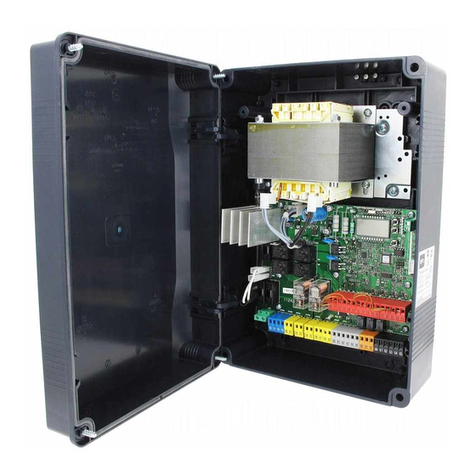
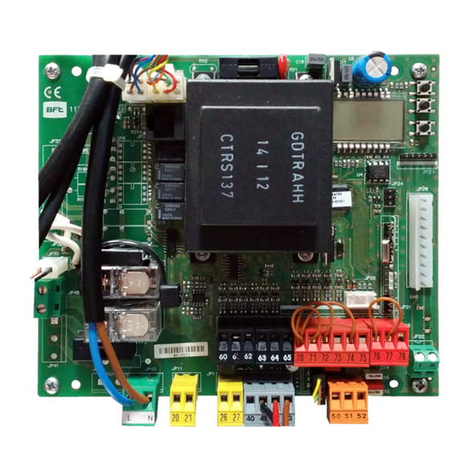
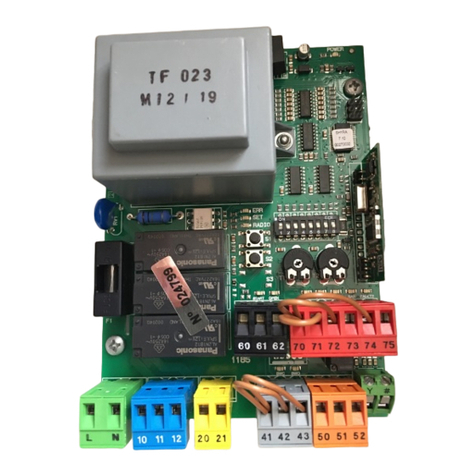
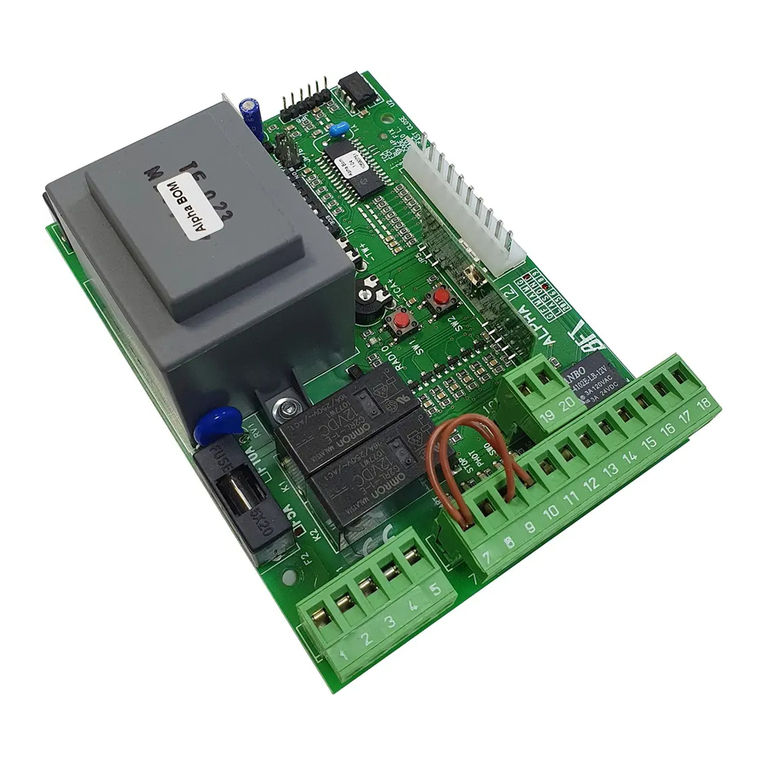
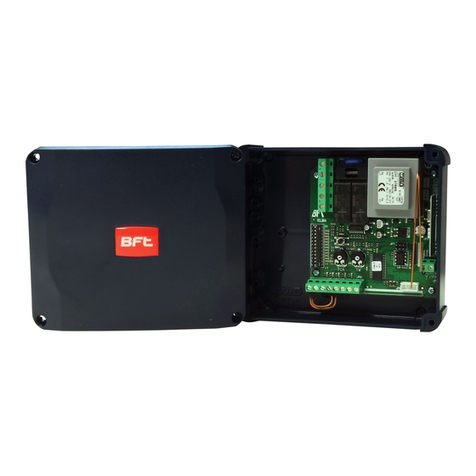
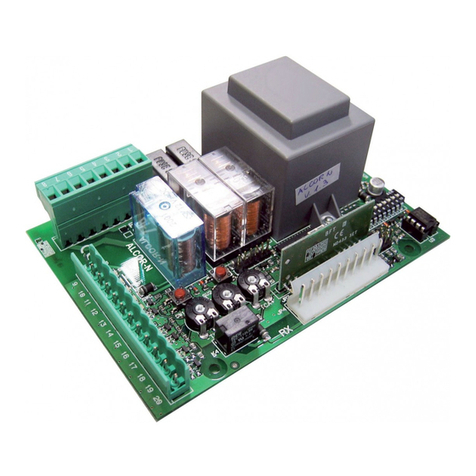
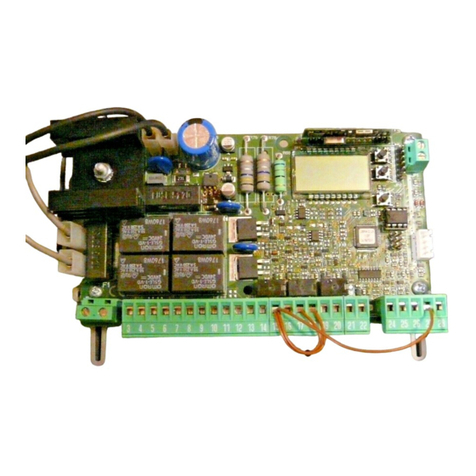
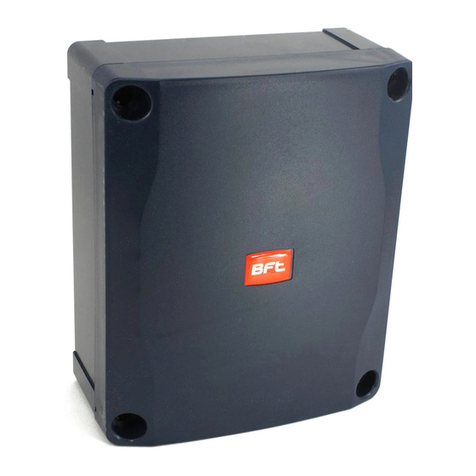
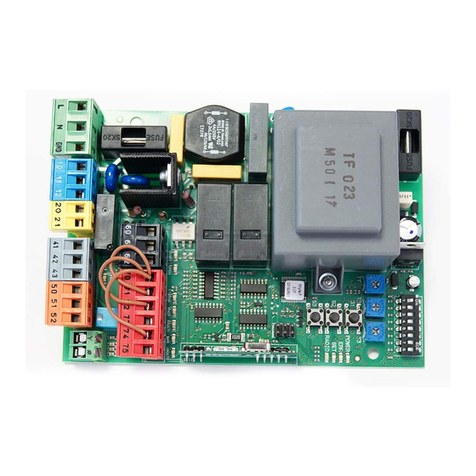
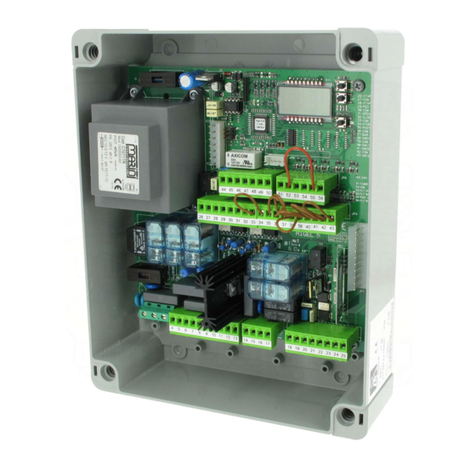
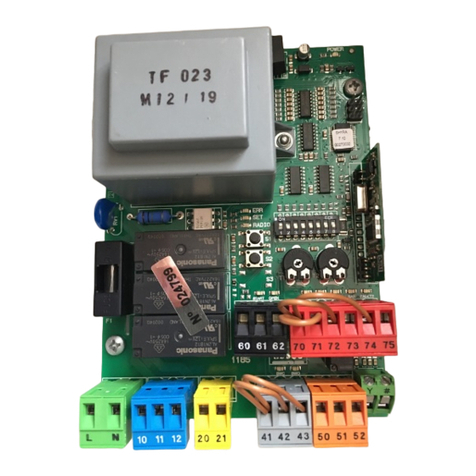
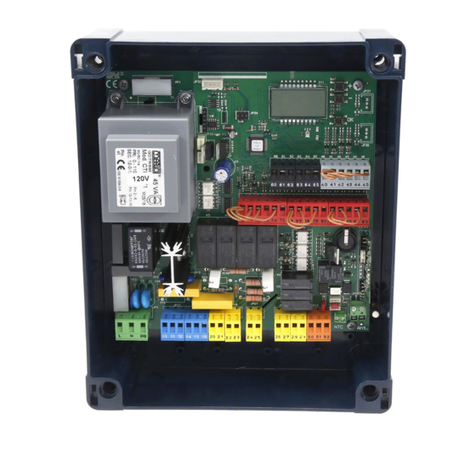
BFT LEO B CBB 3 400 W01 User manual

D811849 00100_01 24-11-11
ISTRUZIONI DI INSTALLAZIONE
INSTALLATION MANUAL
INSTRUCTIONS D’INSTALLATION
MONTAGEANLEITUNG
INSTRUCCIONES DE INSTALACION
INSTALLATIEVOORSCHRIFTEN
Attenzione! Leggere attentamente le“Avvertenze” all’interno! Caution! Read “Warnings” inside carefully! Attention! Veuillez lire attentivement les Avertissements qui se trouvent à l’intérieur! Achtung! Bitte lesen Sie
aufmerksam die„Hinweise“ im Inneren! ¡Atención¡ Leer atentamente las “Advertencias”en el interior! Let op! Lees de “Waarschuwingen”tigre aan de binnenkant zorgvuldig!
QUADRO COMANDO
CONTROL PANEL
CENTRALE DE COMMANDE
SELBSTÜBERWACHENDE STEUERUNG
CUADRO DE MANDOS
BEDIENINGSPANEEL
8027908 401700
LEO B CBB 3 400 W01
https://appceso.com

I
NSTALLAZIONE VELOCE-QUICK INSTALLATION-INSTALLATION RAPIDE
SCHNELLINSTALLATION-INSTALACIÓN RÁPIDA - SNELLE INSTALLATIE
A B
C
JP3
725150 70
24V ~
Collegamento di 1 coppia di fotocellule non vericate,
Connection of 1 pair of non-tested photocells,
Connexion 1 paire photocellules no vériées,
Anschluss von einem Paar nicht überprüften Fotozellen,
Conexión de 1 par fotocélulas no comprobadas,
Aansluiting van 1 paar fotocellen anders dan“trusted device”.
2
1TX1 2
1
RX1
4
5
3
SAFE 1 = 0
60 61 62 70 71 72 73 74 75
COM
SAFE 1
FAULT 1
STOP
SAFE 2
FAULT 2
NC
NC
NC
COM
FAULT 3
SAFE 3 NC
Sicurezze / Safety devices
Sécurités / Sicherheitsvorrichtungen
Dispositivos de seguridad / Veiligheden
76 77 78
63 64 65
COM
IC 1
IC 2
NO
NO
COM
IC 3
IC 4
NO
NO
Ingressi encoder
Encoder inputs
Entrées des encodeur
Eingänge Encoder
Entradas de carrera
Encoder
Alimentazione accessori
Accessories power supply
Alimentation des accessoires
Stromversorgung Zubehör
Alimentación accesorios
Voeding accessoires
Comandi / Commands
Commandes /Bedienelemente
Mandos/ Commando's
10 11
M
12 20 21
230V
max 40W
+
B
A
Alimentazione / Power supply
Alimentation / Stromversorgung
Alimentación / Voeding
*Non in dotazione/Not supplied
Ne sont pas fourni /Nicht im lieferumfang
No asignadas en el equipamiento base
Niet meegeleverd
Motore / Motor
moteur/Motor
Eindaanslag/Motor
*
AUX
AUX 3
(MAX 24V 3 W)
26 27 40 41 42 43 50 51 52
24V -
24V +
24 VSafe+
L1 L2 L3 N
L1 L2 L3 N
Y #
ANT
SHIELD
Antenna
Antenne
Antena
Antenne
222
168
319
10
L1 L2 L3 N
11 12 20 21 26
60 6162 63 6465 70 71 72 737475 76 77 78
27 40 41 42 43 50 51 52
F1= 100 mAT
Y #
10x38
2A 500V
"aM"
Fusibili/Fuses
Fusibles/Sicherungen
Fusibles/Zekeringen
3 x 10x38 2A 500V "aM"
U
V
W
Connettore programmatore palmare,
Palmtop programmer connector,
Connecteur programmateur de poche,
Steckverbinder Palmtop-Programmierer,
Conector del programador de bolsillo,
Connector programmeerbare palmtop.
Display + tasti programmazione
Display + programming keys
Acheur + touches programmation
Display + Programmierungstasten
Pantalla + botones programación
Display + programmeringstoetsen
Connettore per ricevente radio
(vedi paragrafo corrispondente).
Radio-receiver connector (see relevant section).
Connecteur pour récepteur radio (cf. paragraphe
correspondant).
Steckverbindung für Funkempfänger (siehe
entsprechenden Abschnitt).
Conector para receptor radio (véase apartado
correspondiente).
Connector voor radio-ontvanger (zie bijbehoren-
de paragraaf).
2 - LEO B CBB 3 400 W 01
D811849 00100_01
https://appceso.com

ITALIANO ENGLISH FRANÇAIS DEUTSCH ESPAÑOL
NEDERLANDS
D E
REGOLAZIONE FINECORSA, ADJUSTING THE LIMIT SWITCHES,
RÉGLAGE DE LA FIN DE COURSE, EINSTELLUNG DER ENDSCHALTER
REGULACIÓN DE LOS FINALES DE CARRERA,REGELING EINDAANSLAGEN
B
A
AUTOSET COPPIA APERTURA-CHIUSURA
OPENING-CLOSING TORQUE AUTOSETTING
RÉGLAGE AUTOMATIQUE COUPLE OUVERTURE-FERMETURE
AUTOSET DREHMOMENT ÖFFNUNG-SCHLIESSUNG
AJUSTE AUTOMATICO DEL PAR EN FASE DE APERTURA-CIERRE
AUTOSET DRAAIMOMENT OPENING - SLUITING.
I necorsa si adatteranno automaticamente dopo 3 manovre complete dalla loro regolazione.
The limit switches will adapt automatically 3 complete opening-closing cycles after being adjusted.
Après leur réglage, 3 manœuvres complètes susent pour que les ns de course s’adaptent automatiquement.
Die Endschalter passen sich nach drei vollständigen Manövern nach ihrer Einstellung automatisch an.
Los nales de carrera se adaptarán automáticamente tras 3 maniobras completas de su regulación.
De eindaanslagen passen zich automatisch aan na 3 complete manoeuvres vanaf hun afstelling.
C3 2 1
D
E1E2
DL2
DL1
DL2
DL1
1
2
1
2
DL2
DL1
DL2
DL1
DL2
DL1
+
OK
888 8
x 5
x 2
OK
PArAM
+
OK
888 8
x 4
x 2
OK
PArAM
=0 =1
D1
INV.DIREZ. AP
OPENIN OTHER DIRECT.
INV.SENS.OUV
INV RICHT OFFNUNG
INV.DIRECC.AP.
LEO B CBB 3 400 W 01- 3
D811849 00100_01
https://appceso.com

F
76 77 78
SAFE 3
FAULT 3
NC
COM
NC
1
2
1
2
3
4
5
51 TX1 RX1
Bar 1
1
2
3
4
5
6
1
2
1
2
3
4
5
52
50 TX1 RX1
1
2
1
2
3
4
5
TX1 RX1
1
2
1
2
3
4
5
TX2 RX2
Bar 1
1
2
3
4
5
Bar 2
1
2
3
4
5
Bar 1
1
2
3
4
5
6
6
6
1
2
1
2
3
4
5
TX1 RX1
Bar 1
1
2
3
4
5
6
1
2
1
2
3
4
5
TX1 RX1
1
2
1
2
3
4
5
TX1 RX1
1
2
1
2
3
4
5
TX2 RX2
Bar 1
1
2
3
4
5
Bar 2
1
2
3
4
5
Bar 1
1
2
3
4
5
6
6
6
SAFE1 = 0,2,4
SAFE1 = 8
1 PHOT / 1 PHOT OP / 1 PHOT CL
2 PHOT / 2 PHOT OP / 2 PHOT CL
BAR 8K2
1 BAR
1 BAR
2 BAR
50
52
50
52
50
51
50
51
50
51
50
51
50
70
72
70
72
73
70
70
72
73
51
51
50
51
50
51
50
52
52
52
72
70
72
70
73
72
70
51
50
70
73
70
72 8,2Kohm 5%
SAFETY EDGE SAFETY EDGE
70
74 8,2Kohm 5%
SAFETY EDGE SAFETY EDGE
1
2
1
2
3
4
5
51 TX1 RX1
Bar 1
1
2
3
4
5
6
1
2
1
2
3
4
5
52
50 TX1 RX1
1
2
1
2
3
4
5
TX1 RX1
1
2
1
2
3
4
5
TX2 RX2
Bar 1
1
2
3
4
5
Bar 2
1
2
3
4
5
Bar 1
1
2
3
4
5
6
6
6
1
2
1
2
3
4
5
TX1 RX1
Bar 1
1
2
3
4
5
6
1
2
1
2
3
4
5
TX1 RX1
1
2
1
2
3
4
5
TX1 RX1
1
2
1
2
3
4
5
TX2 RX2
Bar 1
1
2
3
4
5
Bar 2
1
2
3
4
5
Bar 1
1
2
3
4
5
6
6
6
SAFE2 = 0,2,4
SAFE2 = 6
SAFE1 = 1,3,5
SAFE2 = 1,3,5
SAFE2 = 7
SAFE2 = 8
1 PHOT / 1 PHOT OP / 1 PHOT CL
2 PHOT / 2 PHOT OP / 2 PHOT CL
BAR 8K2
1 BAR
1 BAR
2 BAR
50
52
50
52
50
51
50
51
50
51
50
51
50
70
74
70
74
75
70
70
74
75
51
51
50
51
50
51
50
52
52
52
74
70
74
70
75
74
70
51
50
70
75
72
50 70 71 73 74 75
24V -
24V +
24 VSafe+
COM
SAFE 1
SAFE 2
STOP
FAULT 1
FAULT 2
NC
NC
NC
70 71 73 74 75
24V -
24V +
24 VSafe+
COM
SAFE 1
SAFE 2
STOP
FAULT 1
FAULT 2
NC
NC
NC
1
2
1
2
3
4
5
51 TX1 RX1
Bar 1
1
2
3
4
5
6
1
2
1
2
3
4
5
52
50 TX1 RX1
1
2
1
2
3
4
5
TX1 RX1
1
2
1
2
3
4
5
TX2 RX2
Bar 1
1
2
3
4
5
Bar 2
1
2
3
4
5
Bar 1
1
2
3
4
5
6
6
6
1
2
1
2
3
4
5
TX1 RX1
Bar 1
1
2
3
4
5
6
1
2
1
2
3
4
5
TX1 RX1
1
2
1
2
3
4
5
TX1 RX1
1
2
1
2
3
4
5
TX2 RX2
Bar 1
1
2
3
4
5
Bar 2
1
2
3
4
5
Bar 1
1
2
3
4
5
6
6
6
SAFE3 = 0,2,4
SAFE3 = 6
1 PHOT / 1 PHOT OP / 1 PHOT CL
2 PHOT / 2 PHOT OP / 2 PHOT CL
1 BAR
1 BAR
2 BAR
50
52
50
52
50
51
50
51
50
51
50
51
50
76
77
76
77
78
76
76
77
78
51
51
50
51
50
51
50
52
52
52
77
76
77
76
78
77
76
51
50
76
78
SAFE3 = 1,3,5
SAFE3 = 7
51 52
SAFE2
SAFE 3
1
2
5
13
24
5
13
24
TEST OFFTEST ON
TEST OFFTEST ON
TEST OFFTEST ON
SAFE 1
SAFE 2
SAFE1 = 6
SAFE1 = 7
3
5
4 - LEO B CBB 3 400 W 01
D811849 00100_01
https://appceso.com

ITALIANO
ACCESSO AI MENU Fig. 1
stat
x 2
-+
OK
vers
bft . . .
+/-
OK
0000
+/-
n. an
OK 01.33
-+
err
02.01
........
30.15
Elenco ultimi 30 errori
+/-
REGOLAZIONE
FINECORSA
autoset
Codice
diagnoistica
Descrizione Note
STRE Attivazione ingresso start esterno START E
STRI Attivazione ingresso start interno START I
OPEN Attivazione ingresso OPEN
CLS Attivazione ingresso CLOSE
PED Attivazione ingresso pedonale PED
TIME Attivazione ingresso TIMER
STOP Attivazione ingresso STOP
PHOT Attivazione ingresso fotocellula PHOT
PHOP Attivazione ingresso fotocellula in apertura PHOT OP
PHCL Attivazione ingresso fotocellula in chiusura PHOT CL
BAR Attivazione ingresso costa BAR
SWC Attivazione ingresso necorsa chiusura del motore SWC
SWO Attivazione ingresso necorsa apertura del motore SWO
rls Attivazione sblocco meccanico Vericare la posizione dello sblocco
ER01 Test fotocellule fallito Vericare collegamento fotocellule e/o
impostazioni logiche
ER02 Test costa fallito Vericare collegamento coste e/o impo-
stazioni logiche
ER03 Test fotocellule apertura fallito Vericare collegamento fotocellule e/o
impostazione parametri/logiche
ER04 Test fotocellule chiusura fallito Vericare collegamento fotocellule e/o
impostazione parametri/logiche
ER06 Test costa 8k2 fallito Vericare collegamento coste e/o impo-
stazioni parametri/logiche
ER1x**Errore test hardware scheda - Vericare collegamenti al motore
- Problemi hardware alla scheda (contat-
tare l’assistenza tecnica)
ER2x**Errore encoder
- Cavi di alimentazione del motore invertiti.
Invertire 2 fasi nella morsettiera di alimen-
tazione.
- Il movimento dell’attuatore risulta
troppo lento o fermo rispetto al funzio-
namento programmato.
ER3x**Inversione per ostacolo - Amperostop
Vericare eventuali ostacoli lungo il
percorso
ER4x**Termica
Attendere il rareddamento dell’automa-
zione
ER7x**Errore interno di controllo supervisione sistema. Provare a spegnere e riaccendere la sche-
da. Se il problema persiste contattare
l’assistenza tecnica.
*X= 0, 1, .., 9, A, B, C, D, E, F
35.40 Soglia ostacolo
Forza istantanea motore
LEO B CBB 3 400 W 01- 5
D811849 00100_01
https://appceso.com

AVVERTENZE PER L’INSTALLATORE
Tutto quello che non è espressamente previsto nel manuale d’in-
stallazione, non è permesso. ll buon funzionamento dell’operatore è
garantito solo se vengono
rispettati i dati riportati. La ditta non risponde dei danni causati
dall’inosservanza delle indicazioni riportate in questo manuale.
Lasciandoinalteratelecaratteristicheessenzialidelprodotto,laDitta
si riserva di apportare in qualunque momento le modiche che essa
ritiene convenienti per
miglioraretecnicamente,costruttivamenteecommercialmenteilpro-
dotto, senza impegnarsi ad aggiornare la presente pubblicazione.
ATTENZIONE! Importanti istruzioni di sicurezza. Leggere e seguire atten-
tamente tutte le avvertenze e le istruzioni che accompagnano il prodotto
poiché un’installazione errata può causare danni a persone, animali o cose.
Leavvertenzeeleistruzionifornisconoimportantiindicazioniriguardantila
sicurezza, l’installazione, l’uso e la manutenzione. Conservare le istruzioni
per allegarle al fascicolo tecnico e per consultazioni future.
SICUREZZA GENERALE
Questo prodotto è stato progettato e costruito esclusivamente per l’utilizzo
indicato in questa documentazione. Usi diversi da quanto indicato potrebbero
essere causa di danni al prodotto e di pericolo.
-Gli elementicostruttivi della macchinae l’installazionedevono esserein accordo
con le seguenti Direttive Europee, ove applicabili: 2004/108/CE, 2006/95/CE,
2006/42/CE, 89/106/CE, 99/05/CE e loro modiche successive. Per tutti i Paesi
extra CEE, oltre alle norme nazionali vigenti, per un buon livello di sicurezza è
opportuno rispettare anche le norme citate.
-La Ditta costruttrice di questo prodotto (di seguito “Ditta”) declina qualsiasi
responsabilità derivante da un uso improprio o diverso da quello per cui è
destinato e indicato nella presente documentazione nonché dall’inosservanza
della BuonaTecnica nella costruzione delle chiusure (porte, cancelli, ecc.) e dalle
deformazioni che potrebbero vericarsi durante l’uso.
-L’installazione deve essere eseguita da personale qualicato (installatore profes-
sionale, secondo EN12635), nell’osservanza della Buona Tecnica e delle norme
vigenti.
-Prima di iniziare l’installazione vericare l’integrità del prodotto.
-Prima di installare il prodotto apportare tutte le modiche strutturali relative alla
realizzazione dei franchi di sicurezza e alla protezione o segregazione di tutte le
zone di schiacciamento, cesoiamento, convogliamento e di pericolo in genere.
Vericare che la struttura esistente abbia i necessari requisiti di robustezza e
stabilità.
-La Ditta non è responsabile della inosservanza della Buona Tecnica nella costru-
zione e manutenzione degli inssi da motorizzare, nonché delle deformazioni
che dovessero intervenire nell’utilizzo.
-Vericare che l’intervallo di temperatura dichiarato sia compatibile con il luogo
destinato all’installazione dell’automazione.
-Non installare questo prodotto in atmosfera esplosiva: la presenza di gas o fumi
inammabili costituisce un grave pericolo per la sicurezza.
- Togliere l’alimentazione elettrica, prima di qualsiasi intervento sull’impianto.
Scollegare anche eventuali batterie tampone se presenti.
-Primadicollegarel’alimentazioneelettrica,accertarsicheidatiditargacorrispon-
dano ai quelli della rete di distribuzione elettrica e che a monte dell’impianto
elettrico vi siano un interruttore dierenziale e una protezione da sovracorrente
adeguati.Prevederesullaretedialimentazionedell’automazione,uninterruttore
ounmagnetotermicoomnipolarecondistanza diaperturadeicontatticonforme
a quanto previsto dalle norme vigenti.
-Vericare che a monte della rete di alimentazione, vi sia un interruttore dieren-
ziale con soglia non superiore a 0.03A e a quanto previsto dalle norme vigenti.
-Vericare che l’impianto di terra sia realizzato correttamente: collegare a terra
tutte le parti metalliche della chiusura (porte, cancelli, ecc.) e tutti i componenti
dell’impianto provvisti di morsetto di terra.
-L’installazione deve essere fatta utilizzando dispositivi di sicurezza e di comandi
conformi alla EN 12978 e EN12453.
-Le forze di impatto possono essere ridotte mediante l’utilizzo di bordi deforma-
bili.
-Nel caso in cui le forze di impatto superino i valori previsti dalle norme, applicare
dispositivi elettrosensibili o sensibili alla pressione.
-Applicaretuttii dispositividisicurezza (fotocellule,coste sensibili,ecc.)necessari
a proteggere l’area da pericoli di impatto, schiacciamento, convogliamento,
cesoiamento. Tenere in considerazione le normative e le direttive in vigore,
i criteri della Buona Tecnica, l’utilizzo, l’ambiente di installazione, la logica di
funzionamento del sistema e le forze sviluppate dall’automazione.
-Applicare i segnali previsti dalle normative vigenti per individuare le zone
pericolose (i rischi residui). Ogni installazione deve essere identicata in modo
visibile secondo quanto prescritto dalla EN13241-1.
-Questo prodotto non può essere installato su ante che incorporano delle porte
(a meno che il motore sia azionabile esclusivamente a porta chiusa).
-Se l’automazione è installata ad una altezza inferiore a 2,5 m o se è accessibile,
è necessario garantire un adeguato grado di protezione delle parti elettriche e
meccaniche.
-Installare qualsiasi comando sso in posizione tale da non causare pericoli e
lontano da parti mobili. In particolare i comandi a uomo presente devono essere
posizionati in vista diretta della parte guidata, e, a meno che non siano a chiave,
devono essere installati a una altezza minima di 1,5 m e in modo tale da non
essere accessibili al pubblico.
-Applicare almeno un dispositivo di segnalazione luminosa (lampeggiante) in
posizione visibile, ssare inoltre alla struttura un cartello di Attenzione.
-Fissareinmodopermanenteunaetichettarelativaalfunzionamentodellosblocco
manuale dell’automazione e apporla vicino all’organo di manovra.
-Assicurarsi che durante la manovra siano evitati o protetti i rischi meccanici ed
in particolare l’impatto, lo schiacciamento, il convogliamento, il cesoiamento tra
parte guidata e parti circostanti.
-Dopo aver eseguito l’installazione, assicurarsi che il settaggio dell’automazione
motore sia correttamente impostato e che i sistemi di protezione e di sblocco
funzionino correttamente.
-Usare esclusivamente parti originali per qualsiasi manutenzione o riparazione.
La Ditta declina ogni responsabilità ai ni della sicurezza e del buon funziona-
mento dell’automazione se vengono impiegati componenti di altri produttori.
-Non eseguire alcuna modica ai componenti dell’automazione se non espres-
samente autorizzata dalla Ditta.
-Istruirel’utilizzatoredell’impiantoperquantoriguardaglieventualirischiresidui,
i sistemi di comando applicati e l’esecuzione della manovra apertura manuale
in caso di emergenza: consegnare il manuale d’uso all’utilizzatore nale.
-Smaltireimateriali diimballo (plastica, cartone,polistirolo, ecc.)secondo quanto
previstodalle norme vigenti. Nonlasciare buste dinylon epolistirolo alla portata
dei bambini.
COLLEGAMENTI
ATTENZIONE! Per il collegamento alla rete utilizzare: cavo multipolare di sezione
minima 5x1,5mm2o 4x1,5mm2per alimentazioni trifase oppure 3x1,5mm2per
alimentazioni monofase (a titolo di esempio, il cavo può essere del tipo H05VV-F
con sezione 4x1.5mm2). Per il collegamento degli ausiliari utilizzare conduttori
con sezione minima di 0,5 mm2.
-Utilizzare esclusivamente pulsanti con portata non inferiore a 10A-250V.
-I conduttori devono essere vincolati da un ssaggio supplementare in prossi-
mità dei morsetti (per esempio mediante fascette) al ne di tenere nettamente
separate le parti in tensione dalle parti in bassissima tensione di sicurezza.
-Il cavo di alimentazione, durante l’installazione, deve essere sguainato in modo
da permettere il collegamento del conduttore di terra all’appropriato morsetto
lasciando però i conduttori attivi il più corti possibile. Il conduttore di terra deve
essere l’ultimo a tendersi in caso di allentamento del dispositivo di ssaggio del
cavo.
ATTENZIONE! i conduttori a bassissima tensione di sicurezza devono essere
sicamente separati dai conduttori a bassa tensione.
L’accessibilità alle parti in tensione deve essere possibile esclusivamente per il
personale qualicato (installatore professionale)
VERIFICA DELL’AUTOMAZIONE E MANUTENZIONE
Primadirenderedenitivamenteoperatival’automazione,edurantegliinterventi
di manutenzione, controllare scrupolosamente quanto segue:
-Vericare che tutti i componenti siano ssati saldamente;
-Vericare l’operazione di avvio e fermata nel caso di comando manuale.
-Vericare la logica di funzionamento normale o personalizzata.
-
Solo per cancelli scorrevoli: vericare il corretto ingranamento cremagliera -
pignone con un gioco di 2 mm; tenere la rotaia di scorrimento sempre pulita e
libera da detriti.
-Controllareilcorrettofunzionamentodituttiidispositividisicurezza(fotocellule,
coste sensibili, ecc) e la corretta regolazione della sicurezza antischiacciamento
vericando che il valore della forza d’impatto misurato nei punti previsti dalla
norma EN 12445, sia inferiore a quanto indicato nella norma EN 12453.
-Vericare la funzionalità della manovra di emergenza ove presente.
-Vericare l’operazione di apertura e chiusura con i dispositivi di comando appli-
cati.
-Vericare l’integrità delle connessioni elettriche e dei cablaggi, in particolare lo
stato delle guaine isolanti e dei pressa cavi.
-Durante la manutenzione eseguire la pulizia delle ottiche delle fotocellule.
-Peril periododifuori servizio dell’automazione,attivarelo sbloccodiemergenza
(vedi paragrafo “MANOVRA DI EMERGENZA”) in modo da rendere folle la parte
guidata e permettere così l’apertura e la chiusura manuale del cancello.
-Se il cavo di alimentazione è danneggiato, esso deve essere sostituito dal co-
struttore o dal suo servizio di assistenza tecnica o comunque da una persona
con qualica similare, in modo da prevenire ogni rischio.
DEMOLIZIONE
L’eliminazione dei materiali va fatta rispettando le norme vigenti. Nel caso di
demolizione dell’automazione non esistono particolari pericoli o rischi derivanti
dall’automazione stessa.
Èopportuno,in casodirecuperodeimateriali, chevenganoseparatipertipologia
(parti elettriche - rame - alluminio - plastica - ecc.).
SMANTELLAMENTO
Nel caso l’automazione venga smontata per essere poi rimontata in altro sito
bisogna:
-Togliere l’alimentazione e scollegare tutto l’impianto elettrico.
-Togliere l’attuatore dalla base di ssaggio.
-Smontare tutti i componenti dell’installazione.
-Nel caso alcuni componenti non possano essere rimossi o risultino danneggiati,
provvedere alla loro sostituzione.
AVVERTENZE PER L’INSTALLATORE D811766_04
-L’alimentazione del quadro deve essere protetta da 3 fusibili 10x38 500V“aM”. I
fusibili vanno scelti in modo che intervangono in caso di bloccaggio del motore.
6 - LEO B CBB 3 400 W 01
D811849 00100_01

https://appceso.com

MANUALE PER L’INSTALLAZIONE
2) GENERALITÁ
IlquadrocomandiLEOBCBB3400W01vienefornitodalcostruttoreconsettaggio
standard.Qualsiasivariazione,deveessereimpostatamedianteilprogrammatore
a display incorporato o mediante programmatore palmare universale.
Le caratteristiche principali sono:
- Controllo di 1 motore trifase
- Regolazione elettronica della coppia con rilevamento ostacoli
- Ingressi separati per le sicurezze
- Ingressi di comando congurabili
- Ingresso controllo ENCODER
La scheda è dotata di una morsettiera di tipo estraibile per rendere più agevole
la manutenzione o la sostituzione.Viene fornita con una serie di ponti precablati
per facilitare l’installatore in opera.
I ponti riguardano i morsetti: 70-71, 70-72, 70-74, 76-77.
Se i morsetti sopraindicati vengono utilizzati, togliere i rispettivi ponti.
Il quadro LEO B CBB 3400W 01 eettua il controllo (verica) dei relè di marcia e dei
dispositividisicurezza(fotocellule),primadieseguireogniciclodiaperturaechiusura.
In caso di malfunzionamenti vericare il regolare funzionamento dei dispositivi
collegati e controllare i cablaggi.
3) DATI TECNICI
Alimentazione 400V~ ±10%, 50-60Hz*
Isolamento rete/bassa tensione > 2MOhm 500V
Temperatura di funzionamento -10 / +55°C
Protezione termica Interna al motore
Rigidità dielettrica rete/bt 3750V~ per 1 minuto
Potenza massima motore 980W
Alimentazione accessori 24V~ (180mA assorbimento max)
24V~safe (180mA assorbimento max)
AUX 3 Contatto N.O. (24V~/3W max)
Lampeggiante 230V~ 40W max
Dimensioni vedi Fig. A
Fusibili vedi Fig. B
(* altre tensioni disponibili a richiesta)
4) COLLEGAMENTI MORSETTIERA Fig. B
Morsetto Denizione Descrizione
Alimentazione
L1 LINEA 1
Alimentazione trifase 400V~ ±10%, 50-60Hz.
L2 LINEA 2
L3 LINEA 3
N NEUTRO
Motore
10 U
Collegamento motore trifase
11 V
12 W
Aux
20 LAMP 230V Uscita lampeggiante 230V max 40W.
21
26 AUX 3 - CONTATTO LIBERO (N.O.)
(Max 24V 3W)
Contatto N.O. (24V~/3W max).
Utilizzabile solamente con ricevente radio inserita nell’apposito connettore.
27
ENCODER
40 - REF SWE Alimentazione ENCODER
41 + REF SWE
42 A RS485 Comunicazione ENCODER
43 B RS485
Alim.
Accessori
50 24V- Uscita alimentazione accessori.
51 24V+
52 24 Vsafe+
Uscita alimentazione per dispositivi di sicurezza vericati (trasmettitore fotocellule e trasmettitore costa sensibile).
Uscita attiva solo durante il ciclo di manovra.
Comandi
60 Comune Comune ingressi IC 1 e IC 2
61 IC 1
Ingresso di comando congurabile 1 (N.O.) - Default START E.
START E / START I / OPEN / CLOSE / PED / TIMER / TIMER PED
Far riferimento alla tabella“Congurazione degli ingressi di comando”.
62 IC 2
Ingresso di comando congurabile 2 (N.O.) - Default PED.
START E / START I / OPEN / CLOSE / PED / TIMER / TIMER PED
Far riferimento alla tabella“Congurazione degli ingressi di comando”.
63 Comune Comune ingressi IC 3 e IC 4
64 IC 3
Ingresso di comando congurabile 3 (N.O.) - Default OPEN.
START E / START I / OPEN / CLOSE / PED / TIMER / TIMER PED
Far riferimento alla tabella“Congurazione degli ingressi di comando”.
65 IC 4
Ingresso di comando congurabile 4 (N.O.) - Default CLOSE.
START E / START I / OPEN / CLOSE / PED / TIMER / TIMER PED
Far riferimento alla tabella“Congurazione degli ingressi di comando”.
Sicurezze
70 Comune Comune ingressi STOP, SAFE 1 e SAFE 2
71 STOP Il comando interrompe la manovra. (N.C.)
Se non si utilizza lasciare il ponticello inserito.
72 SAFE 1
Ingresso di sicurezza congurabile 1 (N.C.) - Default PHOT.
PHOT / PHOT TEST / PHOT OP / PHOT OP TEST / PHOT CL / PHOT CL TEST / BAR / BAR TEST / BAR 8K2
Far riferimento alla tabella“Congurazione degli ingressi di sicurezza”.
73 FAULT 1 Ingresso verica dispositivi di sicurezza collegati al SAFE 1.
74 SAFE 2
Ingresso di sicurezza congurabile 2 (N.C.) - Default BAR.
PHOT / PHOT TEST / PHOT OP / PHOT OP TEST / PHOT CL / PHOT CL TEST / BAR / BAR TEST / BAR 8K2
Far riferimento alla tabella“Congurazione degli ingressi di sicurezza”.
75 FAULT 2 Ingresso verica dispositivi di sicurezza collegati al SAFE 2.
76 Comune Comune ingresso SAFE 3
77 SAFE 3
Ingresso di sicurezza congurabile 3 (N.C.) - Default PHOT OP.
PHOT / PHOT TEST / PHOT OP / PHOT OP TEST / PHOT CL / PHOT CL TEST / BAR / BAR/TEST
Far riferimento alla tabella“Congurazione degli ingressi di sicurezza”.
78 FAULT 3 Ingresso verica dispositivi di sicurezza collegati al SAFE 3.
Antenna
Y ANTENNA Ingresso antenna.
Usare una antenna accordata sui 433MHz. Per il collegamento Antenna-Ricevente usare cavo coassiale RG58. La
presenza di masse metalliche a ridosso dell’antenna, può disturbare la ricezione radio. In caso di scarsa portata del
trasmettitore, spostare l’antenna in un punto più idoneo.
# SHIELD
ITALIANO
LEO B CBB 3 400 W 01- 7
D811849 00100_01
https://appceso.com

MANUALE PER L’INSTALLAZIONE
Congurazione degli ingressi di comando
Logica IC= 0 - Ingresso congurato come Start E. Funzionamento secondo la Logica mov.passo passo.
Logica IC= 1 - Ingresso congurato come Start I. Funzionamento secondo la Logica mov.passo passo.
Logica IC= 2 - Ingresso congurato come Open.
Il comando esegue un’apertura. Se il l’ingresso rimane chiuso, le ante rimangono aperte no all’apertura del contatto. A contatto aperto l’automazione chiude dopo il tempo di tca, se attivato.
Logica IC= 3 - Ingresso congurato come Close.
Il comando esegue una chiusura.
Logica IC= 4 - Ingresso congurato come Ped.
Il comando esegue un’apertura pedonale, parziale. Funzionamento secondo la Logica mov.passo passo.
Logica IC= 5 - Ingresso congurato come Timer.
Funzionamento analogo al open ma la chiusura è garantita anche dopo l’assenza di rete.
Logica IC= 6 - Ingresso congurato come Timer Ped.
I
l comando esegue un’apertura pedonale, parziale. Se l’ingresso rimane chiuso, l’anta rimane aperta no all’apertura del contatto. Se il l’ingresso rimane chiuso e viene attivato un coman-
do di Start E, Start I o Open viene eseguita una manovra completa per poi ripristinarsi in apertura pedonale. La chiusura è garantita anche dopo l’assenza di rete.
Congurazione degli ingressi di sicurezza
Logica SAFE= 0 - Ingresso congurato come Phot, fotocellula. (Fig.F, rif.1).
Consente la connessione di dispositivi non dotati di contatto supplementare di verica. In caso di oscuramento, le fotocellule sono attive sia in apertura che in chiusura. Un oscura-
mento della fotocellula in chiusura, inverte il moto solo dopo il disimpegno della fotocellula. Se non si utilizza lasciare il ponticello inserito.
Logica SAFE= 1 - Ingresso congurato come Phot test, fotocellula vericata. (Fig.F, rif.2).
Attiva la verica delle fotocellule ad inizio manovra. In caso di oscuramento, le fotocellule sono attive sia in apertura che in chiusura. Un oscuramento della fotocellula in chiusura,
inverte il moto solo dopo il disimpegno della fotocellula.
Logica SAFE= 2 - Ingresso congurato come Phot op, fotocellula attiva solo in apertura. (Fig.F, rif.1).
Consente la connessione di dispositivi non dotati di contatto supplementare di verica. In caso di oscuramento è escluso il funzionamento della fotocellula in chiusura. In fase di
apertura blocca il moto per la durata dell’oscuramento della fotocellula. Se non si utilizza lasciare il ponticello inserito.
Logica SAFE= 3 - Ingresso congurato come Phot op test, fotocellula vericata attiva solo in apertura (Fig.F, rif.2).
Attiva la verica delle fotocellule ad inizio manovra. In caso di oscuramento è escluso il funzionamento della fotocellula in chiusura. In fase di apertura blocca il moto per la durata
dell’oscuramento della fotocellula.
Logica SAFE= 4 - Ingresso congurato come Phot cl, fotocellula attiva solo in chiusura. (Fig.F, rif.1).
Consente la connessione di dispositivi non dotati di contatto supplementare di verica. In caso di oscuramento è escluso il funzionamento della fotocellula in apertura. In fase di
chiusura, inverte immediatamente. Se non si utilizza lasciare il ponticello inserito.
Logica SAFE= 5 - Ingresso congurato come Phot cl test, fotocellula vericata attiva solo in chiusura (Fig.F, rif.2).
Attiva la verica delle fotocellule ad inizio manovra. In caso di oscuramento è escluso il funzionamento della fotocellula in apertura. In fase di chiusura, inverte immediatamente.
Logica SAFE= 6 - Ingresso congurato come Bar, costa sensibile. (Fig.F, rif.3).
Consente la connessione di dispositivi non dotati di contatto supplementare di verica. Il comando inverte il movimento per 2 sec. Se non si utilizza lasciare il ponticello inserito
Logica SAFE= 7 - Ingresso congurato come Bar, costa sensibile vericata (Fig.F, rif.4).
Attiva la verica delle coste sensibili ad inizio manovra. Il comando inverte il movimento per 2 sec.
Logica SAFE= 8 - Ingresso congurato come Bar 8k2 (Fig.F, rif.5). Ingresso per bordo resistivo 8K2.
Il comando inverte il movimento per 2 sec.
7.6) MENU REGOLAZIONE FINECORSA (REG. FC) (Fig.D)
Fasi della regolazione dei necorsa:
1) Posizionarsi su REG FC e confermare con OK.
2) Il display indica CLOSE, tramite i tasti SU e GIU, portare la porta nella posizione
di necorsa di chiusura. Confermare con OK, il display indica PRG.
3) Se il display lo richiede, agire sulla ghiera di regolazione: in senso antiorario
se il display indica UP, in senso orario se il display indica DOWN. Quando si
raggiunge la posizione corretta, il display indica OK. Confermare con il tasto
OK, il display indica PRG.
4) Il display indica OPEN, tramite i tasti SU e GIU, portare la porta nella posizione
di necorsa di apertura. Confermare con OK, il display indica PRG.
Se il display indica KO, signica che la regolazione non è andata a buon ne.
Le cause possono essere:
- pressione del tasto ESC prima della ne della regolazione
- corsa memorizzata troppo corta
7.7 MENU STATISTICHE
Consente di visualizzare la versione della scheda, il numero di manovre totali (in
centinaia), e gli ultimi 30 errori (le prime 2 cifre indicano la posizione, le ultime 2 il
codice errore). L’errore 01 è quello più recente.
8 INVERSIONE DIREZIONE DI APERTURA FIG. D1
9) COLLEGAMENTO CON SCHEDE DI ESPANSIONE E PROGRAMMATORE
PALMARE UNIVERSALE VERSIONE >V1.40 (Fig.B) Fare riferimento al manuale
specico.
10) RICEVENTE RADIO (Fig. B)
La scheda è predisposta per la connessione per ricevente radio estraibile.
Il canale 1 della ricevente comanda l’ingresso IC1.
Il canale 2 della ricevente è connesso ai morsetti 26-27.
ATTENZIONE! Un’errata impostazione può creare danni a persone, animali o cose.
ATTENZIONE: Verificare che il valore della forza d’impatto
misuratoneipuntiprevistidallanormaEN12445,siainferiorea quanto
indicato nella norma EN 12453.
Perottenereunrisultatomigliore,siconsigliadieseguirel’autosetconmotoriariposo
(cioè non surriscaldati da un numero considerevole di manovre consecutive).
TABELLA “A” - MENU PARAMETRI - (param)
Parametro Min. Max.
Default Personali
Denizione Descrizione
tca 0 120 10 Tempo chiusura
automatica [s] Tempo di attesa prima della chiusura automatica.
apert.
parziale 1 99 40 Apertura
parziale [%]
Regola la percentuale di apertura parziale rispetto all’apertura totale nel funzionamento “Apre parziale”
(Pedonale).
FORZA AP 1 99 80 Forza anta/e in
apertura [%]
Forza esercitata dall’anta/e in apertura. Rappresenta la percentuale di forza erogata, oltre quella memoriz-
zata durante l’autoset (e successivamente aggiornata), prima di generare un allarme ostacolo.
Il parametro viene impostato automaticamente dall’autoset.
ATTENZIONE: Inuisce direttamente nella forza di impatto: vericare che con il valore impo-
stato vengano rispettate le norme di sicurezza vigenti (*). Installare se necessario dispositivi
di sicurezza antischiacciamento.
FORZA CH 1 99 80 Forza anta/e in
chiusura [%]
Forza esercitata dall’anta/e in chiusura. Rappresenta la percentuale di forza erogata, oltre quella memoriz-
zata durante l’autoset (e successivamente aggiornata), prima di generare un allarme ostacolo.
ll parametro viene impostato automaticamente dall’autoset.
ATTENZIONE: Inuisce direttamente nella forza di impatto: vericare che con il valore impo-
stato vengano rispettate le norme di sicurezza vigenti (*). Installare se necessario dispositivi
di sicurezza antischiacciamento.
(*) Nell’Unione Europea applicare la EN12453 per i limiti di forza, e la EN12445 per il metodo di misura.
6) DISPOSITIVI DI SICUREZZA
Nota: utilizzare solamente dispositivi di sicurezza riceventi con contatto
in libero scambio.
6.1) DISPOSITIVI VERIFICATI Fig. F
6.2) COLLEGAMENTO DI 1 COPPIA DI FOTOCELLULE NON VERIFICATE Fig. C
7 ACCESSO AI MENU: FIG. 1
7.1) MENU PARAMETRI PARA TABELLA“A” PARAMETRI
7.2) MENU LOGICHE LOGICTABELLA“B”LOGICHE
7.3 MENU DEFAULT default
Riporta la centrale ai valori preimpostati dei DEFAULT. Dopo il ripristino è neces-
sario eettuare un nuovo AUTOSET.
7.4 MENU LINGUA lingua
Consente di impostare la lingua del programmatore a display.
7.5 MENU AUTOSET AUTOset
•
Dare avvio ad una operazione di autosettaggio portandosi nell’apposito menu.
• NonappenapremutoilpulsanteOKvienevisualizzatoilmessaggio“............”,
la centrale comanda una manovra di apertura seguita da una manovra di
chiusura, durante la quale viene automaticamente settato il valore minimo di
coppia necessario al movimento dell’anta.
Durante questa fase è importante evitare l’oscuramento delle fotocellule,
nonchè l’utilizzo dei comandi START, STOP e del display.
Alterminediquestaoperazionela centraledicomandoavràautomaticamente
impostato i valori ottimali di coppia. Vericarli ed eventualmente modicarli
come descritto in programmazione.
Attenzione!! Durante l’autosettaggio la funzione di rileva
mentoostacolinonèattiva,l’installatoredevecontrollareilmovimento
dell’automazione ed impedire a persone o cose di avvicinarsi o sostare nel
raggio di azione dell’automazione.
8 - LEO B CBB 3 400 W 01
D811849 00100_01
https://appceso.com

MANUALE PER L’INSTALLAZIONE
ITALIANO
TABELLA “B”- LOGICHE - (LOGIC)
Logica Denizione
Default
Barrare il
settaggio
eseguito
Opzioni
tca Tempo chiusura
automatica 00 Logica non attiva
1 Attiva la chiusura automatica
MOV. PASSO PASSO Movimento passo
passo 0
0Gli ingressi congurati come Start E, Start I,
Ped funzionano con la logica 4 passi. mov. passo passo
2 PASSI 3 PASSI 4 PASSI
CHIUSA
APRE APRE
APRE
IN
CHIUSURA
STOP
APERTA CHIUDE CHIUDE CHIUDE
IN
APERTURA
STOP + TCA
STOP + TCA
DOPO STOP
APRE APRE APRE
1
Gli ingressi congurati come Start E, Start
I, Ped funzionano con la logica 3 passi.
L’impulso durante la fase di chiusura inverte il
movimento.
2
Gli ingressi congurati come Start E, Start I,
Ped funzionano con la logica 2 passi. Ad ogni
impulso inverte il movimento.
PREALL Preallarme 0 0 Il lampeggiante si accende contemporaneamente alla partenza del/i motore/i.
1 Il lampeggiante si accende circa 3 secondi prima della partenza del/i motore/i
UOMO PRESENTE
Uomo presente 0
0 Funzionamento ad impulsi.
1
Funzionamento ad Uomo Presente.
L’ingresso 64 viene congurato come OPEN UP.
L’ingresso 65 viene congurato come CLOSE UP.
La manovra continua nché viene mantenuta la pressione sui tasti di OPEN UP o CLOSE UP.
ATTENZIONE: non sono attive le sicurezze.
2
Funzionamento Uomo Presente Emergency. Normalmente funzionamento ad impulsi.
Se la scheda fallisce i test delle sicurezze (fotocellula o costa, Er0x) per 3 volte consecutivamente,
viene
abilitato il funzionamento ad Uomo Presente attivo no al rilascio dei tasti OPEN UP o CLOSE UP.
L’ingresso 64 viene congurato come OPEN UP.
L’ingresso 65 viene congurato come CLOSE UP.
ATTENZIONE: con Uomo Presente Emergency non sono attive le sicurezze.
3
Funzionamento ad impulsi in apertura.
Funzionamento ad uomo presente in chiusura.
L’ingresso 64 viene congurato come OPEN IMPULSIVO.
L’ingresso 65 viene congurato come CLOSE UP.
ATTENZIONE: durante la chiusura non sono attive le sicurezze.
BL.IMP.AP Blocca impulsi in
apertura 0 0 L’impulso degli ingressi congurati come Start E, Start I, Ped hanno eetto durante l’apertura.
1 L’impulso degli ingressi congurati come Start E, Start I, Ped non hanno eetto durante l’apertura.
INV.DIREZ. AP
Inversione
direzione di
apertura
0 0 Funzionamento standard (Vedi Fig. D1 ).
1 Viene invertito il verso di apertura rispetto al funzionamento standard (Vedi Fig. D1 ).
SAFE 1
Congurazione
dell’ingresso di
sicurezza SAFE 1.
72
0
0 Ingresso congurato come Phot, fotocellula.
1 Ingresso congurato come Phot test, fotocellula vericata.
2 Ingresso congurato come Phot op, fotocellula attiva solo in apertura.
3 Ingresso congurato come Phot op test, fotocellula vericata attiva solo in apertura.
SAFE 2
Congurazione
dell’ingresso di
sicurezza SAFE 2.
74
6
4 Ingresso congurato come Phot cl, fotocellula attiva solo in chiusura.
5 Ingresso congurato come Phot cl test, fotocellula vericata attiva solo in chiusura.
6 Ingresso congurato come Bar, costa sensibile.
7 Ingresso congurato come Bar, costa sensibile vericata.
8 Ingresso congurato come Bar 8k2.
SAFE 3
Congurazione
dell’ingresso di
sicurezza SAFE 3.
77
2
0 Ingresso congurato come Phot, fotocellula.
1 Ingresso congurato come Phot test, fotocellula vericata.
2 Ingresso congurato come Phot op, fotocellula attiva solo in apertura.
3 Ingresso congurato come Phot op test, fotocellula vericata attiva solo in apertura.
4 Ingresso congurato come Phot cl, fotocellula attiva solo in chiusura.
5 Ingresso congurato come Phot cl test, fotocellula vericata attiva solo in chiusura.
6 Ingresso congurato come Bar, costa sensibile.
7 Ingresso congurato come Bar, costa sensibile vericata.
IC 1
Congurazione
dell’ingresso di
comando IC 1.
61
0
0 Ingresso congurato come Start E.
1 Ingresso congurato come Start I.
IC 2
Congurazione
dell’ingresso di
comando IC 2.
62
4
2 Ingresso congurato come Open.
3 Ingresso congurato come Close.
IC 3
Congurazione
dell’ingresso di
comando IC 3.
64
2
4 Ingresso congurato come Ped.
5 Ingresso congurato come Timer.
IC 4
Congurazione
dell’ingresso di
comando IC 4.
65
3 6 Ingresso congurato come Timer Pedonale.
LEO B CBB 3 400 W 01- 9
D811849 00100_01
https://appceso.com

ACCESS MENUS Fig. 1
stat
x 2
-+
OK
vers
bft . . .
+/-
OK
0000
+/-
n. cycles
OK 01.33
-+
err
02.01
........
30.15
+/-
Exit Menù
Conrm/Switch on display
Scroll up
Scroll down
See PARAMETERS MENU
See LOGIC MENU
language
List of last 30 errors
Control unit software version
No total
manoeuvres (in hundreds)
LIMIT SWITCH
ADJUSTMENT
l.sw adj
autoset
Diagnostics
code DESCRIPTION NOTES
STRE START E external start input activated
STRI START I internal start input activated
OPEN OPEN input activated
CLS CLOSE input activated
PED PED pedestrian input activated
TIME TIMER input activated
STOP STOP input activated
PHOT PHOT photocell input activated
PHOP PHOT OP opening photocell input activated
PHCL PHOT CL closing photocell input activated
BAR BAR safety edge input activated
SWC SWC motor closing limit switch input activated
SWO SWO motor opening limit switch input activated
rls Mechanical release activated Check position of release
ER01 Photocell test failed
Check photocell connection and/or logic settings
ER02 Safety edge test failed
Check safety edge connection and/or logic settings
ER03 Opening photocell test failed Check photocell connection and/or param-
eter/logic setting
ER04 Closing photocell test failed Check photocell connection and/or param-
eter/logic setting
er06 8k2 safety edge test failed Check safety edge connection and/or
parameter/logic settings
ER1x*Board hardware test error - Check connections to motor
- Hardware problems with board (contact
technical assistance)
ER2x*Encoder error
- Motor power cables disconnected.
Reverse 2 phases in the supply terminal.
- Actuator movement is too slow or stopped
with respect to programmed operation.
ER3x*Reverse due to obstacle - Amperostop Check for obstacles in path
ER4x*Thermal cutout Allow automated device to cool
ER7x*Internal system supervision control error. Try switching the board o and back on
again. If the problem persists, contact the
technical assistance department.
*X= 0, 1, .., 9, A, B, C, D, E, F
35.40
Obstacle threshold
Instantaneous force motor
10 - LEO B CBB 3 400 W 01
D811849 00100_01
https://appceso.com

ENGLISH
INSTALLER WARNINGS
Anything that is not explicitly provided for in the installation ma-
nual is not allowed. The operator’s proper operation can only be
guaranteed if the information given is complied with. The Firm shall
not be answerable for damage caused by failure to comply with the
instructions featured herein.
While we will not alter the product’s essential features, the Firm re-
serves the right, at any time, to make those changes deemed oppor-
tune to improve the product from a technical, design or commercial
point of view, and will not be required to update this publication
accordingly.
WARNING! Important safety instructions. Carefully read and comply with
all the warnings and instructions that come with the product as incorrect
installation can cause injury to people and animals and damage to proper-
ty. The warnings and instructions give important information regarding
safety, installation, use and maintenance. Keep hold of instructions so that
you can attach them to the technical le and keep them handy for future
reference.
GENERAL SAFETY
This product has been designed and built solely for the purpose indicated herein.
Uses other than those indicated herein might cause damage to the product and
create a hazard.
-Theunitsmakingupthemachineanditsinstallationmustmeettherequirements
of the following European Directives, where applicable: 2004/108/EC, 2006/95/
EC, 2006/42/EC, 89/106/EC, 99/05/EC and later amendments. For all countries
outside the EEC, it is advisable to comply with the standards mentioned, in
addition to any national standards in force, to achieve a good level of safety.
-The Manufacturer of this product (hereinafter referred to as the“Firm”) disclaims
all responsibility resulting from improper use or any use other than that for
which the product has been designed, as indicated herein, as well as for failure
to apply Good Practice in the construction of entry systems (doors, gates, etc.)
and for deformation that could occur during use.
-Installation must be carried out by qualied personnel (professional installer,
according to EN 12635), in compliance with Good Practice and current code.
-Before commencing installation, check the product for damage.
-Before installing the product, make all structural changes required to produce
safety gaps and to provide protection from or isolate all crushing, shearing and
dragging hazard areas and danger zones in general. Check that the existing
structure meets the necessary strength and stability requirements.
-The Firm is not responsible for failure to apply Good Practice in the construction
and maintenance of the doors, gates, etc. to be motorized, or for deformation
that might occur during use.
-Make sure the stated temperature range is compatible with the site in which the
automated system is due to be installed.
-Donotinstallthisproductinanexplosiveatmosphere:thepresenceofammable
fumes or gas constitutes a serious safety hazard.
-Disconnect the electricity supply before performing any work on the system.
Also disconnect buer batteries, if any are connected.
-Before connecting the power supply, make sure the product’s ratings match the
mains ratings and that a suitable residual current circuit breaker and overcurrent
protection device have been installed upline from the electrical system. Have
the automated system’s mains power supply tted with a switch or omnipolar
thermal-magnetic circuit breaker with a contact separation that meets code
requirements.
-Make sure that upline from the mains power supply there is a residual current
circuit breaker that trips at no more than 0.03A as well as any other equipment
required by code.
-Make sure the earth system has been installed correctly: earth all the metal parts
belonging to the entry system (doors, gates, etc.) and all parts of the system
featuring an earth terminal.
-Installation must be carried out using safety devices and controls that meet
standards EN 12978 and EN 12453.
-Impact forces can be reduced by using deformable edges.
-In theeventimpactforcesexceedthevalueslaiddown bytherelevantstandards,
apply electro-sensitive or pressure-sensitive devices.
-Apply all safety devices (photocells, safety edges, etc.) required to keep the
area free of impact, crushing, dragging and shearing hazards. Bear in mind the
standards and directives in force, Good Practice criteria, intended use, the in-
stallation environment, the operating logic of the system and forces generated
by the automated system.
-Apply all signs required by current code to identify hazardous areas (residual
risks).Allinstallationsmustbevisiblyidentiedincompliancewiththeprovisions
of standard EN 13241-1.
-Thisproduct cannotbeinstalled onleavesincorporatingdoors (unlessthemotor
can be activated only when the door is closed).
-If the automated system is installed at a height of less than 2.5 m or is accessible,
the electrical and mechanical parts must be suitably protected.
-Install any xed controls in a position where they will not cause a hazard, away
from moving parts. More specically, hold-to-run controls must be positioned
withindirectsight ofthe part beingcontrolledand, unlesstheyarekeyoperated,
must be installed at a height of at least 1.5 m and in a place where they cannot
be reached by the public.
-Apply at least one warning light (ashing light) in a visible position, and also
attach a Warning sign to the structure.
-Attachalabelneartheoperatingdevice,inapermanentfashion,withinformation
on how to operate the automated system’s manual release.
-Makesurethat,duringoperation,mechanicalrisksareavoidedorrelevantprotec-
tivemeasurestakenand,more specically, thatnothing canbe banged,crushed,
caught or cut between the part being operated and surrounding parts.
-Once installation is complete, make sure the motor automation settings are
correct and that the safety and release systems are working properly.
-Only use original spare parts for any maintenance or repair work. The Firm di-
sclaims all responsibility for the correct operation and safety of the automated
system if parts from other manufacturers are used.
-Do not make any modications to the automated system’s components unless
explicitly authorized by the Firm.
-Instruct the system’s user on what residual risks may be encountered, on the
controlsystemsthathavebeenappliedandonhowtoopenthe systemmanually
in an emergency. give the user guide to the end user.
-Dispose of packaging materials (plastic, cardboard, polystyrene, etc.) in accor-
dance with the provisions of the laws in force. Keep nylon bags and polystyrene
out of reach of children.
WIRING
WARNING! For connection to the mains power supply, use: a multicore cable
with a cross-sectional area of at least 5x1.5mm2or 4x1.5mm2when dealing
with three-phase power supplies or 3x1.5mm2for single-phase supplies (by
way of example, type H05 VV-F cable can be used with a cross-sectional area
of 4x1.5mm2). To connect auxiliary equipment, use wires with a cross-sectional
area of at least 0.5 mm2.
- Only use pushbuttons with a capacity of 10A-250V or more.
- Wiresmustbesecuredwithadditional fasteningneartheterminals(forexample,
using cable clamps) in order to keep live parts well separated from safety extra
low voltage parts.
- During installation, the power cable must be stripped to allow the earth wire
to be connected to the relevant terminal, while leaving the live wires as short
as possible. The earth wire must be the last to be pulled taut in the event the
cable’s fastening device comes loose.
WARNING! safety extra low voltage wires must be kept physically separate from
low voltage wires.
Only qualied personnel (professional installer) should be allowed to access
live parts.
CHECKING THE AUTOMATED SYSTEM AND MAINTENANCE
Beforetheautomatedsystemisnallyputintooperation,andduringmaintenance
work, perform the following checks meticulously:
-Make sure all components are fastened securely.
-Check starting and stopping operations in the case of manual control.
-Check the logic for normal or personalized operation.
-For sliding gates only: check that the rack and pinion mesh correctly with 2 mm
of play; keep the track the gate slides on clean and free of debris at all times.
-Check that all safety devices (photocells, safety edges, etc.) are working properly
and that the anti-crush safety device is set correctly, making sure that the force
of impact measured at the points provided for by standard EN 12445 is lower
than the value laid down by standard EN 12453.
-Make sure that the emergency operation works, where this feature is provi-
ded.
-Check opening and closing operations with the control devices applied.
-Check that electrical connections and cabling are intact, making extra sure that
insulating sheaths and cable glands are undamaged.
-While performing maintenance, clean the photocells’optics.
-When the automated system is out of service for any length of time, activate the
emergency release (see“EMERGENCY OPERATION”section) so that the operated
part is made idle, thus allowing the gate to be opened and closed manually.
-If the power cord is damaged, it must be replaced by the manufacturer or their
technical assistance department or other such qualied person to avoid any
risk
SCRAPPING
Materials must be disposed of in accordance with the regulations in force. There
areno particular hazardsor risks involvedin scrappingtheautomatedsystem.For
the purpose of recycling, it is best to separate dismantled parts into like materials
(electrical parts - copper - aluminium - plastic - etc.).
DISMANTLING
Iftheautomatedsystemisbeingdismantledinordertobereassembledatanother
site, you are required to:
-Cut o the power and disconnect the whole electrical system.
-Remove the actuator from the base it is mounted on.
-Remove all the installation’s components.
-See to the replacement of any components that cannot be removed or happen
to be damaged.
AVVERTENZE PER L’INSTALLATORE D811766_04
-The control panel power supply must be protected by 3 fuses 10x38 500V”aM”.
. Choose the type of fuses which will be triggered in case of motor seizure.
LEO B CBB 3 400 W 01- 11
D811849 00100_01
https://appceso.com

INSTALLATION MANUAL
2) GENERAL INFORMATION
The LEO B CBB 3 400 W 01 control panel comes with standard factory settings.
Anychangemustbemadeusingtheprogrammerwithbuilt-indisplayoruniversal
handheld programmer.
Its main features are:
- Control of 1 three-phase motor
- Electronic torque control with obstacle detection
- Separate inputs for safety devices
- Congurable command inputs
- ENCODER control input
The board has a terminal strip of the removable kind to make maintenance
or replacement easier. It comes with a series of prewired jumpers to make the
installer’s job on site easier.
The jumpers concern terminals: 70-71, 70-72, 70-74, 76-77.
If the above-mentioned terminals are being used, remove the relevant jumpers.
TESTING
The LEO B CBB 3 400 W 01 panel controls (checks) the start relays and safety
devices (photocells) before performing each opening and closing cycle.
If there is a malfunction, make sure that the connected devices are working
properly and check the wiring.
3) TECHNICAL SPECIFICATIONS
Power supply 400V~ ±10%, 50-60Hz*
Low voltage/mains insulation > 2MOhm 500V
Operating temperature range -10 / +55°C
Thermal overload protection built into motor
Dielectric rigidity mains/LV 3750V~ for 1 minute
Maximum motor power 980W
Accessories power supply 24V~ (demand max. 180mA)
24V~safe (demand max. 180mA)
AUX 3 NO contact (24V~/max.3W)
Flashing light 230V~ 40W max
Dimensions see Fig. A
Fuses see Fig. B
(*other voltages to order)
4) TERMINAL BOARD WIRING Fig. B
Terminal Denition Description
Power supply
L1 LINE 1
Three-phase Power supply 400V~ ±10%, 50-60Hz.
L2 LINE 2
L3 LINE 3
N NEUTRAL
Motor
10 U
Three-phase motor connection
11 V
12 W
Aux
20 LIGHT 230V Flashing light 230V output max. 40W.
21
26 AUX 3 - FREE CON-
TACT (N.O.)
(Max. 24V 3W)
Contact N.O. (24V~/3W max).
Can only be used with second channel of radio-receiver plugged into relevant connector.
27
ENCODER
40 - REF SWE ENCODER power supply
41 + REF SWE
42 A RS485 ENCODER communication
43 B RS485
Accessories
power supply
50 24V- Accessories power supply output.
51 24V+
52 24 Vsafe+ Tested safety device power supply output (photocell transmitter and safety edge transmitter).
Output active only during operating cycle.
Commands
60 Common IC 1 and IC 2 inputs common
61 IC 1
Congurable command input 1 (N.O.) - Default START E.
START E / START I / OPEN / CLOSE / PED / TIMER / TIMER PED
Refer to the“Command input conguration” table.
62 IC 2
Congurable command input 2 (N.O.) - Default PED.
START E / START I / OPEN / CLOSE / PED / TIMER / TIMER PED
Refer to the“Command input conguration” table.
63 Common IC 3 and IC 4 inputs common
64 IC 3
Congurable command input 3 (N.O.) - Default OPEN.
START E / START I / OPEN / CLOSE / PED / TIMER / TIMER PED
Refer to the“Command input conguration” table.
65 IC 4
Congurable command input 4 (N.O.) - Default CLOSE.
START E / START I / OPEN / CLOSE / PED / TIMER / TIMER PED
Refer to the“Command input conguration” table.
Safety devices
70 Common STOP, SAFE 1 and SAFE 2 inputs common
71 STOP The command stops movement. (N.C.)
If not used, leave jumper inserted.
72 SAFE 1
Congurable safety input 1 (N.C.) - Default PHOT.
PHOT / PHOT TEST / PHOT OP / PHOT OP TEST / PHOT CL / PHOT CL TEST / BAR / BAR TEST / BAR 8K2
Refer to the“Safety input conguration”table.
73 FAULT 1 Test input for safety devices connected to SAFE 1.
74 SAFE 2
Congurable safety input 2 (N.C.) - Default BAR.
PHOT / PHOT TEST / PHOT OP / PHOT OP TEST / PHOT CL / PHOT CL TEST / BAR / BAR TEST / BAR 8K2
Refer to the“Safety input conguration”table.
75 FAULT 2 Test input for safety devices connected to SAFE 2.
76 Common SAFE 3 input common
77 SAFE 3
Congurable safety input 3 (N.C.) - Default PHOT OP.
PHOT / PHOT TEST / PHOT OP / PHOT OP TEST / PHOT CL / PHOT CL TEST / BAR / BAR TEST
Refer to the“Safety input conguration”table.
78 FAULT 3 Test input for safety devices connected to SAFE 3.
Antenna
Y ANTENNA Antenna input.
Use an antenna tuned to 433MHz. Use RG58 coax cable to connect the Antenna and Receiver. Metal bodies close to the antenna
can interfere with radio reception. If the transmitter’s range is limited, move the antenna to a more suitable position.
# SHIELD
12 - LEO B CBB 3 400 W 01
D811849 00100_01
https://appceso.com

ENGLISH
INSTALLATION MANUAL
Command input conguration
IC logic= 0 - Input congured as Start E. Operation according to STEP-BY-STEP MOV. logic.
IC logic= 1 - Input congured as Start I. Operation according to STEP-BY-STEP MOV. logic.
IC logic= 2 - Input congured as Open.
The command causes the leaves to open. If the input stays closed, the leaves stay open until the contact is opened. When the contact is open, the automated device closes following
the TCA time, where activated.
IC logic= 3 - Input congured as Closed.
The command causes the leaves to close.
IC logic= 4 - Input congured as Ped.
The command causes the leaf to open to the pedestrian (partial) opening position. Operation according to STEP-BY-STEP. logic
IC logic= 5 - Input congured as Timer.
Operation same as open except closing is guaranteed even after a mains power outage.
IC logic= 6 - Input congured as Timer Ped.
The command causes the leaf to open to the pedestrian (partial) opening position. If the input stays closed, the leaf stays open until the contact is opened. If the input stays closed and
a Start E, Start I or Open command is activated, a complete opening-closing cycle is performed before returning to the pedestrian opening position. Closing is guaranteed even after a
mains power outage.
Safety input conguration
SAFE logic= 0 - Input congured as Phot (photocell). (g.F, ref.1).
Enables connection of devices not equipped with supplementary test contacts. When beam is broken, photocells are active during both opening and closing. When beam is broken
during closing, movement is reversed only once the photocell is cleared. If not used, leave jumper inserted.
SAFE logic= 1 - Input congured as Phot test (tested photocell). (g.F, ref.2).
Switches photocell testing on at start of operation. When beam is broken, photocells are active during both opening and closing. When beam is broken during closing, movement is
reversed only once the photocell is cleared.
SAFE logic= 2 - Input congured as Phot op (photocell active during opening only). (g.F, ref.1).
Enables connection of devices not equipped with supplementary test contacts. In the event beam is broken, photocell operation is disabled during closing. During opening, stops
motion for as long as the photocell beam stays broken. If not used, leave jumper inserted.
SAFE logic= 3 - Input congured as Phot op test (tested photocell active during opening only (g.F, ref.2).
Switches photocell testing on at start of operation. In the event beam is broken, photocell operation is disabled during closing. During opening, stops motion for as long as the photo-
cell beam stays broken.
SAFE logic= 4 - Input congured as Phot cl (photocell active during closing only). (g.F, ref.1).
Enables connection of devices not equipped with supplementary test contacts. In the event beam is broken, photocell operation is disabled during opening. During closing, move-
ment is reversed immediately. If not used, leave jumper inserted.
SAFE logic= 5 - Input congured as Phot cl test (tested photocell active during closing only (g.F, ref.2).
Switches photocell testing on at start of operation. In the event beam is broken, photocell operation is disabled during opening. During closing, movement is reversed immediately.
SAFE logic= 6 - Input congured as Bar (safety edge). (g.F, ref.3).
Enables connection of devices not equipped with supplementary test contacts. The command reverses movement for 2 sec.. If not used, leave jumper inserted.
SAFE logic= 7 - Input congured as Bar (tested safety edge (g.F, ref.4).
Switches safety edge testing on at start of operation. The command reverses movement for 2 sec.
SAFE logic= 8 - Input congured as Bar 8k2 (g.F, ref.5). Input for resistive edge 8K2.
The command reverses movement for 2 sec..
6) SAFETY DEVICES
Note: only use receiving safety devices with free changeover contact.
6.1) TESTED DEVICES Fig. F
6.2 CONNECTION OF 1 PAIR OF NONTESTED PHOTOCELLS FIG. C
7 CALLING UP MENUS: FIG. 1
7.1) PARAMETERS MENU PARA PARAMETERS TABLE“A”
7.2) LOGIC MENU LOGICLOGIC TABLE“B”
7.3 DEFAULT MENU default
Restores the controller’s DEFAULT factory settings. Following this reset, you will need to run
the AUTOSET function again.
7.4 LANGUAGE MENU language
Used to set the programmer’s language on the display.
7.5 AUTOSET MENU AUTOset
•
Launch an autoset operation by going to the relevant menu.
•
As soon as you press the OK button, the “.... .... ....” message is displayed and the control unit
commands the device to perform a full cycle (opening followed by closing), during which the
minimum torque value required to move the leaf is set automatically.
During this stage, it is important to avoid breaking the photocells’beams and not to use the
START and STOP commands or the display.
Once this operation is complete, the control unit will have automatically set the optimum
torque values. Check them and, where necessary, edit them as described in the programming
section.
Warning!!Whiletheautosetfunctionisrunning,theobstacledetectionfunctionisnot
active.Consequently,theinstallermustmonitortheautomatedsystem’smovements
and keep people and property out of range of the automated system.
TABLE“A” PARAMETERS MENU - PARA
Parameter min. max. Default
Personal
Denition Description
TCA 0 120 10 Automatic closing time [s] Waiting time before automatic closing.
partial
opening 1 99 40 Partial opening [%] Adjusts partial opening percentage compared to total opening in“Partial open”mode.
OP.FORCE 1 99 80 Leaf force during opening
[%]
Force exerted by leaf/leaves during opening. This is the percentage of force delivered, beyond the force
stored during the autoset cycle (and subsequently updated), before an obstacle alarm is generated.
The parameter is set automatically by the autoset function.
WARNING: It aects impact force directly: make sure that current safety
requirements are met with the set value (*). Install anti-crush safety devices
where necessary.
CLS.FORCE 1 99 80 Leaf force during closing
[%]
Force exerted by leaf/leaves during closing. This is the percentage of force delivered, beyond the force
stored during the autoset cycle (and subsequently updated), before an obstacle alarm is generated.
The parameter is set automatically by the autoset function.
WARNING: It aects impact force directly: make sure that current safety
requirements are met with the set value (*). Install anti-crush safety devices
where necessary.
(*) In the European Union, apply standard EN 12453 for force limitations, and standard EN 12445 for measuring method.
7.6) LIMIT SWITCH ADJUSTMENT MENU L.SW ADJ Fig . D
Limit switch adjustment procedure:
1) Go to L.SW ADJ and conrm with OK.
2) The display reads CLOSE. Use the UP and DOWN keys to move the door to the closing limit switch
position. Conrm with OK. The display reads PRG.
3) If prompted by the display, turn the adjustment ring: anticlockwise if the display reads UP; clock-
wise if the display reads DOWN. Once you have reached the correct position, the display reads
OK. Conrm with the OK key. The display reads PRG.
4) The display reads OPEN. Use the UP and DOWN keys to move the door to the opening limit switch
position. Conrm with OK. The display reads PRG.
If the display reads KO, it means adjustment was not successful.
This may be caused by:
- the ESC key being pressed before adjustment was completed
- stored travel being too short
7.7 STATISTICS MENU
Used to view the version of the board, the total number of operations (in hundreds), the
number of transmitters memorized and the last 30 errors (the rst 2 digits indicate the
position, the last 2 give the error code). Error 01 is the most recent.
8 OPEN IN OTHER DIRECTION (Fig. D1)
9)CONNECTIONWITHEXPANSIONBOARDSANDUNIVERSALHANDHELDPROGRAMMER
VERSION> V1.40 (Fig. B) Refer to specic manual.
10) RADIO-RECEIVER (Fig. B)
The board comes ready for connection of removable radio-receiver.
The receiver’s channel 1 controls input IC1.
The receiver’s channel 2 controls terminals 26-27.
WARNING! Incorrect settings can result in damage to property and injury to people and animals.
WARNING: Check that the force of impact measured at the points provided for
by standard EN 12445 is lower than the value laid down by standard EN 12453.
For best results, it is advisable to run the autoset function with the motors idle (i.e. not over-
heated by a considerable number of consecutive operations).
LEO B CBB 3 400 W 01- 13
D811849 00100_01
https://appceso.com

INSTALLATION MANUAL
TABLE“B” LOGIC MENU LOGIC
Logic Denition
Default
Cross out
setting
used Optional extras
TCA Automatic Closing
Time 0 0 Logic not enabled
1 Switches automatic closing on
STEP-BY-STEP
MOVEMNT
Step-by-step
movement 0
0Inputs congured as Start E, Start I,
Ped operate with 4-step logic. step-by-step mov.
2 STEP 3 STEP 4 STEP
CLOSED
OPENS OPENS
OPENS
DURING
CLOSING
STOPS
OPEN
CLOSES
CLOSES CLOSES
DURING
OPENING
STOP + TCA
STOP + TCA
AFTER STOP
OPENS OPENS OPENS
1
Inputs congured as Start E, Start I,
Ped operate with 3-step logic. Pulse
during closing reverses movement.
2
Inputs congured as Start E, Start I,
Ped operate with 2-step logic. Move-
ment reverses with each pulse.
PRE-ALARM Pre-alarm 0 0 The ashing light comes on at the same time as the motor(s) start.
1 The ashing light comes on approx. 3 seconds before the motor(s) start.
HOLD-TO-RUN Deadman 0
0 Pulse operation.
1
Deadman mode.
Input 64 is congured as OPEN UP.
Input 65 is congured as CLOSE UP.
Operation continues as long as the OPEN UP or CLOSE UP keys are held down.
WARNING: safety devices are not enabled.
2
Emergency Deadman mode. Usually pulse operation.
If the board fails the safety device tests (photocell or safety edge, Er0x) 3 times in a row, the device is
switched to Deadman mode, which will stay active until the OPEN UP or CLOSE UP keys are released.
Input 64 is congured as OPEN UP.
Input 65 is congured as CLOSE UP.
WARNING: with the device set to Emergency Deadman mode, safety devices are not enabled.
3
Pulse operation during opening.
Deadman mode during closing.
Input 64 is congured as PULSE OPEN.
Input 65 is congured as CLOSE UP.
WARNING: safety devices are not enabled during closing.
IBL OPEN Block pulses during
opening 0 0 Pulse from inputs congured as Start E, Start I, Ped has eect during opening.
1 Pulse from inputs congured as Start E, Start I, Ped has no eect during opening.
OPEN IN OTHER
DIRECT.
Open in other
direction 0 0 Standard operating mode (See Fig.D1).
1 Opens in other direction to standard operating mode (See Fig.D1).
SAFE 1
Conguration of
safety input SAFE 1.
72
0
0 Input congured as Phot (photocell).
1 Input congured as Phot test (tested photocell).
2 Input congured as Phot op (photocell active during opening only).
3 Input congured as Phot op test (tested photocell active during opening only).
SAFE 2
Conguration of
safety input SAFE 2.
74
6
4 Input congured as Phot cl (photocell active during closing only).
5 Input congured as Phot cl test (tested photocell active during closing only).
6 Input congured as Bar, safety edge.
7 Input congured as Bar, tested safety edge.
8 Input congured as Bar 8k2.
SAFE 3
Conguration of
safety input SAFE 3.
77
2
0 Input congured as Phot (photocell).
1 Input congured as Phot test (tested photocell).
2 Input congured as Phot op (photocell active during opening only).
3 Input congured as Phot op test (tested photocell active during opening only).
4 Input congured as Phot cl (photocell active during closing only).
5 Input congured as Phot cl test (tested photocell active during closing only).
6 Input congured as Bar, safety edge.
7 Input congured as Bar, tested safety edge.
IC 1
Conguration of
command input IC 1.
61
0
0 Input congured as Start E.
1 Input congured as Start I.
IC 2
Conguration of
command input IC 2.
62
42 Input congured as Open.
3 Input congured as Close.
IC 3
Conguration of
command input IC 3.
64
24 Input congured as Ped.
5 Input congured as Timer.
IC 4
Conguration of
command input IC 4.
65
3 6 Input congured as Timer Pedestrian.
14 - LEO B CBB 3 400 W 01
D811849 00100_01
https://appceso.com

ACCES AUX MENUS Fig. 1
stat
x 2
-+
OK
vers
bft . . .
+/-
OK
0000
+/-
n. an
OK 01.33
-+
err
02.01
........
30.15
+/-
RÉGLAGE DE
LA FIN DE COURSE
autoset
langue
Liste des 30 dernières erreurs
Sortir du menu
Allumage aicheur
Descendre
Monter
Confirmation /
Voir MENU PARAMÈTRES
Voir MENU LOGIQUES
35.40 Seuil obstacle
Force instantanée du moteur
Code de
diagnostic
Description Remarque
STRE Activation entrée Start externe START E
STRI Activation entrée Start interne START I
OPEN Activation entrée OPEN
CLS Activation entrée CLOSE
PED Activation entrée piéton PED
TIME Activation entrée TIMER
STOP Activation entrée STOP
PHOT Activation entrée photocellule PHOT
PHOP Activation entrée photocellule en ouverture PHOT OP
PHCL Activation entrée photocellule en fermeture PHOT CL
BAR Activation entrée linteau BAR
SWC Activation entrée n de course fermeture du moteur SWC
SWO Activation entrée n de course ouverture du moteur SWO
rls Activation déverrouillage mécanique Vériez la position du déverrouillage
ER01 Essai photocellules échoué Vérifier connexion photocellules et/ou
congurations logiques
ER02 Essai linteau échoué Vérifier connexion linteaux et/ou
congurations logiques
ER03 Essai photocellules ouverture échoué vérifier connexion photocellules et/ou
conguration paramètres/logiques
ER04 Essai photocellules fermeture échoué vérifier connexion photocellules et/ou
conguration paramètres/logiques
ER06 Essai linteau 8k2 échoué Vérifier connexion linteau et/ou
congurations paramètres/logiques
ER1x**Erreur essai matériel carte
- Vérifier les connexions sur le moteur
- Problèmes matériels sur la carte (s'adresser
au SAV)
ER2x**Erreur encodeur
- Câbles d'alimentation du moteur ou
du signal encodeur invertis/débranchés
-Invertir 2 phases sur la plaque à bornes
d’alimentation - Le mouvement de
l'actionneur est trop lent ou arrêté par
rapport au fonctionnement programmé.
ER3x**Inversion pour obstacle - Amperostop
Vérifier éventuels obstacles le long du
parcours
ER4x**Thermique
Attendre le refroidissement de
l'automatisation
ER7x**Erreur interne de contrôle supervision système. Essayer d'éteindre et rallumer la carte. Si le
problème persiste contacter le service après-
vente.
*X= 0, 1, .., 9, A, B, C, D, E, F
FRANÇAIS
LEO B CBB 3 400 W 01- 15
D811849 00100_01
https://appceso.com

ATTENTION ! Instructions de sécurité importantes. Veuillez lire et suivre
attentivement tous les avertissements et toutes les instructions fournis
avec le produit sachant qu’une installation incorrecte peut provoquer des
préjudices aux personnes, aux animaux ou aux biens. Les avertissements
fournissentdesindicationsimportantesconcernantlasécurité,l’installation,
l’utilisationetl’entretien.Veuillezconserverlesinstructionspourlesjoindre
au dossier technique et pour d’ultérieures consultations.
SECURITE GÉNÉRALE
Ce produit a été conçu et réalisé exclusivement pour l’usage indiqué dans cette
documentation. Tout usage autre que celui indiqué risque d’endommager le
produit et d’être une source de danger.
-Les éléments qui composent l’appareil et le montage doivent être conformes
aux Directives Européennes suivantes : 2004/108/CE, 2006/95/CE, 2006/42/CE,
89/106/CE, 99/05/CE et leurs modications successives. Pour les pays n’appar-
tenant pas à la CEE, il est conseillé de respecter également les normes citées,
outre les règlements nationaux en vigueur, an de garantir un bon niveau de
sécurité.
-Le Fabricant de ce produit (par la suite « le Fabricant ») décline toute respon-
sabilité dérivant d’un usage incorrect ou diérent de celui prévu et indiqué
dans la présente documentation, de l’inobservation de la bonne technique de
construction des huisseries (portes, portails, etc.) et des déformations pouvant
apparaître à l’usage.
-Le montage doit être accompli par du personnel qualié (monteur profession-
nel, conformément à EN12635), dans le respect de la bonne technique et des
normes en vigueur.
-Avant de commencer le montage, vérier l’intégrité du produit.
-Avant de monter le produit, apporter toutes les modications structurelles in-
téressant les butées de sécurité et la protection ou délimitation de toutes les
zones présentant des risques d’écrasement, de cisaillement, d’entraînement et
de danger en général. - Vérier si la structure existante est susamment robu-
ste et stable.
-Le fabricant décline toute responsabilité en cas d’inobservation de la bonne
technique de construction et d’entretien des huisseries motorisées, ainsi que
de déformations survenant en cours d’utilisation.
-Vérier si l’intervalle de température déclaré est compatible avec le lieu destiné
à l’installation de l’automatisation.
-Ne pas installer ce produit dans une atmosphère explosive: la présence de gaz
ou de fumées inammables constitue un grave danger pour la sécurité.
-Mettre hors tensions l’installation avant d’accomplir une quelconque interven-
tion. Déconnecter également les batteries tampon éventuellement présentes.
-Avant de mettre hors tension, vérier si les données de la plaque d’identi-
cation correspondent à celles du secteur et s’il y a en amont de l’installation
électrique un disjoncteur et une protection adéquats contre la surintensité.
Prévoir sur le réseau d’alimentation de l’automatisation un interrupteur ou un
magnétothermique omnipolaire ayant une distance d’ouverture des contacts
conforme aux règlements en vigueur.
-Vérier s’il y a en amont du réseau d’alimentation un disjoncteur dont le seuil
ne dépasse pas 0,03A et les prescriptions des règlements en vigueur.
-Vérier si l’installation de mise à la terre est réalisée correctement. Connecter
toutes les parties métalliques de la fermeture (portes, portails, etc..) et tous les
composants de l’installation munis de borne de terre.
-L’installation doit être équipée de dispositifs de sécurité et de commandes con-
formes aux normes EN 12978 et EN12453.
-Les forces de choc peuvent être réduites à l’aide de rebords déformables.
-Si les forces de choc dépassent les valeurs prévues par les normes, appliquer
des dispositifs électrosensibles ou sensibles à la pression.
-Appliquer tous les dispositifs de sécurité (photocellules, linteaux sensibles,
etc..) nécessaires pour protéger la zone contre les risques de choc, d’écrase-
ment, d’entraînement ou de cisaillement. Tenir compte des règlements et des
directives en vigueur, des critères de bonne technique, de l’utilisation, de l’en-
vironnement de l’installation, de la logique de fonctionnement du système et
des forces développées par l’automatisation.
-Appliquer les signaux prévus par les règlements en vigueur pour indiquer les
zones de danger (risques résiduels). Toutes les installations doivent être identi-
ées de façon visible conformément aux prescriptions de EN13241-1.
-Ce produit ne peut pas être installé sur des vantaux munis de portes (à moins
que le moteur ne puisse être actionné qu’avec la prote fermée).
- Si l’automatisation est installée à une hauteur inférieure à 2,5 m ou si elle est
accessible, il est indispensable de garantir un degré de protection adapté aux
parties électriques et mécaniques.
-Installer toutes commandes xes en hauteur de façon à ce qu’elles ne représen-
tent pas une source de danger et qu’elles soient éloignées des parties mobiles.
En particulier les commandes à homme présent doivent être visibles directe-
ment de la partie guidée et- à moins qu’il n’y ait une clé, se trouver à 1,5 m
minimum de hauteur de façon à être inaccessibles au public.
-Appliquer au moins un dispositif de signalement lumineux (clignotant) visible,
xer également un panneau Attention sur la structure.
-Fixer, à proximité de l’organe de manœuvre et de façon permanente, une éti-
quette sur le fonctionnement du déverrouillage manuel de l’automatisation.
-S’assurer que soient évités pendant la manœuvre les risques mécaniques et, en
particulier, l’écrasement, l’entraînement et le cisaillement par la partie guidée
et les parties voisines.
-
Une fois l’installation accomplie, s’assurer que le réglage du moteur est correct et
que les systèmes de protection et de déverrouillage fonctionnement correctement.
-Utiliser exclusivement des pièces détachées originales pour les opérations
d’entretien ou les réparations. Le Fabricant décline toute responsabilité quant
à la sécurité et au bon fonctionnement de l’automatisation en cas d’utilisation
de composants d’autres Fabricants.
-Ne modier d’aucune façon les composants de l’automatisation sans l’autorisa-
tion expresse du Fabricant.
-Informer l’utilisateur de l’installation sur les risques résiduels éventuels, sur les
systèmes de commande appliqués et sur la façon de procéder à l’ouverture
manuelle en cas d’urgence: remettre le manuel d’utilisation à l’utilisateur nal.
-Eliminer les matériaux d’emballage (plastique, carton, polystyrène, etc.) con-
formément aux normes en vigueur. Ne pas laisser les sachets en plastique et la
mousse de polystyrène à la portée des enfants.
Tout ce qui n’est pas expressément prévu dans le manuel de montage
est interdit. Le bon fonctionnement de l’appareil n’est garanti que si
lesdonnéesindiquées sont respectées.LeFabricantnerépondpas des
dommages provoqués par l’inobservation des indications données
dans ce manuel.
En laissant inaltérées les caractéristiques essentielles de l’appareil,
l’entreprise se réserve le droit d’apporter à tout moment les modi-
cations qu’elle jugera opportunes pour améliorer le produit du point
de vue technique, commercial et de sa construction, sans s’engager à
mettre à jour la présente publication.
AVERTISSEMENTS POUR LE MONTEUR
CONNEXIONS
ATTENTION ! Pour le branchement sur le secteur, utiliser un câble multipolaire
ayant une section minimum de 5x1,5mm2ou de 4x1,5mm2pour alimentation
triphasée ou de 3x1,5mm2pour alimentation monophasée (par exemple, le câ-
ble peut être du type H05 VV-F avec une section de 4x1,5mm2). Pour le branche-
ment des auxiliaires, utiliser des conducteurs de 0,5 mm2de section minimum.
-Utiliser exclusivement des touches ayant une portée supérieure ou égale à
10A-250V.
-Immobiliser les conducteurs à l’aide d’une xation supplémentaire à proximité
des bornes (par exemple, à l’aide d’un collier) an de séparer nettement les
parties sous tension des parties sous très faible tension de sécurité.
-
Pendant l’installation, dénuder le câble d’alimentation an de pouvoir brancher
le conducteur de terre sur la borne appropriée en laissant cependant les con-
ducteurs actifs aussi courts que possibles. Le conducteur de terre doit être le
dernier à se tendre en cas de desserrement du dispositif de xation du câble.
ATTENTION ! Les conducteurs à très faible tension de sécurité doivent être phy-
siquement séparés des conducteurs à basse tension.
Seul le personnel qualié (monteur professionnel) doit pouvoir accéder aux par-
ties sous tension.
VÉRIFICATION DE L’AUTOMATISATION ET ENTRETIEN
Vérier scrupuleusement ce qui suit avant de rendre l’automatisation dénitive-
ment opérationnelle et pendant les interventions d’entretien:
- Vérier si tous les composants sont solidement xés.
-Vérier le fonctionnement du démarrage et de l’arrêt en cas de commande ma-
nuelle.
-Vérier la logique de fonctionnement normale ou personnalisée.
-Uniquement sur les portails coulissants: vérier l’engagement correct entre la
crémaillère et le pignon avec un jeu de 2mm ; le rail de glissement doit être
toujours propre et dépourvu de débris.
-Contrôler le bon fonctionnement de tous les dispositifs de sécurité (photocel-
lules, linteaux sensibles etc..) et le bon réglage du dispositif de sécurité anti-
écrasement, en vériant si la valeur de la force de choc mesurée aux endroits
prévus par la norme EN12445 est inférieure à celle indiquée par la norme
EN12453.
-Vérier le fon fonctionnement de la manœuvre d’urgence s’il y en a une.
-Vérier le bon fonctionnement à l’ouverture et à la fermeture avec les dispositi-
fs de commande appliqués.
-Vérier l’intégrité des connexions électriques et des câblages, en particulier
l’état des gaines isolantes et des presse-câbles.
-Pendant les opérations d’entretien, nettoyer les lentilles des photocellules.
-Pendant la période de mise hors service de l’automatisation, activer le déver-
rouillage d’urgence (cf. paragraphe MANŒUVRE D’URGENCE) de façon à libérer
la partie guidée et à pouvoir accomplir l’ouverture et la fermeture manuelles
due portail.
-Silecâbled’alimentationestendommagé,ildoitêtreremplacéparleconstructeur
ou par son service après-vente ou par une personne qualiée, an d’éviter tout
risque.
DÉMOLITION
L’élimination des matériaux doit être faite conformément aux normes en vi-
gueur. En cas de démolition de l’automatisation, il n’existe ni dangers particu-
liers, ni risques dérivant de l’automatisation en question. En cas de récupération
des matériaux, séparez-les par type (parties électriques - cuivre - aluminium -
plastique - etc.).
DÉMANTÈLEMENT
Si l’automatisation est démontée pour ensuite être remontée sur un autre site,
il faut:
- Couper l’alimentation et débrancher toute l’installation électrique.
- Retirer l’actionneur de la base de xation.
- Démonter tous les composants de l’installation.
- Remplacer les composants ne pouvant pas être retirés ou endommagés.
AVVERTENZE PER L’INSTALLATORE D811766_04
- L’alimentation du tableau doit être protégée par 3 fusibles 10x38 500V”aM”.
Choisirles fusiblesde façonà cequ’ilsinterviennenten casdeblocage dumoteur.
16 - LEO B CBB 3 400 W 01
D811849 00100_01
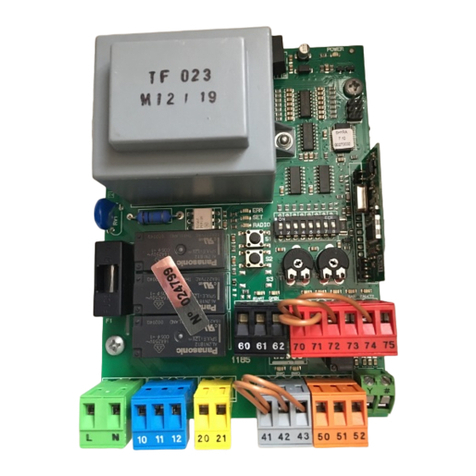
https://appceso.com

2) GÉNÉRALITÉS
Le tableau de commande LEO B CBB 3 400W 01 est fourni par le fabricant avec
unréglagestandard.Toutevariationdoitêtreconguréeàl’aideduprogrammeur
muni d’acheur intégré ou d’un programmeur palmaire universel.
Les caractéristiques principales sont:
- Contrôle d’1 moteur triphasé
- Réglage électronique du couple avec détection des obstacles.
- Entrées séparées pour les dispositifs de sécurité
- Entrées de commande congurables
- Entrée contrôle encodeur
La carte est munie d’un bornier extractible , pour faciliter les opérations
d’entretien ou le remplacement. Elle est équipée de plusieurs barrettes pré-
câblées pour faciliter la pose.
Les barrettes intéressent les bornes: 70-71, 70-72, 70-74, 76, 77. Si vous
utilisez les bornes ci-dessus , retirez les barrettes.
VÉRIFICATION
Le tableau
LEO B CBB 3 400W 01
accomplit le contrôle (vérication) des relais de
marche et des dispositifs de sécurité (photocellules) avant chaque cycle d’ouver-
ture et de fermeture. En cas de mauvais fonctionnement, vériez si les dispositifs
branchés fonctionnent correctement et contrôlez les câblages.
3) DONNÉES TECHNIQUES
Alimentation 400V~ ±10%, 50-60Hz*
Isolation/basse tension > 2MOhm 500V
Température de fonctionnement -10 / +55°C
Protection thermique Interne au moteur
Rigidité diélectrique secteur/bt 3750V~ pendant 1 minute
Puissance maximum moteur 980W
Alimentation des accessoires 24V~ (180mA absorption maxi)
24V~safe (180mA absorption maxi)
AUX 3 Contact N.O. (24V~/1A maxi)
Clignotant 230V~ 40W maxi
Dimensions Cf. Fig. A
Fusibles Cf. Fig. B
(* autres tensions disponibles à la demande)
4) CONNEXIONS DU BORNIER Fig. B
MANUEL D’INSTALLATION
Borne Dénition Description
Alimentation
L1 LIGNE 1
Alimentation triphasée 400V~ ±10%, 50-60Hz
L2 LIGNE 2
L3 LIGNE 3
N NEUTRE
Moteur
10 U
Connexion moteur triphasé
11 V
12 W
Aux
20 LAMP 230V Sortie clignotant 230V maxi 40W.
21
26 AUX 3 - CONTACT LIBRE (N.O.)
(Max 24V 3W)
Contact N.O. (24 V~/3W maxi).
Utilisable uniquement avec un récepteur radio enché dans son connecteur.
27
ENCODEUR
40 - REF SWE Alimentation ENCODEUR
41 + REF SWE
42 A RS485 Communication ENCODEUR
43 B RS485
Alimentation
des
accessoires
50 24V- Sortie alimentation accessoires.
51 24V+
52 24 Vsafe+ Sortie alimentation des dispositifs de sécurité vériés (émetteur photocellules et émetteur linteau sensible)
Sortie active uniquement pendant le cycle de manœuvre.
Commandes
60 Commun Commun entrées IC 1 et IC 2
61 IC 1
Entrée de commande congurable 1 (N.O.) - Défaut START E.
START E / START I / OPEN / CLOSE / PED / TIMER / TIMER PED
Consulter le tableau“Conguration des entrées de commande”.
62 IC 2
Entrée de commande congurable 2 (N.O.) - Défaut PED.
START E / START I / OPEN / CLOSE / PED / TIMER / TIMER PED
Consulter le tableau“Conguration des entrées de commande”.
63 Commun Commun entrées IC 3 et IC 4
64 IC 3
Entrée de commande congurable 3 (N.O.) - Default OPEN.
START E / START I / OPEN / CLOSE / PED / TIMER / TIMER PED
Consulter le tableau“Conguration des entrées de commande”.
65 IC 4
Entrée de commande congurable 4 (N.O.) - Default CLOSE.
START E / START I / OPEN / CLOSE / PED / TIMER / TIMER PED
Consulter le tableau“Conguration des entrées de commande”.
Sécurités
70 Commun Commun entrées STOP, SAFE 1 et SAFE 2
71 STOP La commande interrompt la manœuvre. (N.F.)
Si vous ne l’utilisez pas, laissez la barrette en place.
72 SAFE 1
Entrée de sécurité congurable 1 (N.F.) - Défaut PHOT.
PHOT / PHOT TEST / PHOT OP / PHOT OP TEST / PHOT CL / PHOT CL TEST / BAR / BAR TEST / BAR 8K2
Consulter le tableau“Conguration des entrées de sécurité”.
73 FAULT 1 Entrée de vérication des dispositifs de sécurité connectés sur le SAFE 1
74 SAFE 2
Entrée de sécurité congurable 2 (N.F.) - Défaut BAR
PHOT / PHOT TEST / PHOT OP / PHOT OP TEST / PHOT CL / PHOT CL TEST / BAR / BAR TEST / BAR 8K2
Consulter le tableau“Conguration des entrées de sécurité”.
75 FAULT 2 Entrée de vérication des dispositifs de sécurité connectés sur le SAFE 2
76 Commun Commun entrées SAFE 3.
77 SAFE 3
Entrée de sécurité congurable 3 (N.F.) - Défaut PHOT OP.
PHOT / PHOT TEST / PHOT OP / PHOT OP TEST / PHOT CL / PHOT CL TEST / BAR / BAR/TEST
Consulter le tableau“Conguration des entrées de sécurité”.
78 FAULT 3 Entrée de vérication des dispositifs de sécurité connectés sur le SAFE 3
Antenne
Y ANTENNE Entrée de l’antenne
Utilisez une antenne syntonisée sur 433 MHz. Pour la connexion Antenne Récepteur utilisez un câble coaxial RG58.
La présence de masses métalliques près de l’antenne risque de déranger la réception radio. Si l’émetteur a une
portée réduite, déplacez l’antenne dans un endroit plus adéquat.
# SHIELD
FRANÇAIS
LEO B CBB 3 400 W 01- 17
D811849 00100_01
https://appceso.com

MANUEL D’INSTALLATION
Conguration des entrées de commande
Logique IC= 0 - Entrée congurée comme Start E. Fonctionnement suivant la Logique MOUVT PAS A PAS.
Logique IC= 1 - Entrée congurée comme Start I. Fonctionnement suivant la Logique MOUVT PAS A PAS.
Logique IC= 2 - Entrée congurée comme Open.
La commande accomplit une ouverture. Si l’entrée reste fermée, les vantaux restent ouverts jusqu’à l’ouverture du contact. Avec le contact ouvert l’automatisation se ferme après le temps de TCA,
s’il est activé.
Logique IC= 3 - Entrée congurée comme Close.
La commande accomplit une fermeture
Logique IC= 4 - Entrée congurée comme Ped.
La commande accomplit une ouverture piétonne, partielle. Fonctionnement suivant la logique MOUVT PAS A PAS.
Logique IC= 5 - Entrée congurée comme Timer.
Fonctionnement analogue à Open mais la fermeture est garantie même après une panne de courant.
Logique IC= 6 - Entrée congurée comme Timer Ped.
La commande accomplit une ouverture piétonne, partielle. Si l’entrée reste fermée, le vantail reste ouvert jusqu’à l’ouverture du contact. Si l’entrée reste fermée et qu’une commande Start E, Start I
ou Open est activée, une manoeuvre complète est accomplie par la suite pour rétablir l’ouverture piétonne. La fermeture est garantie même après une panne de courant.
Conguration des entrées de sécurité
Logique SAFE= 0 - Entrée congurée comme Phot, photocellule. (Fig. F, réf.1).
Permet de connecter les dispositifs dépourvus de contact supplémentaire de vérication. En cas d’obscurcissement, les photocellules sont actives en ouverture et en fermeture. Un
obscurcissement de la photocellule en fermeture n’inverse le mouvement que lorsque la photocellule est libérée. Si vous ne l’utilisez pas, laissez la barrette en place.
Logique SAFE= 1 - Entrée congurée comme Phot test , photocellule vériée. (Fig. F, réf.2).
Active la vérication des photocellules au début de la manoeuvre. En cas d’obscurcissement, les photocellules sont actives en ouverture et en fermeture. Un obscurcissement de la
photocellule en fermeture inverse le mouvement uniquement après le dégagement de la photocellule.
Logique SAFE = 2 - Entrée congurée comme Phot op. photocellule active uniquement à l’ouverture. (Fig. F, réf.1)
Permet de connecter les dispositifs dépourvus de contact supplémentaire de vérication. En cas d’obscurcissement, le fonctionnement de la photocellule en fermeture est exclu.
Pendant l’ouverture verrouille le mouvement pendant la durée de l’obscurcissement de la photocellule. Si vous ne l’utilisez pas, laissez la barrette en place.
Logique SAFE = 3 - Entrée congurée comme Phot op test. photocellule vériée active uniquement à l’ouverture (Fig. F, réf.2).
Active la vérication des photocellules au début de la manoeuvre. En cas d’obscurcissement, le fonctionnement de la photocellule en fermeture est exclu. Pendant l’ouverture ver-
rouille le mouvement pendant la durée de l’obscurcissement de la photocellule.
Logique SAFE = 4 - Entrée congurée comme Phot cl. photocellule active uniquement à la fermeture. (Fig. F, réf.1)
Permet de connecter les dispositifs dépourvus de contact supplémentaire de vérication. En cas d’obscurcissement, le fonctionnement de la photocellule en ouverture est exclu. En
phase de fermeture, inverse immédiatement. Si vous ne l’utilisez pas, laissez la barrette en place.
Logique SAFE = 5 - Entrée congurée comme Phot cl test. photocellule vériée active uniquement à la fermeture (Fig. F, réf.2).
Active la vérication des photocellules au début de la manoeuvre. En cas d’obscurcissement, le fonctionnement de la photocellule en ouverture est exclu. En phase de fermeture,
inverse immédiatement.
Logique SAFE = 6 - Entrée congurée comme Bar, linteau sensible. (Fig. F, réf.3)
Permet de connecter les dispositifs dépourvus de contact supplémentaire de vérication. La commande inverse le mouvement pendant 2s. Si vous ne l’utilisez pas, laissez la barrette en place
Logique SAFE = 7 - Entrée congurée comme Bar, linteau sensible vérié (Fig. F, réf.4).
Active la vérication des linteaux sensibles au début de la manoeuvre. La commande inverse le mouvement pendant 2 secondes.
Logique SAFE= 8 - Entrée congurée comme Bar 8k2 (Fig. F, réf. 5). Entrée pour linteau résistif 8K2.
La commande inverse le mouvement pendant 2 secondes.
6) DISPOSITIFS DE SÉCURITÉ
Remarque: utiliser uniquement les dispositifs de sécurité récepteurs avec
contact en libre échange.
6.1) DISPOSITIFS VÉRIFIÉS Fig. F
6.2) CONNEXION D’1 PAIRE DE PHOTOCELLULES NON VÉRIFIÉES Fig. C
7 ACCÈS AUX MENUS: FIG. 1
7.1) MENU PARAMÈTRES PARA TABLEAU“A”PARAMÈTRES
7.2) MENU LOGIQUES LOGICTABLEAU“B”LOGIQUES
7.3 MENU DÉFAUT DEFAUT
IlramènelacentraleauxvaleurspréconguréesparDÉFAUT.Aprèslaréinitialisation
vous devez accomplir une nouvelle AUTOCONFIGURATION.
7.4 MENU LANGUE LANGUE
Permet de sélectionner la langue de l’acheur.
7.5 MENU AUTOCONFIGURATION AUTOset
•
Lancer une opération d’autoconguration en allant dans le menu prévu à cet eet.
• AprèsavoirappuyésurlatoucheOKlemessage“..........…”s’ache,lacentrale
commande une manœuvre d’ouverture suivie d’une manœuvre de fermeture,
pendant laquelle la valeur minimum de couple nécessaire pour le mouvement
du vantail est automatiquement réglée.
Pendant cette phase, il est important d’éviter d’obscurcir les photocellules et
d’utiliser les commandes START, STOP et l’acheur.
Au terme de cette opération, la centrale de commande aura automatiquement
conguré les valeurs de couple optimales. Les vérier et les modier, le cas échéant,
de la façon décrite dans la programmation.
Attention!!Pendantl’autoréglagelafonctiondedétectiondesobstacles
n’étant pas active le monteur doit contrôler le mouvement de l’auto-
matisation et empêcher que des personnes ou des choses ne s’approchent
ou ne stationnent dans le rayon d’action de l’automatisation.
7.6) MENU RÉGLAGE FIN DE COURSE Reg fc Fig. D
Phases du réglage des ns de course :
1) Se placer sur REG FC et conrmer avec OK.
2) L’acheur indique CLOSE, à l’aide des touches HAUT et BAS, congurer la porte en
position n de course de fermeture. Conrmer avec OK, l’acheur indique PRG.
3) Si l’acheur le demande, agir sur la bague de réglage : dans le sens contraire des
aiguilles d’une montre si l’acheur indique UP, dans le sens des aiguilles d’une
montresil’acheurindiqueDOWN. Unefoisquelapositioncorrecteaétéatteinte,
l’acheur indique OK. Conrmer avec la touche OK, l’acheur indique PRG.
4) L’acheur indique OPEN, à l’aide des touches HAUT et BAS, congurer la porte en
position n de course d’ouverture. Conrmer avec OK, l’acheur indique PRG.
Si l’acheur indique KO, cela signie que le réglage n’a pas fonctionné.
Les causes peuvent être les suivantes :
- pression de la touche ESC avant la n du réglage
- course mémorisée trop courte
7.7 MENU STATISTIQUES
Permet d’acher la version de la carte, le nombre total de manœuvres (en
centaines),lenombrederadiocommandesmémoriséesetles30dernièreserreurs
(les 2 premiers chires indiquent la position, les 2 derniers le code d’erreur).
L’erreur 01 est la plus récente.
8 INVERSION DIRECTION DE L’OUVERTURE (Fig. D1)
9)CONNEXIONAVECCARTESD’EXPANSIONETPROGRAMMATEURPALMAIRE
UNIVERSELLE VERSION > V1.40 (Fig. B) Consultez le manuel intéressé.
10) RÉCEPTEUR RADIO (Fig. B)
La che est prédisposée pour la connexion d’un récepteur radio extractible.
Le canal 1 du récepteur commande l’entrée IC1.
Le canal 2 du récepteur est connecté sur les bornes 26-27.
ATTENTION!Touteerreurdecongurationpeutcauserdespréjudicesauxpersonnes,
aux animaux et aux biens.
ATTENTION : Vériez si la valeur de la force de choc mesurée dans les
points prévus par la norme EN12445 est inférieure à celle indiquée
dans la norme EN 12453.
Pour obtenir un meilleur résultat, nous vous conseillons d’accomplir l’auto-
conguration avec les moteurs au repos (c’est-à-dire alors qu’ils ne sont pas
surchaués par un grand nombre de manœuvres consécutives).
18 - LEO B CBB 3 400 W 01
D811849 00100_01
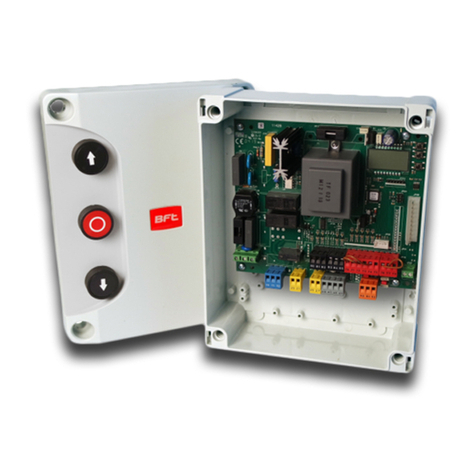
https://appceso.com

MANUEL D’INSTALLATION
FRANÇAIS
Paramètre mini.maxi.Dé-
faut
Person-
nels Dénition Description
TCA 0 120 10
Temps
fermeture
automatique [s]
Temps d’attente avant la fermeture automatique
ouv.
partielle 1 99 40
Ouverture
partielle [%] Règle le pourcentage d’ouverture partielle par rapport à l’ouverture totale en fonctionnement
“ouverture partielle”(Pedonale).
FORCE OUV 1 99 80
Force vantail/
vantaux à
l’ouverture [%]
Force exercée par le(s) vantail(vantaux) à l’ouverture. Représente le pourcentage de force fournie,
outre à celle mémorisée pendant l’autoconguration (et mise à jour par la suite), avant de générer une
alarme d’obstacle.
Le paramètre est conguré automatiquement par l’autoconguration.
ATTENTION : A une incidence directe sur la force de choc: vérier si la valeur congurée
permet de respecter les règlements de sécurité en vigueur (*) Installer au besoin des dispositifs
de sécurité antiécrasement.
FORCE
FERM 1 99 80
Force vantail/
vantaux à la
fermeture [%]
Force exercée par le(s) vantail(vantaux) à la fermeture. Représente le pourcentage de force fournie,
outre à celle mémorisée pendant l’autoconguration (et mise à jour par la suite), avant de générer une
alarme d’obstacle.
Le paramètre est conguré automatiquement par l’autoconguration.
ATTENTION : A une incidence directe sur la force de choc: vérier si la valeur congurée
permet de respecter les règlements de sécurité en vigueur (*) Installer au besoin des dispositifs
de sécurité antiécrasement.
(*) Dans l’Union européenne appliquer la EN12453 pour les limites de force et la EN12445 pour la méthode de mesure.
TABLEAU“B” - LOGIQUES - (LOGIC)
Logique Dénition
Défaut
Cochez le
réglage
accompli
Options
TCA Temps fermeture
automatique 00 Logique non active
1 Active la fermeture automatique
MOUVT
PAS A PAS
Mouvement pas
à pas 0
0Les entrées congurées comme Start E, Start I,
Ped fonctionnement avec la logique 4 pas. Mouvement pas à pas
2 PAS 3 PAS 4 PAS
FERMÉE
OUVRE OUVRE
OUVRE
EN
FERMETURE
STOP
OUVERTE FERME FERME FERME
EN
OUVERTURE
STOP + TCA
STOP + TCA
APRÈS
STOP
OUVRE OUVRE OUVRE
1
Les entrées congurées comme Start E, Start
I, Ped fonctionnement avec la logique 3 pas.
L'impulsion pendant la phase de fermeture
inverse le mouvement.
2
Les entrées congurées comme Start E, Start
I, Ped fonctionnement avec la logique 2 pas. A
chaque impulsion le mouvement est inverti.
PREAL Préalarme 0 0 Le clignotant s’éclaire au moment où le(s) moteur(s) démarre(nt).
1 Le clignotant s'allume pendant 3 secondes environ avant le démarrage du(des) moteur(s).
HOMME MORTE
Homme-présent 0
0 Fonctionnement à impulsions
1
Fonctionnement avec Homme présent.
L’entrée 64 est congurée comme OPEN UP.
L’entrée 65 est congurée comme CLOSE UP.
La manœuvre continue tant que les touches de commande OPEN UP ou CLOSE UP restent enfoncées.
ATTENTION : les dispositifs de sécurité ne sont pas actifs.
2
Fonctionnement Homme présent Urgence. Normalement fonctionnement à impulsions.
Si la carte échoue aux essais de sécurité (photocellule ou linteau, Er0x) 3 fois de suite, le fonctionnement
Homme présent actif est activé jusqu’à ce que les touches OPEN UP ou CLOSE UP soient libérées.
L’entrée 64 est congurée comme OPEN UP.
L’entrée 65 est congurée comme CLOSE UP.
ATTENTION : avec Homme présent Urgence les dispositifs de sécurité ne sont pas actifs.
3
Fonctionnement à impulsions à l’ouverture
Fonctionnement à homme mort en fermeture.
L’entrée 64 est congurée comme OPEN IMPULSIF.
L’entrée 65 est congurée comme CLOSE UP.
ATTENTION : pendant la fermeture les sécurités ne sont pas actives.
BL.IMP.OUV
Verrouillage
impulsions à
l’ouverture
0
0 L'impulsion des entrées congurées come Start E, Start I, Ped prend eet pendant l'ouverture.
1 L'impulsion des entrées congurées come Start E, Start I, Ped ne prend pas eet pendant l'ouverture.
INV.SENS.OUV
Inversion
direction de
l'ouverture
00 Fonctionnement standard (Cf Fig. D1)
1 Le sens de l'ouverture est inverti par rapport au fonctionnement standard (Cf Fig. D1)
TABLEAU“A” - MENU PARAMÈTRES - (param)
LEO B CBB 3 400 W 01- 19
D811849 00100_01
https://appceso.com

MANUEL D’INSTALLATION
Logique Dénition
Défaut
Cochez le
réglage
accompli
Options
SAFE 1
Conguration
de l'entrée de
sécurité SAFE 1.
72
0
0 Entrée congurée comme Phot, photocellule.
1 Entrée congurée comme Phot test , photocellule vériée.
2 Entrée congurée comme Phot op. photocellule active uniquement à l'ouverture.
3 Entrée congurée comme Phot op test. photocellule vériée active uniquement à l'ouverture.
SAFE 2
Conguration
de l'entrée de
sécurité SAFE 2.
74
6
4 Entrée congurée comme Phot cl. photocellule active uniquement à la fermeture.
5 Entrée congurée comme Phot cl test. photocellule vériée active uniquement à la fermeture.
6 Entrée congurée comme Bar, linteau sensible
7 Entrée congurée comme Bar, linteau sensible vériée
8 Entrée congurée comme Bar 8k2
SAFE 3
Conguration
de l’entrée de
sécurité SAFE 3.
77
2
0 Entrée congurée comme Phot, photocellule.
1 Entrée congurée comme Phot test , photocellule vériée.
2 Entrée congurée comme Phot op. photocellule active uniquement à l'ouverture.
3 Entrée congurée comme Phot op test. photocellule vériée active uniquement à l'ouverture.
4 Entrée congurée comme Phot cl. photocellule active uniquement à la fermeture.
5 Entrée congurée comme Phot cl test. photocellule vériée active uniquement à la fermeture.
6 Entrée congurée comme Bar, linteau sensible
7 Entrée congurée comme Bar, linteau sensible vériée
IC 1
Conguration
de l'entrée de
commande IC 1.
61
0
0 Entrée congurée comme Start E
1 Entrée congurée comme Start I
IC 2
Conguration
de l'entrée de
commande IC 2.
62
4
2 Entrée congurée comme Open.
3 Entrée congurée comme Close.
IC 3
Conguration
de l'entrée de
commande IC 3.
64
2
4 Entrée congurée comme Ped.
5 Entrée congurée comme Timer.
IC 4
Conguration
de l'entrée de
commande IC 4.
65
3 6 Entrée congurée comme Timer Piéton
20 - LEO B CBB 3 400 W 01
D811849 00100_01
https://appceso.com
Other manuals for LEO B CBB 3 400 W01
1
Table of contents
Languages:
Other BFT Control Panel manuals

BFT
BFT VISTA SEL User manual

BFT
BFT THALIA User manual

BFT
BFT NETTUNO B User manual

BFT
BFT THALIA L Installation and operating instructions

BFT
BFT PERSEO CBD 230.P SD User manual

BFT
BFT ZARA BTL2 User manual

BFT
BFT THALIA User manual

BFT
BFT RIGEL 6 User manual

BFT
BFT LEO B CBB 3 230 L02 User manual

BFT
BFT ALTAIR-P User manual