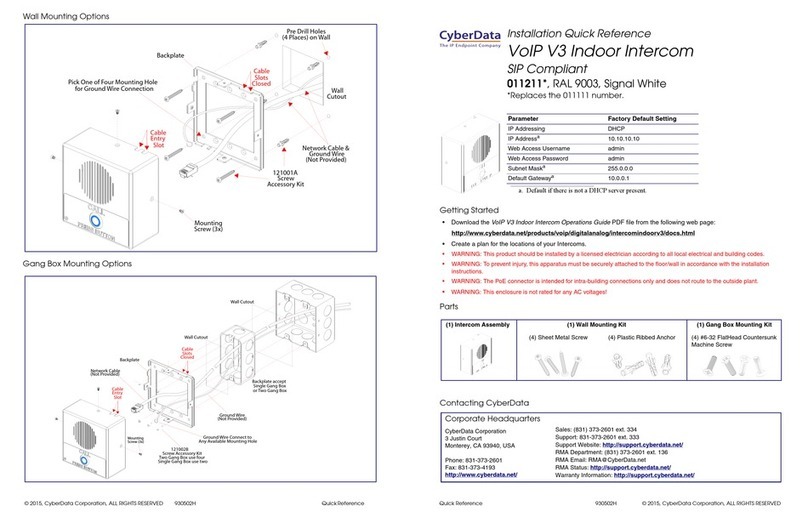
DIP2 state Master/Slave type
1 2 3
ON
Master monitor
1 2 3
ON
Slave monitor 1
1 2 3
ON
Slave monitor 2
1 2 3
ON
Slave monitor 3
1 2 3 4 5 6
ON
Code=33
1 2 3
ON
DIP2 state DIP1 state User Code
1 2 3 4 5 6
ON
Code=1
1 2 3
ON
1 2 3 4 5 6
ON
Code=2
1 2 3
ON
... ... ...
1 2 3 4 5 6
ON
Code=31
1 2 3
ON
1 2 3 4 5 6
ON
Code=32
1 2 3
ON
1 2 3 4 5 6
ON
Code=34
1 2 3
ON
... ... ...
1 2 3 4 5 6
ON
Code=63
1 2 3
ON
1 2 3 4 5 6
ON
Code=64
1 2 3
ON
... ... ...
... ... ...
1 2 3 4 5 6
ON
Code=65
1 2 3
ON
1 2 3 4 5 6
ON
Code=66
1 2 3
ON
1 2 3 4 5 6
ON
Code=95
1 2 3
ON
1 2 3 4 5 6
ON
Code=96
1 2 3
ON
1 2 3 4 5 6
ON
Code=97
1 2 3
ON
1 2 3 4 5 6
ON
Code=98
1 2 3
ON
1 2 3
ON
1 2 3 4 5 6
ON
Code=127
1 2 3
ON
1 2 3 4 5 6
ON
Code=128
DIP2 state DIP1 state User Code
When multiple Monitors are installed in one apartment, these Monitors have to use
the same User Code setting therefore the Master/Slave mode should be set on the
Monitor.
5.2.2 When Bit-3 of DIP2 is set to ON, Bit-1~2 of DIP2 and Bit-1~5 of DIP1 are
used to extended address setting:
2.2 Slave Address Or Extended Address Setting (DIP2)
• Bit-1~2 of DIP2 are used to set the slave address or extended address.
• Bit-3 of DIP2 is used to switch between Master /Slave selection and extended
addressing
• When Bit-3 of DIP2 set to OFF, the Bit-1~2 of DIP2 are use to set the
master/slave address setting: