3
4.5 Proper arrangement and organisation of the work-
place
GKeep other persons, children in particular, outside the
working area.
GDo not expose the appliance to rain or snow and do
not use it in damp or wet areas or in the vicinity of inflam-
mable liquids or gases.
4.6 General hazards presented by the appliance
GOperate the appliance only as directed and only when
it is in faultless condition.
GNever leave the appliance unsupervised.
GWhen the appliance is not in use, it must be stored in
a dry place, locked up or out of reach of children.
4.6.1 Mechanical hazards
GFollow the instructions concerning care and mainte-
nance.
4.6.2 Electrical hazards
GProtect yourself from electric shocks. Avoid body
contact with earthed objects, e.g. pipes and radiators.
GCheck the condition of the appliance including the
supply cord and extension cord as well as the plug con-
nections. Do not operate the appliance if damage is
found, if the appliance is not complete or if its controls
cannot be operated faultlessly.
GNever carry the appliance by the cable.
GGrip the plug and not the cable when pulling it out of
the socket.
GDo not expose the supply cord to heat, oil or sharp
edges.
GDo not touch the supply cord in the event of it becom-
ing damaged while working. Disconnect the supply cord
plug from the socket.
GWhen working outdoors, use only extension cords
approved and correspondingly marked for this applica-
tion.
GIf necessary, have the appliance repaired by an elec-
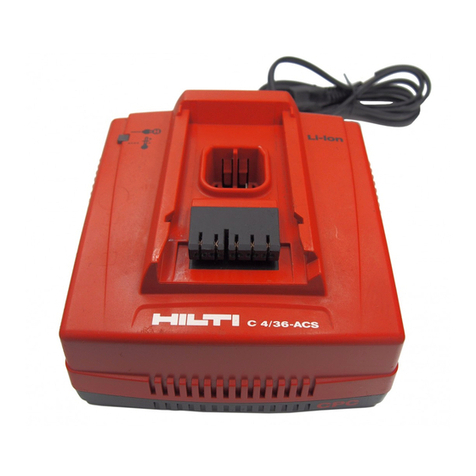
trical specialist (Hilti service department).
GTo avoid risk of accident, use only original Hilti spare
parts.
GNever operate the appliance when it is dirty or
wet. Under unfavourable conditions, dust or dampness
on the surface of the appliance may lead to electric
shocks.
GAvoid short-circuiting the battery. A short circuit may
present a fire hazard.
GCheck that the battery is seated securely in the appli-
ance.
4.6.3 Liquids
Caustic liquids may leak from defective batteries. Avoid
contact with these liquids. In the event of contact with
the skin, wash the area affected with soap and plenty of
water. Should the liquid come into contact with the eyes,
flush the eyes with water immediately and subsequent-
ly consult a doctor.
5. Before use
It is essential that the safety precautions printed in these
operating instructions are read and observed.
5.1 Batteries
GA new battery must be charged for 24 hours in order
to ensure that the cells form correctly.
GNever use the battery until the cells become fully dis-
charged. Recharge the battery as soon as a drop in per-
formance is noticed. When a battery is allowed to become
fully discharged, the cells that reach zero voltage first
are damaged by the current still flowing from the other
cells.
At low temperatures
GBattery performance drops at low temperatures. Bat-
teries should be stored at room temperature, removed
from the tool.
At high temperatures
GNever store and load the battery at high temperatures,
i.e. exposed to the direct heat of the sun, on a radiator,
behind a motor vehicle windscreen or at a window. High
temperatures may cause chemical liquids to leak from
the battery.
5.2 Operating the appliance
The charger should be operated in a clean, dry, cool
place but not at temperatures below zero.
1. Check that the voltage of the mains supply corre-
sponds to the information on the type plate.
2. Insert the supply cord plug in the mains socket. The
green lamp should light continuously.
5.3 Wall mounting
The surface on which the charger is mounted should
not be overhanging (the battery may fall out).
1. Mount the charger by way of the mounting holes in
the base of the casing.
2. Check at regular intervals to ensure that it is secure-
ly fastened.
Printed: 07.07.2013 | Doc-Nr: PUB / 5070686 / 000 / 00