manuals.online logo
Brands
  1. Home
  2. •
  3. Brands
  4. •
  5. MacDon
  6. •
  7. Farm Equipment
  8. •
  9. MacDon FlexDraper FD2 Series User manual

MacDon FlexDraper FD2 Series User manual

Other manuals for FlexDraper FD2 Series

4

This manual suits for next models

1

Other MacDon Farm Equipment manuals

MacDon R80 User manual

MacDon

MacDon R80 User manual

MacDon 912 User manual

MacDon

MacDon 912 User manual

MacDon M105 2011 User manual

MacDon

MacDon M105 2011 User manual

MacDon FD75 User manual

MacDon

MacDon FD75 User manual

MacDon M155 User manual

MacDon

MacDon M155 User manual

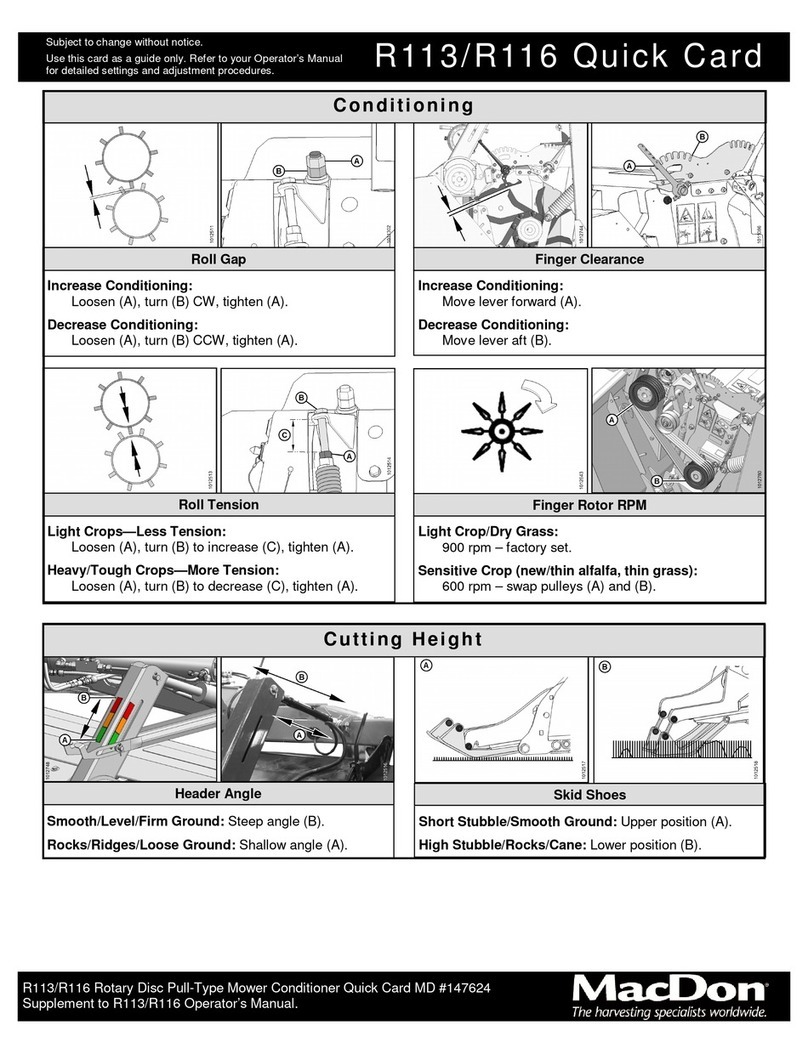
MacDon R116 User manual

MacDon

MacDon R116 User manual

MacDon 9000 User manual

MacDon

MacDon 9000 User manual

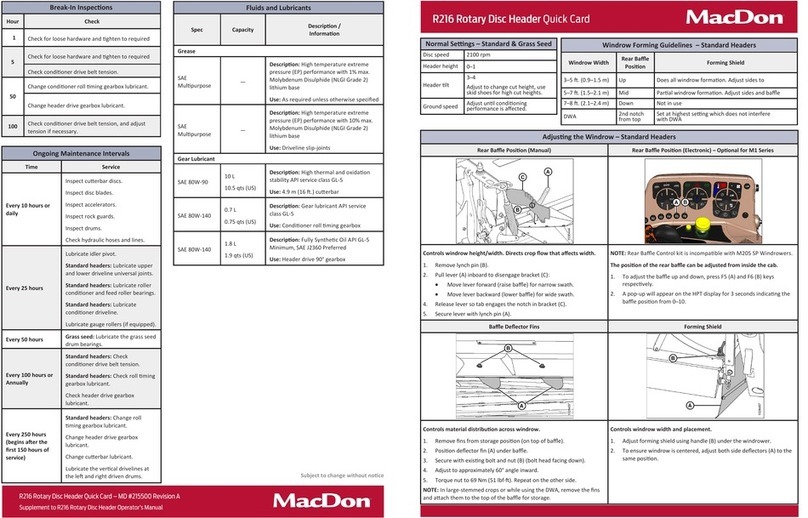
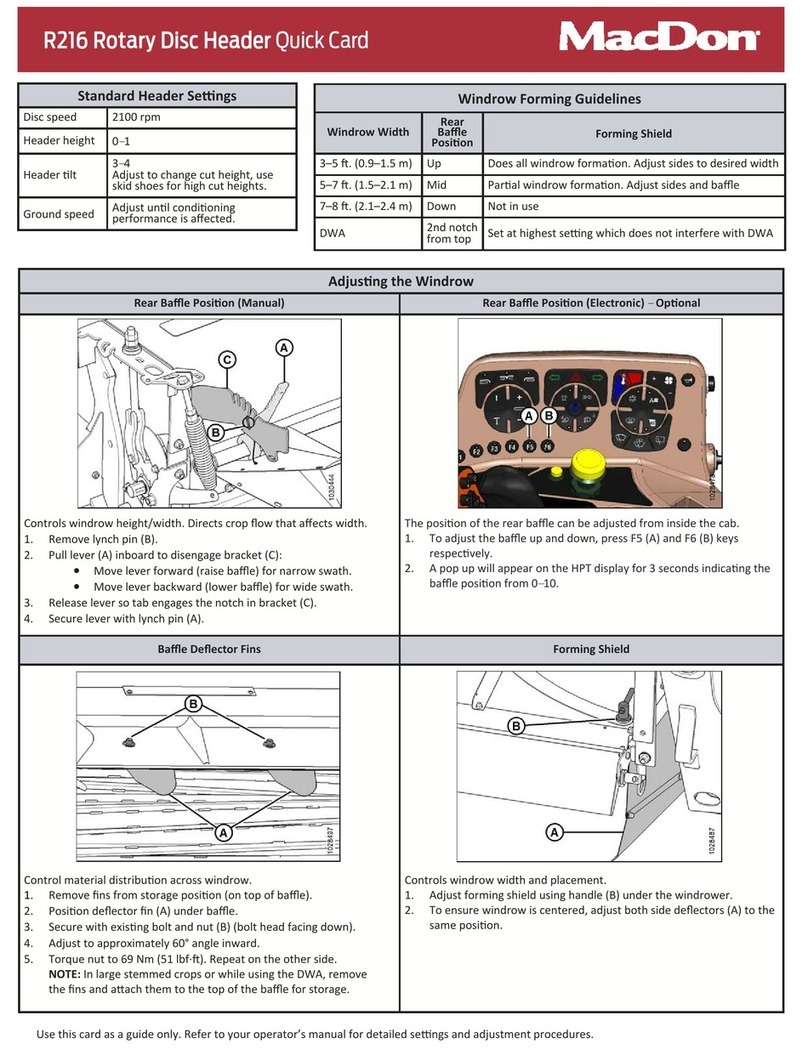
MacDon R216 User manual

MacDon

MacDon R216 User manual

MacDon D1X Series User manual

MacDon

MacDon D1X Series User manual

MacDon M150 Owner's manual

MacDon

MacDon M150 Owner's manual

MacDon M155E4 User manual

MacDon

MacDon M155E4 User manual

MacDon M1170 Parts list manual

MacDon

MacDon M1170 Parts list manual

MacDon R113 User manual

MacDon

MacDon R113 User manual

MacDon FlexDraper FD1 Series User manual

MacDon

MacDon FlexDraper FD1 Series User manual

MacDon D1X Series User manual

MacDon

MacDon D1X Series User manual

MacDon M155 User manual

MacDon

MacDon M155 User manual

MacDon FD75 User manual

MacDon

MacDon FD75 User manual

MacDon Swath Compressor Guide

MacDon

MacDon Swath Compressor Guide

MacDon FlexDraper FD1 Series User manual

MacDon

MacDon FlexDraper FD1 Series User manual

MacDon M1 Series Technical manual

MacDon

MacDon M1 Series Technical manual

MacDon HC10 Guide

MacDon

MacDon HC10 Guide

MacDon R216 User manual

MacDon

MacDon R216 User manual

MacDon M1 Series User manual

MacDon

MacDon M1 Series User manual

MacDon 2000-B User manual

MacDon

MacDon 2000-B User manual

Popular Farm Equipment manuals by other brands

GSi PNEG-2314 installation manual

GSi

GSi PNEG-2314 installation manual

Checchi & Magli TEXDRIVE owner's manual

Checchi & Magli

Checchi & Magli TEXDRIVE owner's manual

Amazone Cenius 4003-2TX operating manual

Amazone

Amazone Cenius 4003-2TX operating manual

MASSEY FERGUSON MF 9313S Operator's manual

MASSEY FERGUSON

MASSEY FERGUSON MF 9313S Operator's manual

Cima BLITZ Maintenance Instruction

Cima

Cima BLITZ Maintenance Instruction

Amazone CombiDisc 3000 Original operating manual

Amazone

Amazone CombiDisc 3000 Original operating manual

HE-VA Disc-Roller XL Contour Operating instructions/spare parts list

HE-VA

HE-VA Disc-Roller XL Contour Operating instructions/spare parts list

AGT AGT-SSFM product manual

AGT

AGT AGT-SSFM product manual

Milestone 72-84 manual

Milestone

Milestone 72-84 manual

KUHN Hector 3000 Complementary instructions

KUHN

KUHN Hector 3000 Complementary instructions

Krone X-Disc 6200 operating instructions

Krone

Krone X-Disc 6200 operating instructions

Eliet DZC450 manual

Eliet

Eliet DZC450 manual

Taarup BIO+ B4000 Operator's manual

Taarup

Taarup BIO+ B4000 Operator's manual

Garland SHAKER 310 DPG instruction manual

Garland

Garland SHAKER 310 DPG instruction manual

stable comfort StableWall System installation guide

stable comfort

stable comfort StableWall System installation guide


Raven AccuBoom installation manual

Raven

Raven AccuBoom installation manual

International 710 Operator's manual

International

International 710 Operator's manual

Ashland HDW-3217-14 parts manual

Ashland

Ashland HDW-3217-14 parts manual

manuals.online logo
manuals.online logoBrands
  • About & Mission
  • Contact us
  • Privacy Policy
  • Terms and Conditions

Copyright 2025 Manuals.Online. All Rights Reserved.

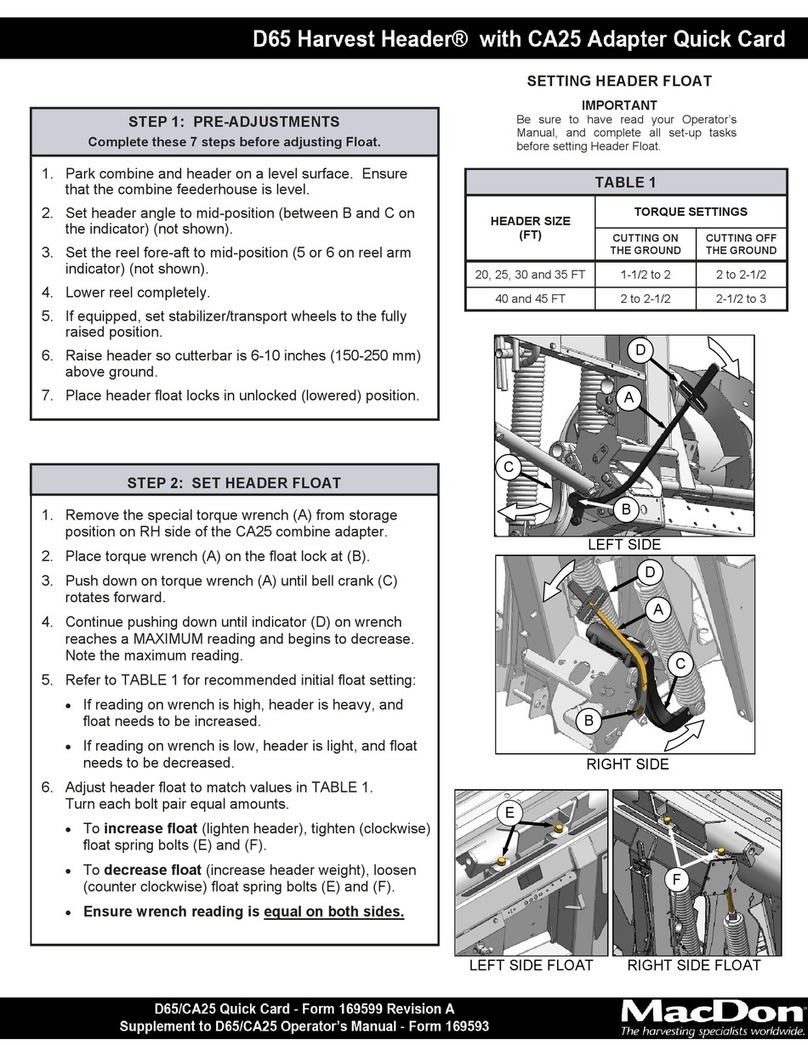
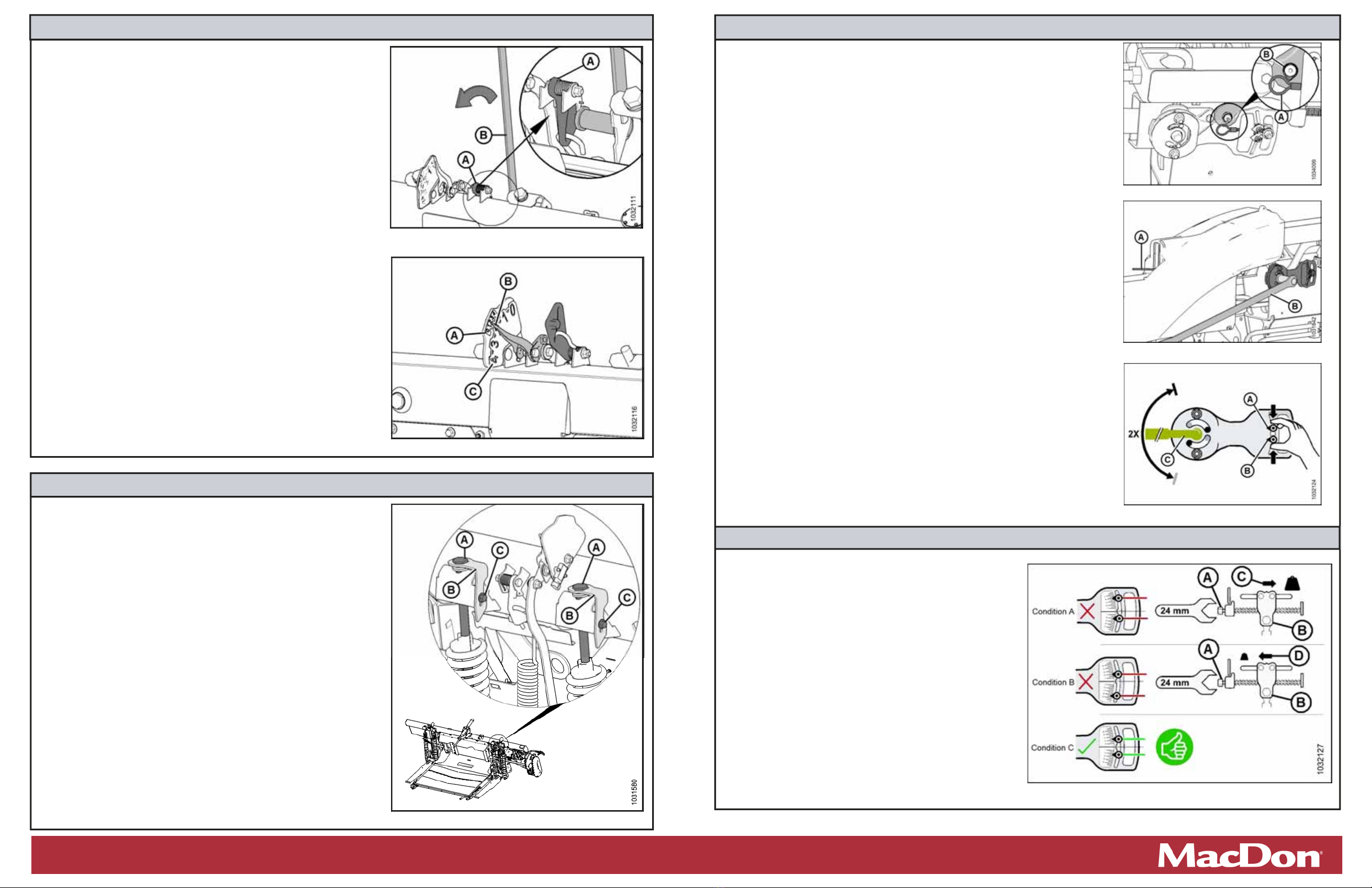
a. Park combine on a level surface, and ensure the combine feeder house
is level. Use bubble level on float module.
b. Adjust header so cuerbar is 250 mm (10 in.) (A) offthe ground.
c. Set the header angle hydraulic cylinder to D on indicator (B).
d. Set the reel fore-ato 6 on reel arm fore-aindicator (C).
e. Lower the reel completely, shut down the combine, and remove key
from the combine ignion.
f. Remove linkage cover (A).
g. Place both leand right wing lock spring handle (B) in the locked
(upper) posion. You should hear the lock engaged. If not, move the
wings up and down, so that the lock engages.
h. Place both leand right header float locks in unlocked (lowered)
posion (A).
i. Set stabilizer/transport wheels or contour wheels (if equipped) to
upper most posion.
Step 1: Preadjustments
NOTE:
Read your operator’s manual and complete all the setup tasks before seng the header float.
Figure 3: Float Unlocked – LeŌSide Shown
Figure 1: Header – Side View
Ensure your machine operates at top efficiency by using clean fluids and lubricants only.
• Use clean containers to handle all fluids and lubricants.
• Store fluids and lubricants in an area protected from dust, moisture, and other contaminants.
Break-In InspecƟons
To help avoid major component service or replacement, perform break-in inspecons on your machine for the first 50 hours of
operaon. Refer to your operator’s manual for complete break-in inspecon and adjustment procedures.
Figure 2: Wing Lock Spring Handle in Locked PosiƟon – LeŌ
Side Shown
Follow these five steps in order to set the header float and wing balance:
InspecƟon Instance Item
First 5 Minutes Check hydraulic oil level in reservoir (check aer first run-up and aer the hydraulic hoses have filled with oil).
5 Hours Check for loose hardware and ghten to required torque.
10 Hours
Check auger drive chain tension.
Check knife drive box mounng bolts.
50 Hours
Change float module gearbox oil.
Change float module hydraulic oil filter.
Change knife drive box lubricant.
Check gearbox chain tension.
Ongoing Maintenance Intervals
Refer to the operator’s manual for a comprehensive maintenance schedule and record. Log hours of operaon, use the maintenance
record, and keep copies of your maintenance records.
Following the maintenance schedule will increase your machine’s life.
SETTING HEADER FLOAT AND WING BALANCE
Recommended Fluids and Lubricants
Lubricant SpecificaƟon DescripƟon Use CapaciƟes
Grease SAE mul-purpose
High temperature extreme
pressure (EP) performance
grease with 1% max
Molybdenum Disulphide
(NLGI Grade 2) lithium base
As required unless
otherwise specified —
High temperature extreme
pressure (EP) performance
grease with 10% max
Molybdenum Disulphide
(NLGI Grade 2) lithium base
Driveline slip-joints —
Gear Lubricant SAE 85W-140 API service class GL-5
Knife drive box 1.5 liters (1.3 quarts)
Compleon gearbox 1.5 liters (1.3 quarts)
Hydraulic Oil
Single grade trans-hydraulic oil
Recommended viscosity:
• 60.1 cST @ 40°C
• 9.5 cST @ 100°C
Recommended brands:
• Petro-Canada Duratran
• John Deere Hy-Gard J20C
• Case Hy-Tran Ultracon
• AGCO Power Fluid 821 XL
Lubricant trans / hydraulic oil Header drive systems
reservoir
95 liters
(25.1 US gallons)
Main drive gearbox 1.5 liters (1.3 quarts)
FD2 Series FlexDraper® Header / FM200 Float Module
Subject to change without noƟce
FD2 Series FlexDraper® / FM200 Quick Card – MD #215504 Revision A
Supplement to FD2 Series Combine Header Operator’s Manual
a. Loosen bolts (C), and rotate spring locks (B).
b. To decrease header weight, turn both adjustment bolts (A) clockwise
(decrease number on float seng indicator [FSI]).
c. To increase header weight, turn both adjustment bolts (A)
counterclockwise (increase number on FSI).
NOTE: Ensure float seng indicator readings are equal on both sides
of the float module.
d. Liend of header by hand aer adjusng and recheck reading.
e. Once complete, use the tool and return the float seng lever to its
original locaon.
NOTE: If adequate header float cannot be achieved using all the
available adjustments, an oponal heavy duty spring is available. See
your MacDon Dealer or refer to the parts catalog for ordering
informaon.
Step 3: Seƫng Header Float
NOTE: Oil reservoir tank made transparent in Figure 4 to show tool
engaged on the float seng lever at the front of the header.
a. Lifloat seng lever (A) by hand to remove any slack.
b. Place tool (B) on the float seng lever. The tool should be slightly
angled towards the front of the header.
c. Pull down on tool (B) towards the back of the header unl lever (A) is
over center and will not return to its original posion. Remove the
tool and repeat on the opposite side. It is important that float seng
levers on both sides are engaged while adjusng.
d. On the side that you are adjusng, move header up and down by
hand, and release to reduce the effect of fricon.
e. Check the numbers in small print (A) on float seng indicator (FSI) for
the current float value. The pointer arm (B) on the FSI should be
on number 2.
• If the reading on FSI is higher than 2, the header is heavy.
• If the reading on FSI is lower than 2, the header is light.
NOTE: The numbers in large print (B) are for the float height indicator
and used when operang the header in the field.
Step 2: Checking Header Float
Figure 5: Checking Float – LeŌSide Shown, View from Rear
Figure 4: Checking Float – LeŌSide Shown, View from Rear
NOTE:
If necessary, set float values to suit crop and field condions. For more
informaon, refer to the header operator’s manual.
NOTE: Before proceeding, the header float must be set properly. Refer to
Step 3: Seng Header Float.
a. Aach flex checker cable (A) to flex checker cable lock (B).
NOTE: Images shown are from the leside.
b. Move spring handle (A) on the side that you are adjusng to the lower (UNLOCK)
posion. You should hear the lock disengaged. If not, use tool (B) to rotate
mechanism so that the lock disengages.
NOTE: Keep the opposite wing locked.
c. On flex checker plate, pinch indicators (A) and (B) together with your fingers.
d. Use tool (C) to rotate flex checker plate up unl pin reaches the end of slot. The
lower indicator (B) will move down to give the first reading.
e. Use tool (C) to rotate flex checker plate down unl pin reaches the end of slot.
The upper indicator (A) will move up to give the second reading.
f. Repeat Steps c and d.
g. Refer to Figure 10 and compare the two readings as follows:
• Condion A –the wing is too light; make wing heavier.
• Condion B –the wing is too heavy; make wing lighter.
• Condion C –wing balance correctly adjusted. Reinstall the linkage cover, and
repeat the procedure on the opposite wing.
Step 4: Checking Wing Balance
a. If the wing is too light (Condion A), make it heavier by
turning adjuster bolt (A) to move clevis (B) in direcon (C).
b. If the wing is too heavy (Condion B), make it lighter by
turning adjuster bolt (A) to move clevis (B) in direcon (D).
c. Recheck wing balance. Adjust as required unl wing is
balanced (Condion C).
d. Move the spring handle to the upper (LOCK) posion.
e. If the lock does not engage, move the wing up and down
with tool unl it locks.
f. Detach the flex checker cable from the flex checker lock.
g. Repeat on the other side.
h. Return the tool to its storage locaon, and reinstall the
linkage cover.
Step 5: AdjusƟng Wing Balance
Figure 8: Wing Balance Linkage
Figure 9: Wing Balance Adjustment
Figure 6: Float Adjustment Bolts – LeŌSide Shown
The Harvesting Specialists. MacDon.com
Figure 10: Wing Balance Adjustment
Figure 7: Flex Checker Cable