manuals.online logo
Brands
  1. Home
  2. •
  3. Brands
  4. •
  5. GE
  6. •
  7. Circuit Breaker
  8. •
  9. GE AM-4.16-250-6 User manual

GE AM-4.16-250-6 User manual

Other manuals for AM-4.16-250-6

1

This manual suits for next models

2

Other GE Circuit Breaker manuals

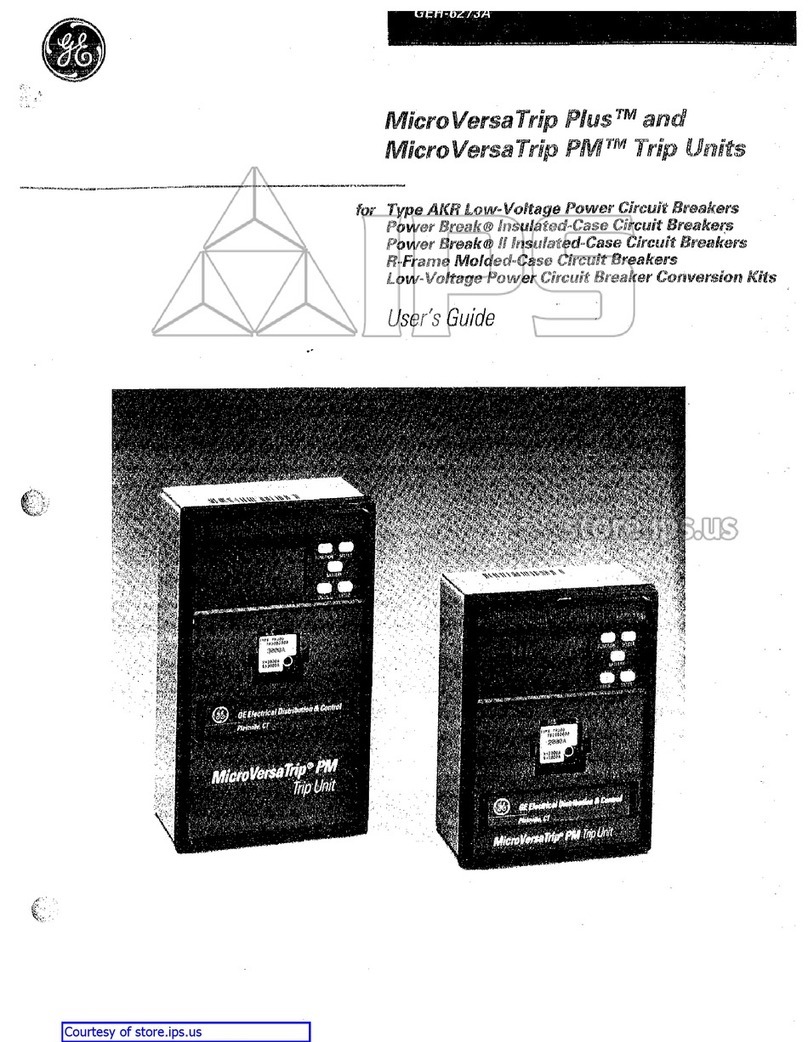
GE MicroVersaTrip AK-50 User manual

GE

GE MicroVersaTrip AK-50 User manual

GE AM-2.4/4.16-100/150- 3 User manual

GE

GE AM-2.4/4.16-100/150- 3 User manual

GE M-Pact Plus User manual

GE

GE M-Pact Plus User manual

GE Spectra K-frame User manual

GE

GE Spectra K-frame User manual

GE SecoVac Series User manual

GE

GE SecoVac Series User manual

GE AK-1-50 User manual

GE

GE AK-1-50 User manual

GE POWER/VAC GEK 86132A User manual

GE

GE POWER/VAC GEK 86132A User manual

GE AKR-30S User manual

GE

GE AKR-30S User manual

GE AM-13.8-750-5 User manual

GE

GE AM-13.8-750-5 User manual
GE AM-4.16-250-9 User manual

GE

GE AM-4.16-250-9 User manual

GE PowerVac User manual

GE

GE PowerVac User manual

GE AK-1-15 Series User manual

GE

GE AK-1-15 Series User manual

GE WavePro 3200 A User manual

GE

GE WavePro 3200 A User manual

GE EntelliGuard G User manual

GE

GE EntelliGuard G User manual

GE GEH-62808 User manual

GE

GE GEH-62808 User manual

GE FD 63 User manual

GE

GE FD 63 User manual

GE SPST012 User manual

GE

GE SPST012 User manual

GE MicroVersaTrip Plus Series User manual

GE

GE MicroVersaTrip Plus Series User manual

GE EntelliGuard L User manual

GE

GE EntelliGuard L User manual

GE A Series Pro-Stock THQB User manual

GE

GE A Series Pro-Stock THQB User manual

GE GEK-7345 User manual

GE

GE GEK-7345 User manual

GE ReliaGear Pro-Stock THQB User manual

GE

GE ReliaGear Pro-Stock THQB User manual

GE MicroVersa Trip Plus User manual

GE

GE MicroVersa Trip Plus User manual

GE EntelliGuard R7 User manual

GE

GE EntelliGuard R7 User manual

Popular Circuit Breaker manuals by other brands
Siemens 3VT9524-4TG30 quick start guide

Siemens

Siemens 3VT9524-4TG30 quick start guide

Acrel ASCB1 Series Installation and operation manual

Acrel

Acrel ASCB1 Series Installation and operation manual

ABB SACE Emax 2 E2.2 manual

ABB

ABB SACE Emax 2 E2.2 manual

Eaton NOVA LBS 15 Installation and operation instructions

Eaton

Eaton NOVA LBS 15 Installation and operation instructions

ABB SACE Emax E1 quick start guide

ABB

ABB SACE Emax E1 quick start guide

Siemens SIRIUS 3RV1742 Original operating instructions

Siemens

Siemens SIRIUS 3RV1742 Original operating instructions

WEG FHU ACW125 installation instructions

WEG

WEG FHU ACW125 installation instructions

TERASAKI NHP TemBreak PRO P160 Series installation instructions

TERASAKI

TERASAKI NHP TemBreak PRO P160 Series installation instructions

Siemens Sentron 3VA9157-0PK1 Series operating instructions
Siemens

Siemens Sentron 3VA9157-0PK1 Series operating instructions

hager TS 303 User instruction

hager

hager TS 303 User instruction

ETI EFI-4B Instructions for mounting

ETI

ETI EFI-4B Instructions for mounting

Gladiator GCB150 Installation instruction

Gladiator

Gladiator GCB150 Installation instruction

nader NDM3EU-225 operating instructions
nader

nader NDM3EU-225 operating instructions

Eaton 50DHP-VR Instruction handbook

Eaton

Eaton 50DHP-VR Instruction handbook

ABB SACE Emax 2 E6.2 Instruction handbook

ABB

ABB SACE Emax 2 E6.2 Instruction handbook

Gewiss 90 RCD Installation

Gewiss

Gewiss 90 RCD Installation

OEZ LFN Instructions for use

OEZ

OEZ LFN Instructions for use

Eaton Power Defense PDG2 Instruction leaflet

Eaton

Eaton Power Defense PDG2 Instruction leaflet

manuals.online logo
manuals.online logoBrands
  • About & Mission
  • Contact us
  • Privacy Policy
  • Terms and Conditions

Copyright 2025 Manuals.Online. All Rights Reserved.

GEI
-
88761
J
INSTRUCTIONS
AND
RECOMMENDED
PARTS
FOR
MAINTENANCE
SUPEBSEDES
GEI
-
88761
I
MAGNE
-
BLAST
CIRCUIT
BREAKER
TYPES
AM
-
4.16
-
250
-
6
AM
-
4.16
-
250
-
7
AM
-
4.16
-
250
-
8
CONTENTS
Introduction
.
.
.
.
.
.
3
•
.
•
Receiving
,
Handling
and
Storage
Installation
.
..
3
...
4
Description
of
Operation
.
..
Adjustments
.
General
Maintenance
.
.
.
.
1 4
4
10
2 8
Renewal
Parts
GENERALH
)
ELECTRIC
Courtesy of store.ips.us
MAGNE
-
BLAST
CIRCUIT
BREAKER
AM
-
4.16
-
250
-
7
M
AM
-
4.16
-
250
-
6
(
AM
-
4.16
-
250
-
8
Letter
Designation
B
,
C
,
H
,
K
,
and
N
,
used
immediately
following
the
model
number
indicates
basic
design
features
.
A
INTRODUCTION
age
,
current
,
and
interrupting
ratings
are
never
exceeded
.
all
ratings
of
the
breaker
as
well
as
several
design
;
variations
,
the
instructions
will
be
of
a
general
;
character
and
all
illustrations
will
be
typical
unless
otherwise
specified
.
The
magne
-
blast
breaker
is
the
removable
and
interchangeable
interrupting
element
used
in
metal
-
clad
switchgear
to
provide
reliable
control
and
pro
-
tection
of
electrical
apparatus
and
power
systems
.
The
AM
-
4.16
-
250
Magne
-
blast
Breaker
is
avail
-
able
with
continuous
current
ratings
of
1200
amperes
and
2000
amperes
in
accordance
with
applicable
industry
standards
,
plate
for
complete
rating
information
of
any
par
-
ticular
breaker
.
The
nameplate
also
describes
the
control
power
requirements
for
that
breaker
.
The
application
of
a
breaker
must
be
such
that
its
volt
-
Since
this
book
is
written
to
include
,
PROPER
INSTALLATION
AND
MAINTENANCE
ARE
NECESSARY
TO
INSURE
CONTINUED
SAT
-
ISFACTORY
OPERATION
OF
THE
BREAKER
.
The
following
instructions
will
provide
complete
infor
-
mation
for
placing
magne
-
blast
breakers
in
service
and
for
maintaining
satisfactory
operation
.
Refer
to
the
breaker
name
-
RECEIVING
*
HANDLING
AND
STORAGE
Receiving
and
Handling
against
condensation
,
preferably
by
storing
it
in
a
warm
dry
room
,
since
water
absorp
-
tion
has
an
adverse
effect
on
theinsulation
parts
.
Circuit
breakers
for
outdoor
metal
-
clad
switchgear
should
be
stored
in
the
equipment
only
when
power
is
available
and
the
heaters
are
in
operation
to
pre
-
vent
condensation
.
Each
breaker
is
carefuHy
inspected
and
packed
for
shipment
.
Immediately
upon
receipt
of
the
circuit
breaker
,
an
examination
should
be
made
for
any
damage
sustained
in
transit
.
If
injury
or
rough
handling
is
evident
,
a
damage
claim
should
be
filed
immediately
with
the
transportation
com
-
pany
and
the
nearest
General
Electric
Sales
Office
should
be
notified
.
2
.
The
breaker
should
be
stored
in
a
clean
location
,
free
from
corrosive
gases
or
fumes
;
particular
care
should
be
taken
to
protect
the
equipment
from
moisture
and
cement
dust
,
as
this
combination
has
a
very
corrosive
effect
on
many
parts
.
3
.
Unfinished
surfaces
of
rollers
,
latches
etc
.
,
of
the
operating
mechanism
shouldbe
coated
with
grease
to
prevent
rusting
.
If
the
breaker
is
stored
for
any
length
of
time
,
it
should
be
inspected
periodically
to
see
that
rusting
has
not
started
and
to
insure
good
mechan
-
ical
condition
.
Should
the
breaker
be
stored
under
unfavorable
atmospheric
conditions
,
it
should
be
cleaned
and
dried
out
before
being
placed
in
service
.
It
is
expected
that
due
care
will
be
exercised
during
the
unpacking
and
installation
of
the
breaker
so
that
no
damage
wiU
occur
from
careless
or
rough
handling
,
or
from
exposure
to
moisture
or
dirt
.
Check
all
parts
against
the
packing
list
to
be
sure
that
no
parts
have
been
overlooked
.
Storage
It
is
recommended
that
the
breaker
be
put
into
service
immediately
in
its
permanent
location
.
If
this
is
not
possible
,
the
following
precautions
must
be
taken
to
insure
the
proper
storage
of
the
breaker
:
1
.
The
breaker
should
be
carefully
protected
These
instructions
do
not
purport
to
cover
all
details
or
variations
in
equipment
nor
to
provide
for
every
possible
contingency
to
be
met
in
connection
with
installation
,
operation
or
maintenance
.
further
information
be
desired
or
should
particular
problems
arise
which
are
not
covered
sufficiently
for
the
purchaser
'
s
purposes
,
the
matter
should
be
referred
to
the
General
Electric
Company
.
Should
To
the
extent
required
the
products
described
herein
meet
applicable
ANSI
,
IEEE
and
NEMA
standards
/
hut
no
such
assurance
is
given
with
respect
to
local
codes
and
ordinances
because
they
vary
greatly
.
3
Courtesy of store.ips.us
GEI
-
88761
Magne
-
blast
Circuit
Breaker
INSTALLATION
1
.
Remove
the
box
barrier
and
mechanism
cover
and
make
a
visual
inspection
to
as
-
certain
that
the
breaker
and
mechanism
is
in
satisfactory
condition
.
Check
all
bearing
surfaces
of
the
mechanism
for
lubrication
.
Refer
to
section
on
lubrication
page
16
and
Figure
17
.
2
.
Charge
the
breaker
closing
springs
man
-
ually
using
a
5
/
8
"
ratchet
wrench
to
turn
the
driving
eccentric
(
6
)
Figure
1
.
Turning
the
eccentric
counter
clockwise
will
advance
the
ratchet
wheel
and
compress
the
springs
.
When
the
springs
have
reached
the
fully
charged
position
the
indicator
(
1
)
will
read
"
CHARGED
"
,
and
the
driving
pawl
will
be
raised
from
the
ratchet
wheel
teeth
.
Ad
-
ditional
turning
of
the
eccentric
will
not
advance
the
ratchet
wheel
.
Insert
the
spring
blocking
device
(
10
)
and
manually
discharge
the
springs
against
the
pins
by
pushing
the
manual
release
button
(
4
)
.
The
springs
are
now
blocked
and
slow
closing
of
the
breaker
contacts
can
be
accomplished
by
again
turning
the
driving
eccentric
with
a
5
/
8
"
ratchet
wrench
.
During
the
slow
closing
operation
check
to
insure
that
the
mechanism
does
not
stick
or
bind
during
the
entire
stroke
,
that
it
latches
securely
in
the
closed
position
,
and
that
it
trips
freely
when
the
manual
trip
lever
is
operated
.
At
this
time
,
also
check
the
following
adjustments
:
a
.
Arcing
contact
wipe
(
Refer
to
page
10
)
b
.
Primary
contact
wipe
(
Refer
topage
11
)
c
.
Primary
contact
gap
(
Refer
to
page
11
)
OR
MECHANISM
UNLESS
THE
CLOSING
SPRINGS
ARE
BLOCKED
AND
THE
OPEN
-
ING
SPRINGS
HAVE
BEEN
TRIPPED
OPEN
OR
MECHANICALLY
BLOCKED
.
PRECAUTION
IS
REQUIRED
TO
PREVENT
ACCIDENTAL
CLOSING
OR
TRIPPING
.
THE
The
closing
springs
should
now
be
un
-
blocked
.
Rotate
the
driving
eccentric
until
the
indicator
reads
"
CHARGED
"
and
the
ratchet
wheel
does
~
nut
advance
.
The
spring
blocking
device
can
now
be
removed
.
3
.
Connect
the
test
coupler
to
the
circuit
breaker
and
operate
it
electrically
several
times
.
Check
the
control
voltage
as
de
-
scribed
under
"
CONTROL
POWER
CHECK
"
(
Page
14
)
.
4
.
Disconnect
the
test
coupler
and
replace
box
barrier
.
5
.
If
the
breaker
has
been
stored
for
a
long
period
of
time
,
it
is
recommended
that
the
insulation
be
checked
with
a
standard
60
hertz
high
potential
test
.
Refer
to
Insulation
Test
(
Page
16
)
.
If
the
breaker
secondary
wiring
NOTE
:
is
to
be
given
a
hi
-
potential
test
at
1500
volts
,
remove
both
the
motor
leads
from
the
terminal
connection
.
Failure
to
dis
-
connect
the
motor
from
the
circuit
may
cause
damage
to
the
winding
insulation
.
6
.
Lubricate
the
silver
portion
of
the
ball
contact
at
the
top
of
the
breaker
bushing
by
applying
a
thin
film
of
contact
lubricant
D
50
H
47
.
7
.
Refer
to
metal
-
clad
instruction
book
GEH
-
1802
for
instructions
on
inserting
the
break
-
er
into
the
metal
-
clad
unit
.
DO
NOT
WORK
ON
EITHER
THE
BREAKER
DESCRIPTION
OF
OPERATION
The
Magne
-
blast
Breaker
has
twoprincipal
com
-
ponents
;
the
breaker
element
and
the
operating
mechanism
:
The
breaker
element
is
three
similar
pole
units
,
each
of
which
includes
the
current
carrying
parts
,
main
and
arcing
contacts
,
interrupter
,
and
an
enclosing
barrier
system
that
provides
insulation
between
poles
,
or
phases
and
to
ground
.
The
pri
-
mary
connections
to
the
associated
metal
-
clad
switchgear
are
made
through
the
ball
contacts
at
the
top
of
the
breaker
bushings
.
The
operating
mechanism
type
ML
-
13
is
of
the
stored
energy
type
designed
to
give
high
speed
closing
and
opening
.
The
mechanism
will
operate
on
a
-
c
or
d
-
c
voltage
as
indicated
on
the
breaker
nameplate
.
Closing
and
opening
operations
are
controlled
either
electrically
from
the
metal
-
clad
unit
and
remote
location
,
or
mechanically
by
the
manual
close
and
trip
levers
on
the
breaker
.
All
secondary
connections
from
the
breaker
to
the
metal
clad
unit
are
made
through
the
coupler
(
1
)
Fig
,
2
.
A
spring
release
interlock
,
Fig
3
,
is
provided
to
discharge
both
the
closing
and
opening
springs
when
the
breaker
is
withdrawn
from
or
inserted
into
the
Metal
Clad
unit
.
4
Courtesy of store.ips.us
1
-
3
T
2
3
a
?
4
5
6
7
8
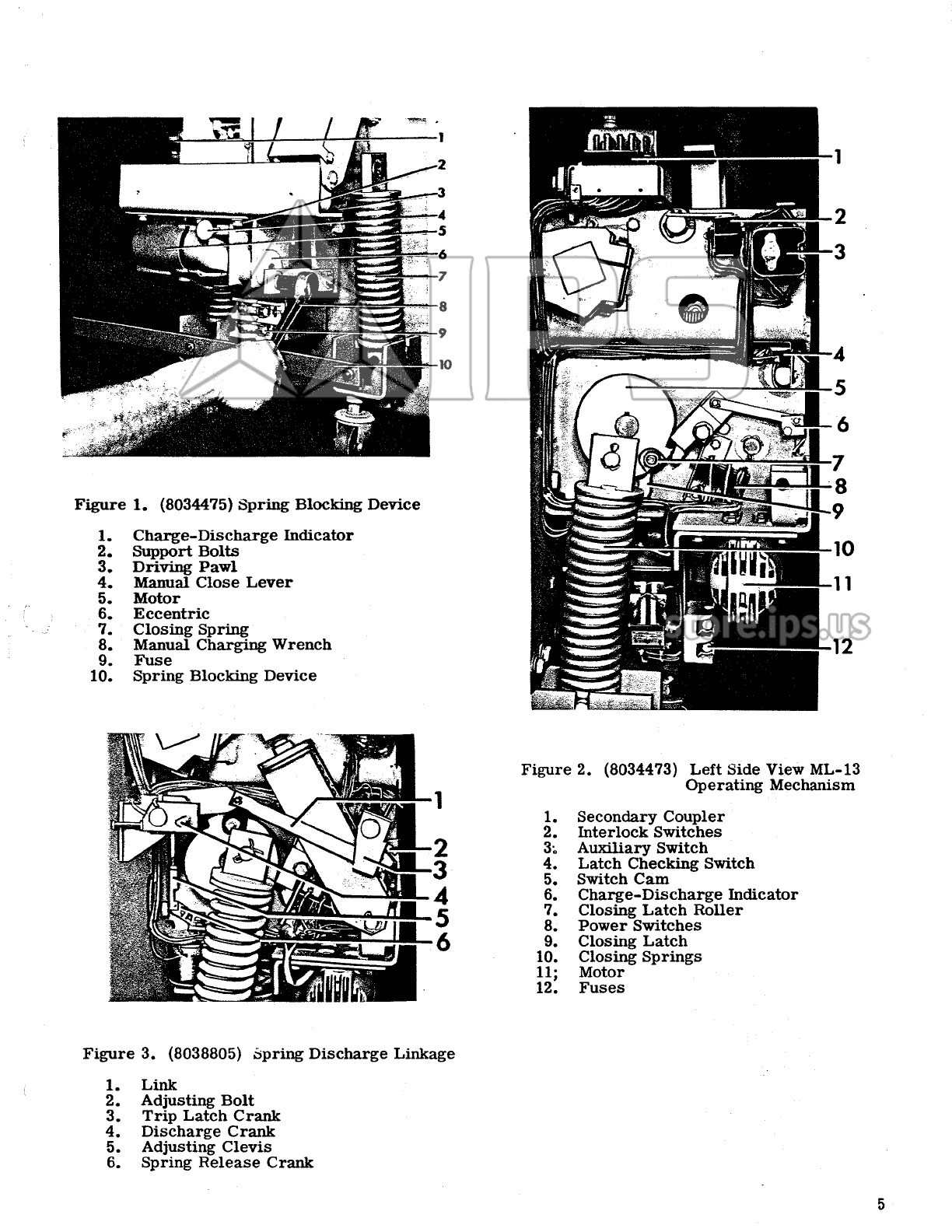
Figure
1
.
(
8034475
)
Spring
Blocking
Device
1
.
Charge
-
Discharge
Indicator
2
.
Support
Bolts
3
.
Driving
Pawl
4
.
Manual
Close
Lever
5
.
Motor
6
.
Eccentric
7
.
Closing
Spring
8
.
Manual
Charging
Wrench
9
.
Fuse
10
.
Spring
Blocking
Device
9
-
10
g
11
ft
‘
xSL
12
llllyifi
p
-
f
Figure
2
.
(
8034473
)
Left
Side
View
ML
-
13
Operating
Mechanism
v
;
1
Secondary
Coupler
Interlock
Switches
Auxiliary
Switch
Latch
Checking
Switch
Switch
Cam
Charge
-
Discharge
Indicator
Closing
Latch
Roller
Power
Switches
Closing
Latch
Closing
Springs
Motor
Fuses
1
.
<
3
2
.
2
3
-
.
£
2
4
.
3
5
.
6
.
.
w
3
HI
7
.
&
8
.
6
9
.
10
.
ii
;
i
-
1
12
.
Figure
3
.
(
8038805
)
Spring
Discharge
Linkage
1
.
Link
2
.
Adjusting
Bolt
3
.
Trip
Latch
Crank
4
.
Discharge
Crank
5
.
Adjusting
Clevis
6
.
Spring
Release
Crank
5
Courtesy of store.ips.us
GEI
-
88761
Magne
-
blast
Circuit
Breaker
When
the
breaker
is
used
interchangeably
with
type
MS
-
13
solenoid
operated
breakers
in
M
-
26
metal
-
clad
units
,
fuses
(
12
)
Figure
2
,
are
mounted
on
the
breaker
for
protection
of
the
motor
and
posing
circuit
.
These
breakers
are
identified
by
a
"
C
"
or
"
K
"
suffix
in
the
breaker
nomenclature
.
A
positive
interlock
(
3
)
Figure
4
and
interlock
switch
(
2
)
Figure
2
,
are
provided
between
the
breaker
and
metal
-
clad
unit
to
prevent
raising
or
lowering
of
the
breaker
in
the
unit
while
in
a
closed
position
and
to
prevent
a
closing
operation
when
the
breaker
is
not
in
either
the
fully
raised
or
lowered
position
.
To
insure
that
this
interlock
will
function
during
manual
,
as
well
as
during
electrical
operation
of
the
equipment
,
both
mechan
-
ical
and
electrical
blocking
is
provided
.
If
for
any
reason
the
closing
springs
should
be
dis
-
charged
against
the
positive
interlock
the
mechan
-
ism
will
be
jammed
and
be
inoperable
.
The
mechanism
can
be
released
and
returned
to
the
reset
position
by
pushing
in
on
the
trip
lever
(
8
)
Figure
5
.
It
may
require
more
than
normal
force
to
release
the
interlock
.
A
plunger
interlock
,
Figure
14
can
be
provided
when
required
to
operate
a
stationary
auxiliary
switch
and
/
or
a
rod
interlock
mounted
in
the
metal
-
clad
unit
.
In
cases
where
breakers
with
type
ML
-
13
mechanisms
must
match
and
line
up
with
breakers
having
type
ML
-
11
mechanisms
the
spring
charging
circuit
for
both
mechanisms
should
be
fused
with
Buss
Company
Fusetrons
as
follows
:
Cont
.
Volt
.
Fuse
Size
Cat
.
No
.
48
v
d
-
c
llOv
d
-
c
125
v
d
-
c
115
v
a
-
c
220
v
d
-
c
250
v
d
-
c
230
v
a
-
c
10
A
FRN
10
FRN
4
FRN
4
FRN
4
FRN
2.5
FRN
2.5
FRN
2.5
4
A
4
A
4
A
2.5
A
2.5
A
2.5
A
Spring
Charging
The
mechanism
has
a
high
speed
gear
motor
(
10
)
Figure
5
,
that
compresses
a
set
of
closing
springs
through
the
action
of
an
eccentric
,
ratchet
,
and
pawl
assembly
.
The
rotary
action
of
the
motor
is
converted
to
a
straight
stroke
through
the
eccen
-
tric
(
11
)
Figure
4
,
and
a
lever
that
carries
a
spring
loaded
driving
pawl
(
3
)
Figure
1
.
Figure
4
.
(
8034463
)
Right
Side
View
ML
-
13
Operating
Mechanism
Figure
5
.
(
8034471
)
Front
View
ML
-
13
Operating
Mechanism
1
.
Upper
Spring
Pin
Latching
Pawls
Positive
Interlock
Roller
Opening
Spring
Cam
Shaft
Ratchet
Wheel
Bearing
Block
Driving
Pawl
Lower
Spring
Pin
Driving
Pawl
Lever
Eccentric
Closing
Spring
2
.
3
.
1
.
Auxiliary
Switch
2
.
Open
-
Close
Indicator
3
.
Trip
Coil
4
.
Prop
Spring
5
.
Operation
Counter
6
.
Trip
Latch
7
.
Charge
-
Discharge
Indicator
8
.
Manual
Trip
Lever
9
.
Manual
Close
Lever
10
.
Motor
4
.
5
.
6
.
7
.
8
.
9
.
10
.
11
.
12
.
6
Courtesy of store.ips.us
Magne
-
blast
Circuit
Breaker
GEI
-
88761
The
pawl
advances
the
ratchet
wheel
(
6
)
Figure
4
a
few
degrees
each
stroke
where
it
is
held
in
pos
-
ition
by
the
latching
pawls
(
2
)
.
When
the
ratchet
wheel
has
been
rotated
approximately
180
degrees
the
closing
springs
(
12
)
will
be
fully
compressed
.
As
the
ratchet
wheel
continues
to
rotate
,
the
spring
load
will
shift
over
center
and
attempt
to
discharge
.
After
a
few
degrees
of
rotation
,
the
closing
roller
(
7
)
Figure
2
,
will
engage
the
closing
latch
(
9
)
and
the
compressed
springs
will
be
held
by
the
latch
until
a
closing
operation
is
required
.
During
the
last
few
degrees
of
the
ratchet
wheel
rotation
the
power
switches
(
8
)
are
opened
and
the
driving
pawl
is
raised
from
the
ratchet
wheel
surface
.
This
allows
the
motor
and
driving
mechanism
to
coast
to
a
natural
stop
expending
all
residual
energy
.
During
the
time
the
springs
are
being
com
-
pressed
a
relay
(
17
)
Figure
6
,
is
energized
to
hold
the
closing
circuit
open
.
The
relay
remains
energized
until
the
springs
are
fully
charged
and
the
control
switch
contacts
are
re
-
set
.
The
closing
springs
may
be
charged
manually
if
control
voltage
is
lost
.
A
5
/
8
"
ratchet
wrench
can
be
used
to
rotate
the
eccentric
in
a
counter
clockwise
direction
until
the
indicator
reads
"
Charg
-
ed
"
and
the
driving
pawl
is
raised
from
the
ratchet
wheel
.
The
use
of
the
ratchet
wrench
provides
for
maximum
safety
in
die
event
that
control
power
is
suddenly
restored
without
warning
.
In
this
event
,
die
motor
drive
will
override
die
ratchet
wrench
and
continues
to
charge
die
springs
.
Closing
Operation
The
breaker
can
be
closed
electrically
by
energizing
the
spring
release
solenoid
(
15
)
Figure
6
,
or
manually
by
pushing
the
close
button
(
9
)
Figure
5
.
In
either
method
the
closing
latch
is
rotated
from
under
the
closing
roller
to
release
the
closing
springs
(
10
)
Figure
2
.
The
energy
in
the
springs
is
used
to
rotate
a
cam
(
16
)
Figure
7
and
close
the
breaker
through
the
operating
mechanism
linkage
.
During
the
closing
operation
the
mechanism
is
trip
-
free
at
all
times
.
The
break
-
er
is
held
closed
by
the
closing
prop
(
14
)
moving
into
position
under
the
prep
pin
(
13
)
.
During
the
closing
operation
the
opening
springs
(
4
)
Figure
4
,
are
compressed
and
held
ready
for
an
opening
operation
with
the
trip
latch
(
8
)
Figure
7
bearing
against
the
trip
latch
roller
(
9
)
.
When
the
closing
operation
of
the
breaker
is
completed
and
the
closing
latch
is
fully
reset
,
6
9
10
11
12
13
14
15
16
17
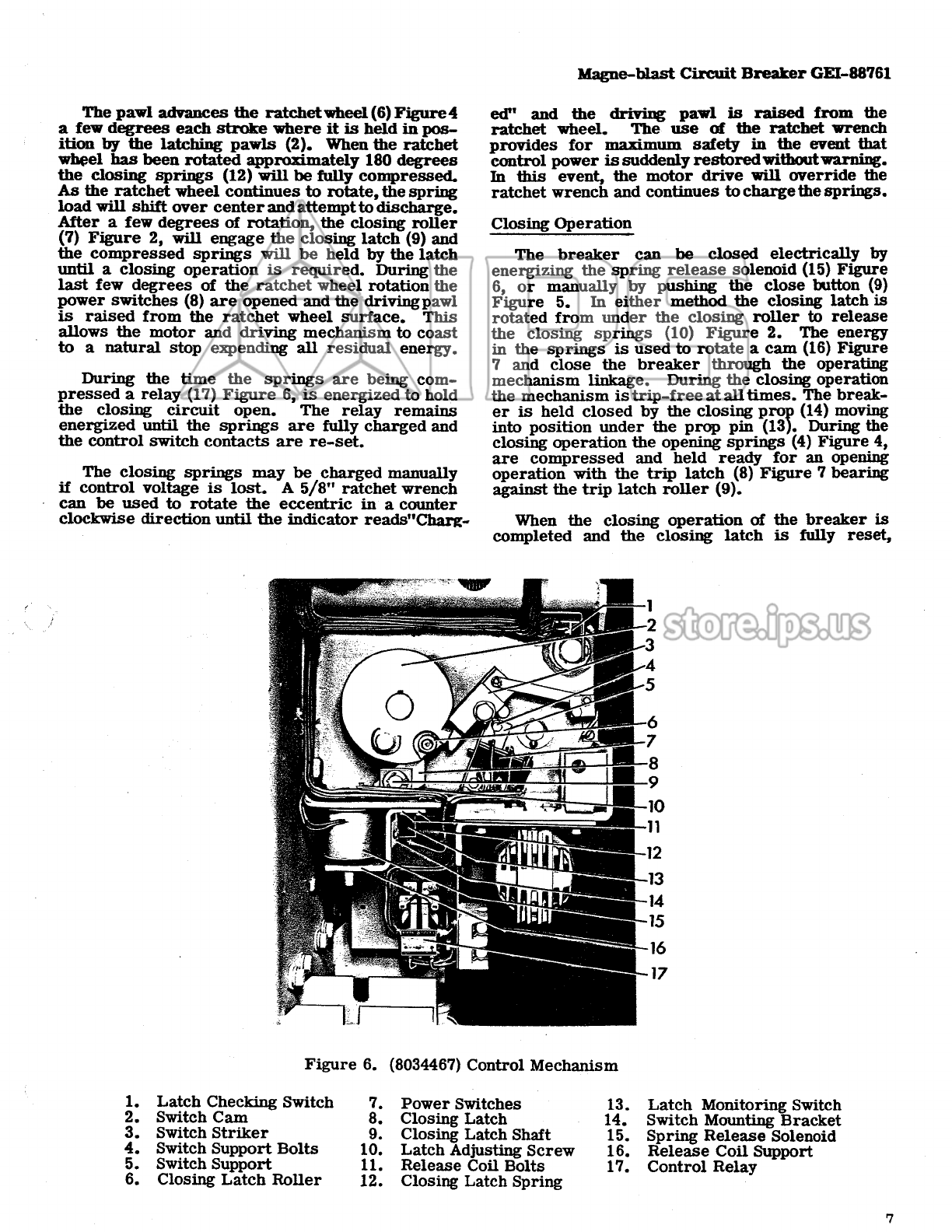
Figure
6
.
(
8034467
)
Control
Mechanism
1
.
Latch
Checking
Switch
2
.
Switch
Cam
3
.
Switch
Striker
4
.
Switch
Support
Bolts
5
.
Switch
Support
6
.
Closing
Latch
Roller
7
.
Power
Switches
8
.
Closing
Latch
9
.
Closing
Latch
Shaft
10
.
Latch
Adjusting
Screw
11
.
Release
Coil
Bolts
12
.
Closing
Latch
Spring
13
.
Latch
Monitoring
Switch
14
.
Switch
Mounting
Bracket
15
.
Spring
Release
Solenoid
16
.
Release
Coil
Support
17
.
Control
Relay
7
Courtesy of store.ips.us
GEI
-
88761
Magne
-
blast
Circuit
Breaker
the
contacts
of
the
latch
monitoring
switch
closes
to
permit
the
spring
charging
motor
to
be
energiz
-
ed
and
recharge
the
closing
springs
.
Opening
Operation
The
breaker
can
be
opened
either
electrically
by
energizing
the
trip
coil
(
3
)
Figure
5
,
or
man
-
ually
by
pushing
the
trip
lever
(
8
)
.
In
each
method
the
trip
latch
is
rotated
off
the
trip
latch
roller
,
permitting
the
operating
mechanism
linkage
to
collapse
.
The
energy
stored
in
the
opening
springs
is
released
to
provide
the
required
opening
speed
for
successful
interruption
of
the
circuit
.
As
the
breaker
opens
to
interrupt
a
current
,
the
arc
first
starts
at
the
arcing
contacts
(
6
&
27
)
Figure
8
,
transfers
to
the
arc
runner
(
4
&
10
)
and
energizes
the
blow
-
out
coils
(
3
&
11
)
.
action
introduces
a
magnetic
field
between
the
pole
pieces
(
5
&
9
)
of
the
interrupter
that
forces
the
arc
deeper
into
the
arc
chute
(
8
)
.
the
arcing
contacts
part
a
discharge
of
air
is
expelled
through
the
booster
tube
(
28
)
across
the
arc
.
This
air
flow
assists
the
arc
transfer
and
interruption
by
blowing
the
arc
away
from
the
contacts
and
into
the
arc
.
chute
.
The
magnetic
field
forces
the
arc
deeper
into
the
interrupter
along
the
diverging
arc
runners
.
This
At
the
time
/
R
24
—
r
\
i
'
V
)
>
1
T
I
-
'
v
\\
'
V
;
I
2
t
K
-
-
:
;
.
v
-
.
f t
cr
M
;
N
,
r
:
j
i
L
'
13
T
K
14
15
/
25
16
/
Fig
.
7
(
0114
C
5320
)
Sectional
Side
View
of
Mechanism
1
.
Handle
2
.
Trip
Coil
Support
3
.
Trip
Coil
4
.
Trip
Armature
5
.
Prop
Reset
Spring
6
.
Cam
Follower
Roller
7
.
Trip
Shaft
8
.
Trip
Latch
9
.
Trip
Latch
Roller
10
.
Trip
Latch
Roller
Support
11
.
Crankshaft
12
.
Cranks
13
.
Prop
Pin
14
.
Prop
15
.
Drive
Shaft
16
.
Cam
.
17
.
Check
Nut
18
.
Stop
Plate
19
.
Spring
Rod
20
.
Spring
21
.
Spring
22
.
Spring
Guide
23
.
Stop
Pin
24
.
Main
Shaft
Bearing
25
.
Cam
Shaft
Bearing
8
Courtesy of store.ips.us
Magne
-
blast
Circuit
Breaker
GEI
-
88761
Q
14
15
16
T
T
I
O
!
!
»
17
2
e
I
!
5
19
*
-
20
4
n
21
5
1
I
22
6
I
23
7
24
6
25
26
27
9
28
rt
29
IO
II
i
\
\
30
ESA
12
\
ior
fW
-
-
]
13
CO
±
Fig
.
8
(
0258
C
0689
)
Cross
Section
of
Breaker
Pole
Unit
i
.
Box
Barrier
Handle
Upper
Blow
-
out
Core
Upper
Blow
-
out
Coil
Upper
Arc
Runner
Upper
Pole
Piece
Stationary
Arcing
Contact
Box
Barrier
Arc
Chute
Side
Lower
Pole
Piece
Lower
Arc
Runner
21
.
Operating
Rod
22
.
Stationary
Primary
Contacts
23
.
Movable
Primary
Contacts
24
.
Cup
Bearing
25
.
Yoke
26
.
Movable
Contact
Arm
Assembly
27
.
Movable
Arcing
Contact
28
.
Booster
Tube
and
Piston
29
.
Connection
Bar
30
.
Booster
Cylinder
11
.
Lower
Blow
-
out
Coil
12
.
Lower
Blow
-
out
Core
13
.
Lower
Barrier
14
.
Front
Bushing
15
.
Rear
Bushing
16
.
Frame
17
.
Main
Operating
Crank
18
.
Upper
Horizontal
Barrier
19
.
Spring
Retainer
20
.
Lower
Horizontal
Barrier
2
.
3
.
4
.
5
.
6
.
7
.
8
.
9
.
10
.
9
Courtesy of store.ips.us
GEI
-
88761
Magne
-
blast
Circuit
Breaker
The
arc
chute
has
a
series
of
interleaving
cer
-
amic
fins
,
Figure
19
.
As
the
arc
is
forced
into
the
interrupter
it
is
lengthened
in
the
gradually
deep
-
ening
serpentine
path
between
the
fins
so
that
the
electrical
resistance
of
the
arc
is
rapidly
increased
and
its
heat
is
absorbed
by
the
ceramic
material
.
The
increased
resistance
reduces
the
magnitude
and
phase
angle
of
the
current
and
at
an
early
current
zero
the
arc
cannot
re
-
establish
itself
and
interruption
occurs
.
Trip
Free
Operation
If
the
trip
coil
circuit
is
energized
while
the
breaker
is
closing
,
the
trip
armature
will
force
the
trip
latch
(
8
)
Figure
7
away
from
the
trip
roiier
(
9
)
causing
the
mechanism
linkage
to
collapse
and
the
breaker
to
re
-
open
.
The
closing
cam
(
16
)
will
complete
its
closing
stroke
and
the
springs
will
re
-
charge
as
in
a
normal
closing
operation
.
ADJUSTMENTS
All
adjustments
should
be
checked
during
per
-
iodic
inspections
and
whenever
it
becomes
nec
-
essary
to
repair
or
replace
parts
that
have
become
worn
or
defective
while
in
service
.
The
following
adjustments
are
listed
in
the
order
in
which
they
are
to
be
checked
after
removing
the
box
barriers
and
front
cover
from
the
breaker
.
MECHANISM
UNLESS
THE
CLOSING
SPRINGS
ARE
BLOCKED
AND
THE
OPENING
SPRINGS
HAVE
BEEN
BLOCKED
.
PREVENT
ACCIDENTAL
CLOSING
OR
TRIPPING
.
TRIPPED
OPEN
OR
MECHANICALLY
THIS
MEASURE
IS
REQUIRED
TO
Arcing
Contact
Wipe
DO
NOT
WORK
ON
EITHER
THE
BREAKER
OR
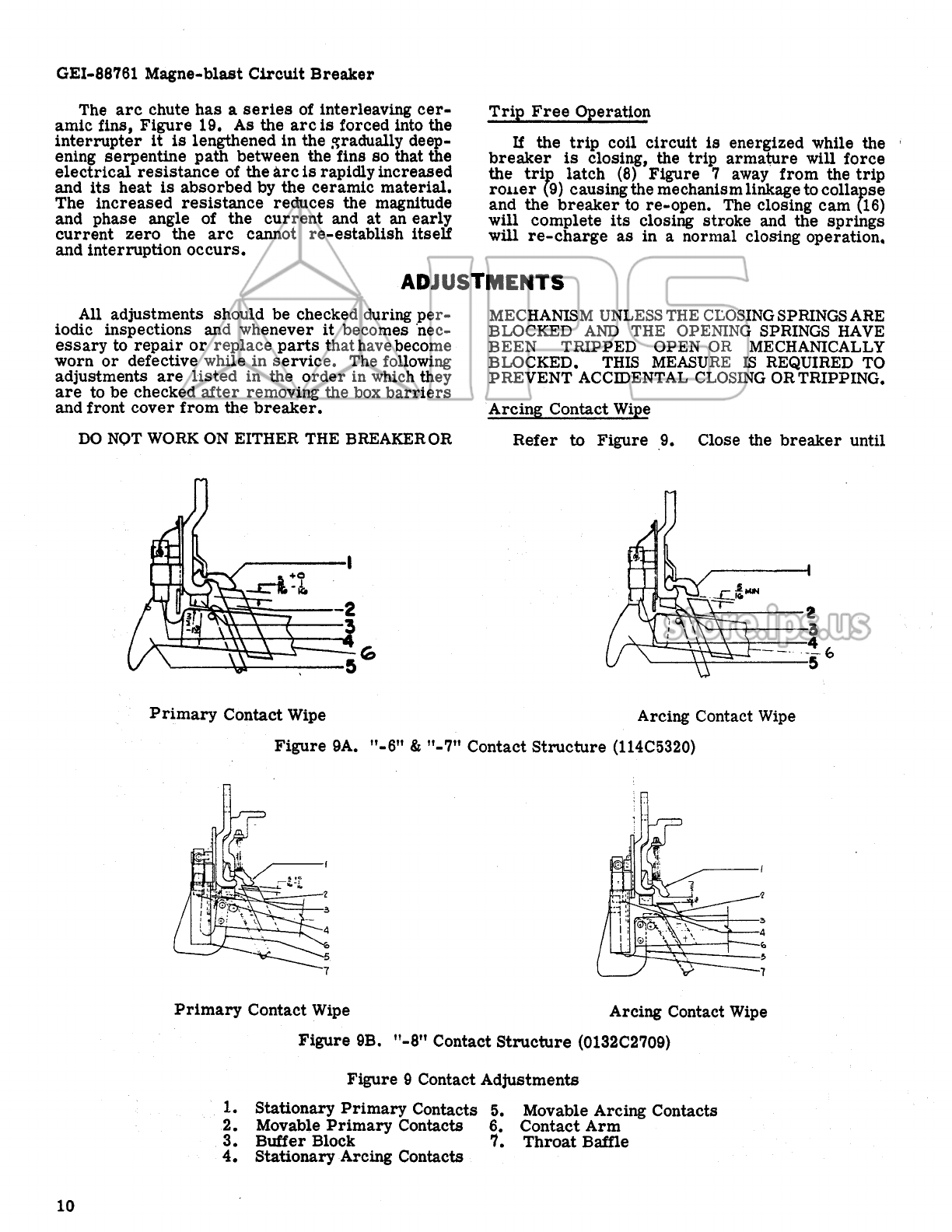
Refer
to
Figure
9
.
Close
the
breaker
until
k
.
+
o
-
cri
-
i
,
U
-
cjS
*
"
Q
-
2
2
an
)
3
\
'
4
<
o
56
5
Primary
Contact
Wipe
Arcing
Contact
Wipe
Figure
9
A
.
"
-
6
"
&
"
-
7
"
Contact
Structure
(
114
C
5320
)
&
•
2
2
i
!
•
•
3
ll
%
-
1
44
7
7
Primary
Contact
Wipe
Arcing
Contact
Wipe
Figure
9
B
.
"
-
8
”
Contact
Structure
(
0132
C
2709
)
Figure
9
Contact
Adjustments
1
*
Stationary
Primary
Contacts
5
.
Movable
Arcing
Contacts
2
.
Movable
Primary
Contacts
6
.
Contact
Arm
3
.
Buffer
Block
7
.
Throat
Baffle
4
.
Stationary
Arcing
Contacts
10
Courtesy of store.ips.us