Keep the battery charger clean.
Contamination can lead to danger of an
electric shock.
Before each use, check the battery
charger, cable and plug. If damage
is detected, do not use the battery
charger. Never open the battery
charger yourself. Have repairs
performed only by a qualied
technician. Damaged battery chargers,
cables and plugs increase the risk of an
electric shock.
Do not operate the battery charger
on easily inammable surfaces (e. g.,
paper, textiles, etc.) or surroundings.
The heating of the battery charger during
the charging process can pose a re
hazard.
Children should be supervised to
ensure that they do not play with the
battery charger.
Products sold in GB only: Your product is
tted with an BS 1363/A approved electric
plug with internal fuse (ASTA approved to
BS 1362). If the plug is not suitable for
your socket outlets, it should be cut off
and an appropriate plug tted in its place
by an authorised customer service agent.
The replacement plug should have the
same fuse rating as the original plug. The
severed plug must be disposed of to avoid
a possible shock hazard and should never
be inserted into a mains socket elsewhere.
Products sold in AUS only: Use a residual
current device (RCD) with a rated residual
current of 30 mA or less.
VIBRATION INFORMATION
Vibration level
The vibration emission level stated in this
instruction manual has been measured in
accordance with a standardised test given
in EN 60745. It may be used to compare
one tool with another and as a preliminary
assessment of exposure to vibration
when using the tool for the applications
mentioned in this manual. However, using
the tool for different applications, or with
different or poorly maintained accessories,
may signicantly increase the exposure
level.
An estimation of the level of exposure to
vibration should also take into account
the times when the tool is switched off or
when it is running but not actually doing
the job, as this may signicantly reduce
the exposure level over the total working
period.
Protect yourself against the effects of
vibration by maintaining the tool and its
accessories, keeping your hands warm,
and organising your work patterns.
DECLARATION OF CONFORMITY
We declare under our sole responsibility
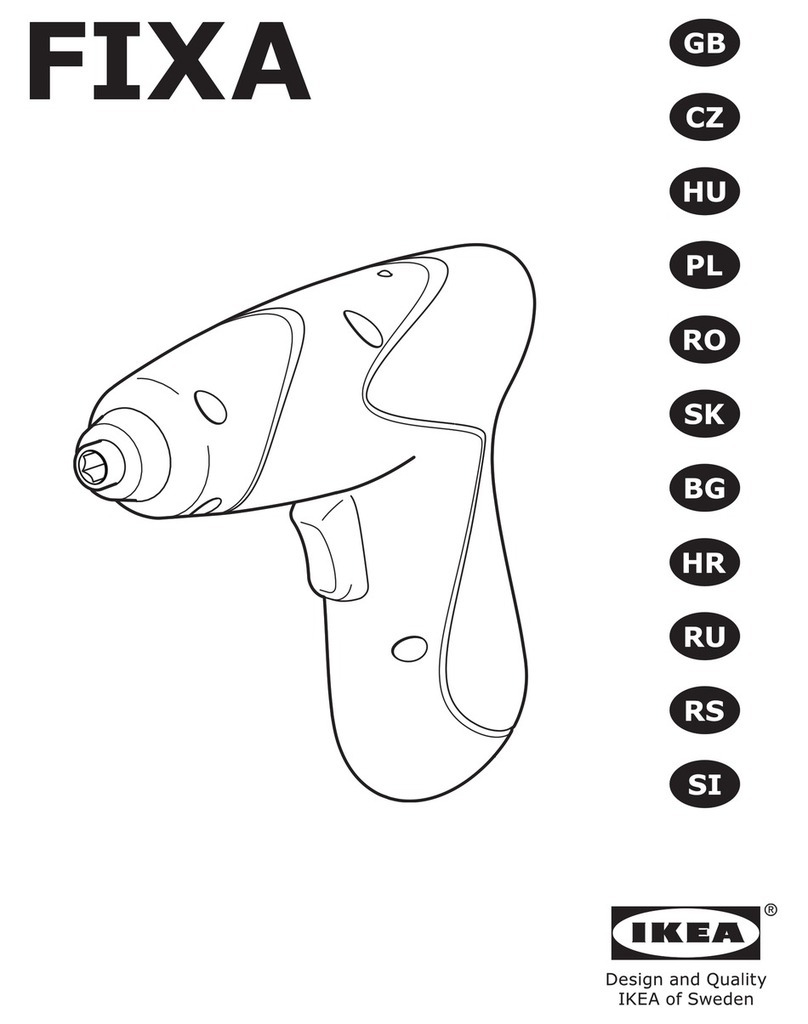
that this product, FIXA screwdriver/
drill Li-Ion 14.4V, is in conformity with
the following standards or standardized
documents: EN 60745-1, EN 60745-2-1,
EN 60745-2-2, EN 55014-1, EN 55014-
2,EN 61000-3-2, EN 61000-3-3, EN 60335-
1, EN 60335-2-29, EN 62233 in accordance
with the provisions of the directives
2006/42/EC, 2004/108/EC, 2006/95/EC,
2002/96/EC, 2011/65/EC.
Technical documentation at: IKEA of
Sweden AB, Box 702, Tulpanvägen 8,
SE-343 81 Älmhult, SWEDEN.
8
The undersigned is responsible for
compilation of the technical documentation
and makes this declaration on behalf of
IKEA of Sweden AB.
Christina Niemelä Ström
Business Area Manager
IKEA of Sweden AB
ASSEMBLY
Before any work on the machine
(e. g., maintenance, tool change, etc.) as
well as during transport and storage,
set the rotational direction switch
to the centre position. Unintentional
actuation of the On/Off switch can lead to
injuries.
Battery charging
Charging your screwdriver/drill
When the charger is connected to the
electricity supply, the red diode on the
screwdriver/drill lights up. The diode lights
up while the battery is being charged (7).
Under normal conditions of use the
screwdriver/drill can be recharged several
hundred times.
ATTENTION! The recharging process
generates heat in the battery.
Note: The battery that is supplied with the
screwdriver/drill has been charged for test
purposes only and must be fully recharged
before rst time use.
First read the safety instructions and then
follow the loading instructions. Insert
the transformer plug into the socket in
the screwdriver/drill. Then connect the
charger’s transformer to the electricity
supply.
Make sure that there are no knots or sharp
bends in the cable.
The charger’s transformer and the battery
have been designed to be used together.
NEVER use this charger to recharge
cordless tools or batteries from other
manufacturers. The battery will gradually
lose its charge over a period of time, even
if the tool is not used.
The lithium-ion battery is protected against
deep discharging by the “Electronic Cell
Protec tion (ECP)”. When the battery is
empty, the ma chine is switched off by
means of a protective circuit: The inserted
tool no longer rotates.
WARNING! Do not continue to
press the On/Off switch after the ma-
chine has been automatically switched
off. The battery can be damaged.
WARNING! Recharge the battery
on a non-ammable surface.
Do not recharge the battery for more
than eight hours. The red diode will turn
green when the battery has been fully
loaded.
Disconnect the cable and store the
transformer in a suitable place when it is
not in use.
It is not advisable to recharge the battery
in temperatures below freezing.
When removing the battery from the
machine, actuate the trigger switch
(5) until the battery is completely
9