4
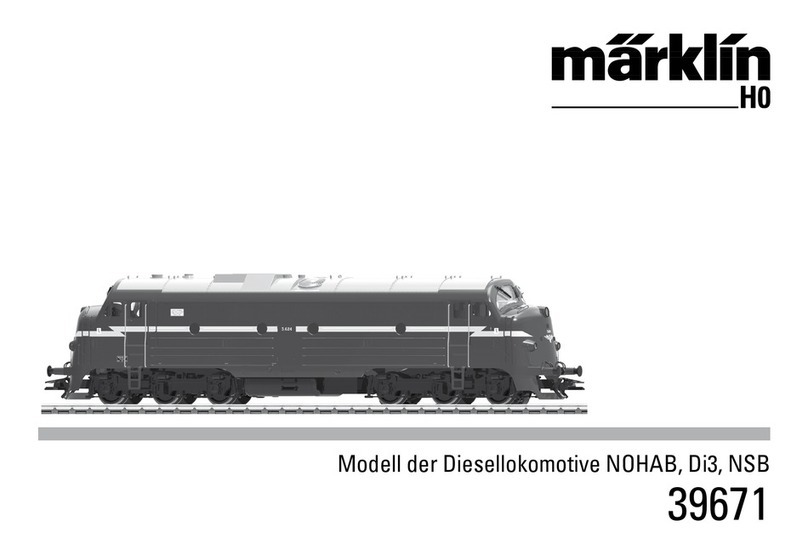
Informationen zum Vorbild
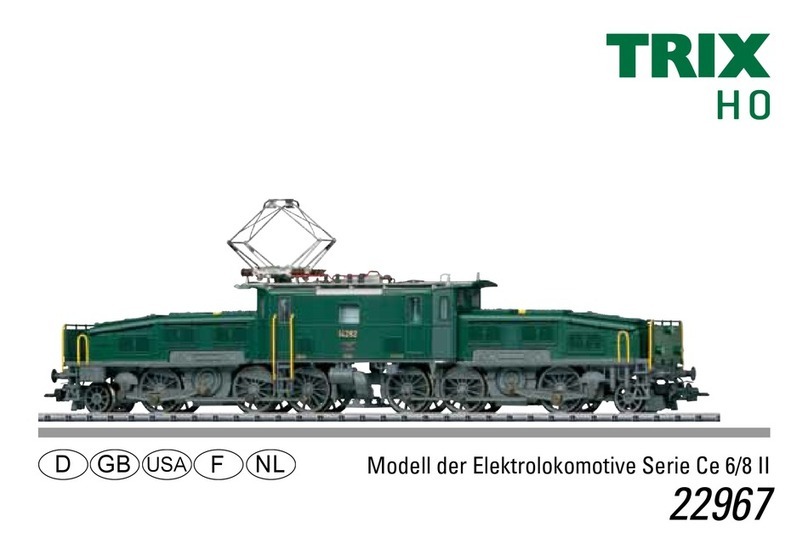
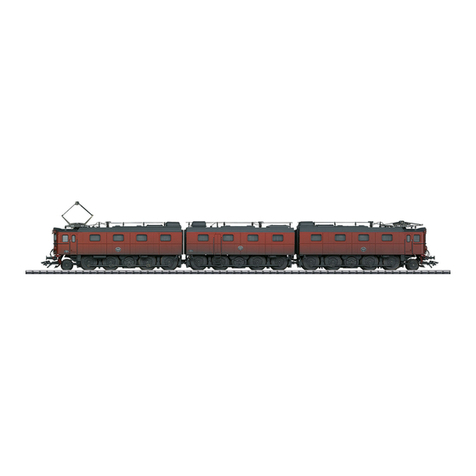
Die besonderen Erfordernisse der Steilrampen der
Gotthardstrecke führten zu Beginn der 30er-Jahre des
20. Jahrhunderts zur Entwicklung einer riesigen Dop-
pellokomotive, der Ae 8/14.
Die Kraft von insgesamt 8 Fahrmotoren wurden durch
den Buchli-Antrieb auf die Räder übertragen. Die
Antriebe der beiden Hälften waren jeweils gegenseitig
montiert worden, so dass die Lokomotive optisch aus
zwei gleichen Teilen bestand.
Zusätzlich zu dem großen Gewicht erhielten die
Lokomotiven einen so genannten Adhäsionsvermehrer.
Dieser entlastete die mittlere Laufachse jeder Lokhälfte,
wodurch die Achslast an den Treibachsen um ca. 1,5 t
auf ungefähr 21,5 t anstieg.
Insgesamt wurden 3 verschiedene Ae 8/14 von unter-
schiedlichen Herstellern in Betrieb genommen.
Länge über Puffer 34 000 mm
Höchstgeschwindigkeit 100 km/h
Dienstmasse 240 t
Nennleistung 5408 kW (7350 PS)
Baujahr ab 1931
Length over the buffers 34,000 mm / 111 feet
6-9/16 inches
Maximum speed 100 km/h / 63 mph
Service weight 240 metric tons
Nominal power 5,408 kilowatts /
7,350 horsepower
Built starting in 1931
Information about the prototype
The special requirements of the steep grades on the
Gotthard route led to the development of an immense
double locomotive at the start of the 1930s, the Ae 8/14.
The power from a total of 8 traction motors was
transmitted to the wheels by means of quill drive, also
known as “Buchli” drive in Switzerland. The running
gear for the two halves was mounted opposite each
other so that in terms of appearance the locomotive
consisted of two equal parts.
In addition to their great weight, these locomotives
were also equipped with so-called adhesion multipliers.
These took weight off of the center pilot trucks such
that the axle load on the driving axles was increased by
about 1.5 metric tons to about 21.5 metric tons.
A total of 3 different Ae 8/14 locomotives from different
builders were placed into service.