04 05
Check if the Juice Extractor is firm in its position. Before using it,
wash partsin contact with the food with neutral soap and water.
3. Operation
3.1 Starting
IMPORTANT
Always wait until the motor complete stop before changing the
crown.
Make sure the Crown is properly fitted.
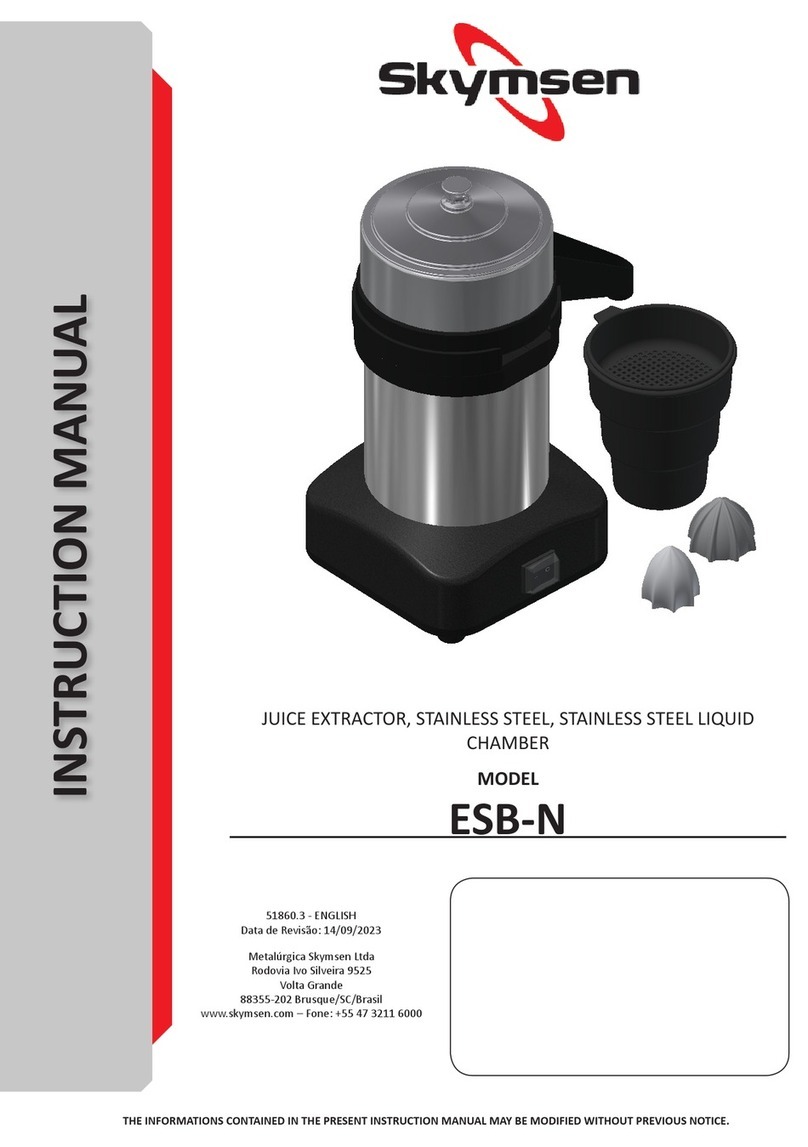
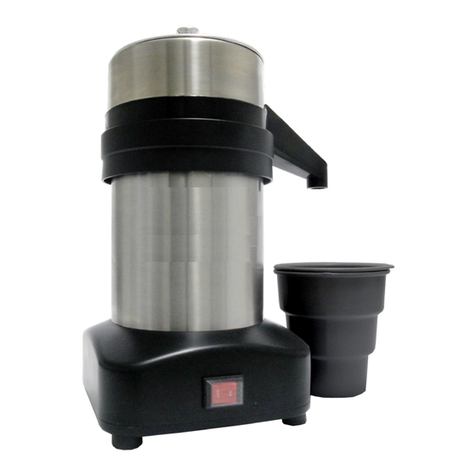
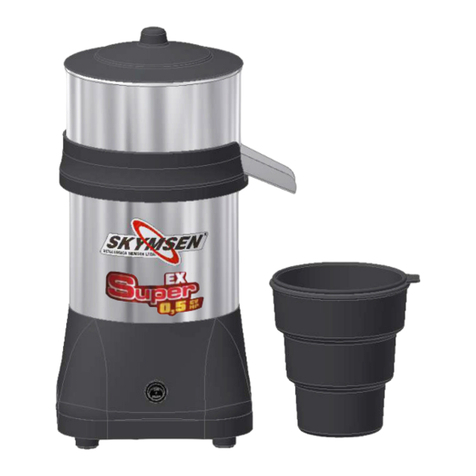
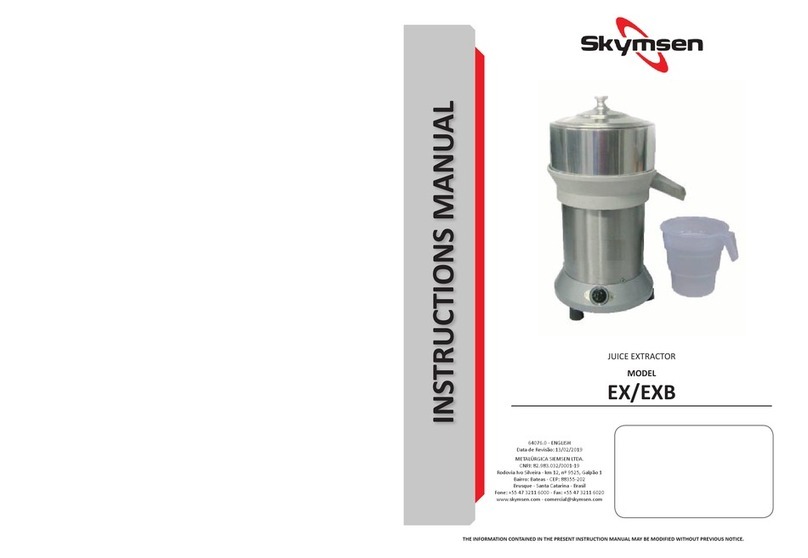
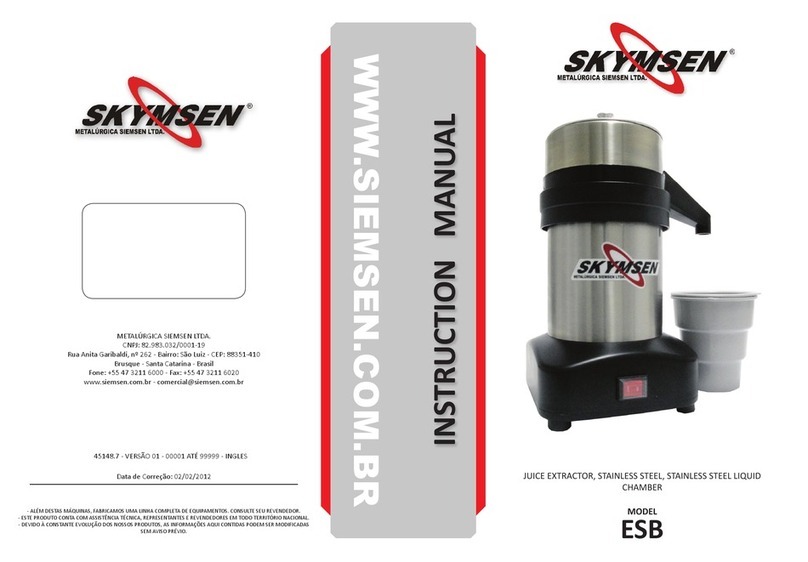
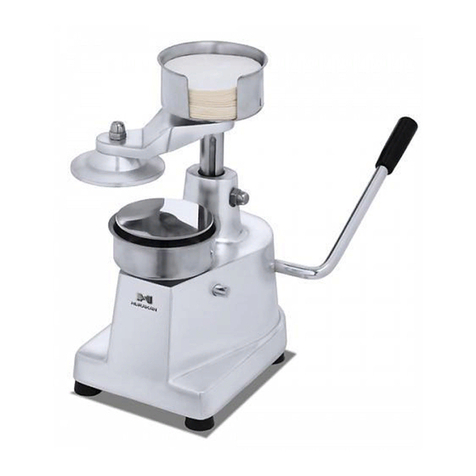
To start operating turn ON the ON/OFF switch Nº05 (Pic-1) located on the
Base Nº 06 (Pic-01).
3.2 Feeding Procedures
Juice Extractors work with high speed. First, cut the oranges or the
lemons in two halves.
T urn the machine on, hold half of the fruit and press it down firmly
against the crown Nº09 or Nº10 (Pic-01) and the juice will run into the cup
Nº08 (Pic-1) going first through the Sieve Nº07 (Pic-01).
3.3 Cleaning
IMPORTANT
Never clean the machine when it is connected to a power point,
always unplug the machine before cleaning. Before taking out the
crown, be sure the motor has come to a complete stop.
All removable parts must be removed and washed.
Follow the below instructions for washing removable parts:
3.3.1 Turn off the machine and unplug it.
3.3.2 Remove the Lid Nº01 (Pic-01), the Crown Nº 09 or N° 10
(Pic-01) and then the Juice Chamber Nº 02 (Pic-01)
3.3.3 Wash all removable parts with running water and neutral
soap and dry them.
3.3.4 To reinstall them, follow the above order inversely.
3.3.1 Cautions with Stainless Steel:
The Stainless Steel may present rust signs, which ARE ALWAYS CAUSED
BY EXTERNAL AGENTS, especially when the cleaning or sanitization is not
constant and appropriate.
The Stainless Steel resistance towards corrosion is mainly due to the
presence of chrome, which in contact with oxygen allows the formation of a very
thin protective coat. This protective coat is formed through the whole surface of the
steel, blocking the action of external corrosive agents.
When the protective coat is broken, the corrosion process begins, being
possible to avoid it by means of constant and adequate cleaning.
Cleaning must always be done immediately after using the equipment. For
such end, use water, neutral soap or detergent, and clean the equipment with a soft
cloth or a nylon sponge. Then rinse it with plain running water, and dry immediately
with a soft cloth, this way avoiding humidity on surfaces and especially on gaps.
The rinsing and drying processes are extremely important to prevent stains
and corrosion from arising.
IMPORTANT
Acid solutions, salty solutions, disinfectants and some sterilizing solutions
(hypochlorites, tetravalent ammonia salts, iodine compounds, nitric acid
and others), must be AVOIDED, once it cannot remain for long in contact
with the stainless steel:
These substances attack the stainless steel due to the CHLORINE on its
composition, causing corrosion spots (pitting).
Even detergents used in domestic cleaning must not remain in contact with
the stainless steel longer than the necessary, being mandatory to remove it with plain
water and then dry the surface completely.
Use of abrasives:
Sponges or steel wool and carbon steel brushes, besides scratching the
surface and compromising the stainless steel protection, leave particles that rust and
react contaminating the stainless steel. That is why such products must not be used
for cleaning and sanitization. Scrapings made with sharp instruments or similar must
also be avoided.
Main substances that cause stainless steel corrosion:
Dust, grease, acid solutions such as vinegar, fruit juices, etc., saltern
solutions (brine), blood, detergents (except for the neutral ones), common steel
particles, residue of sponges or common steel wool, and also other abrasives.