BEGA Gantenbrink-Leuchten KG · Postfach 31 60 · 58689 Menden · info@bega.com · www.bega.com
Sicherheit
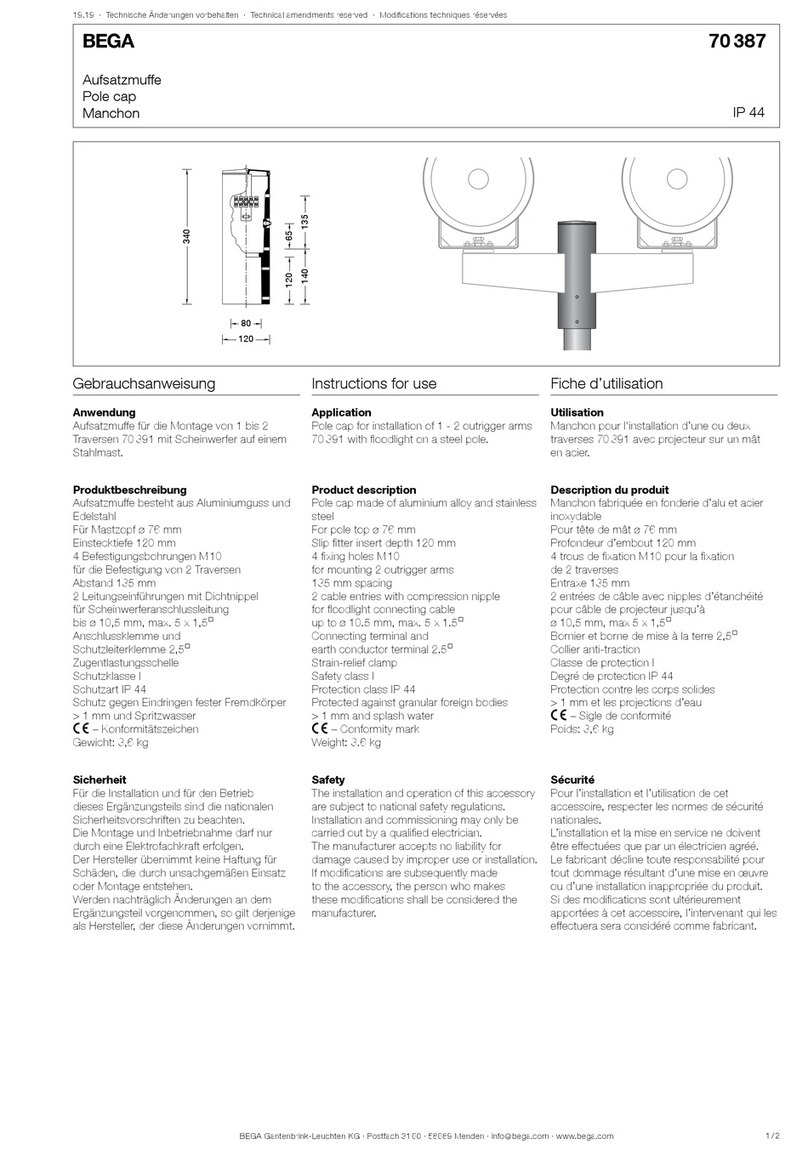
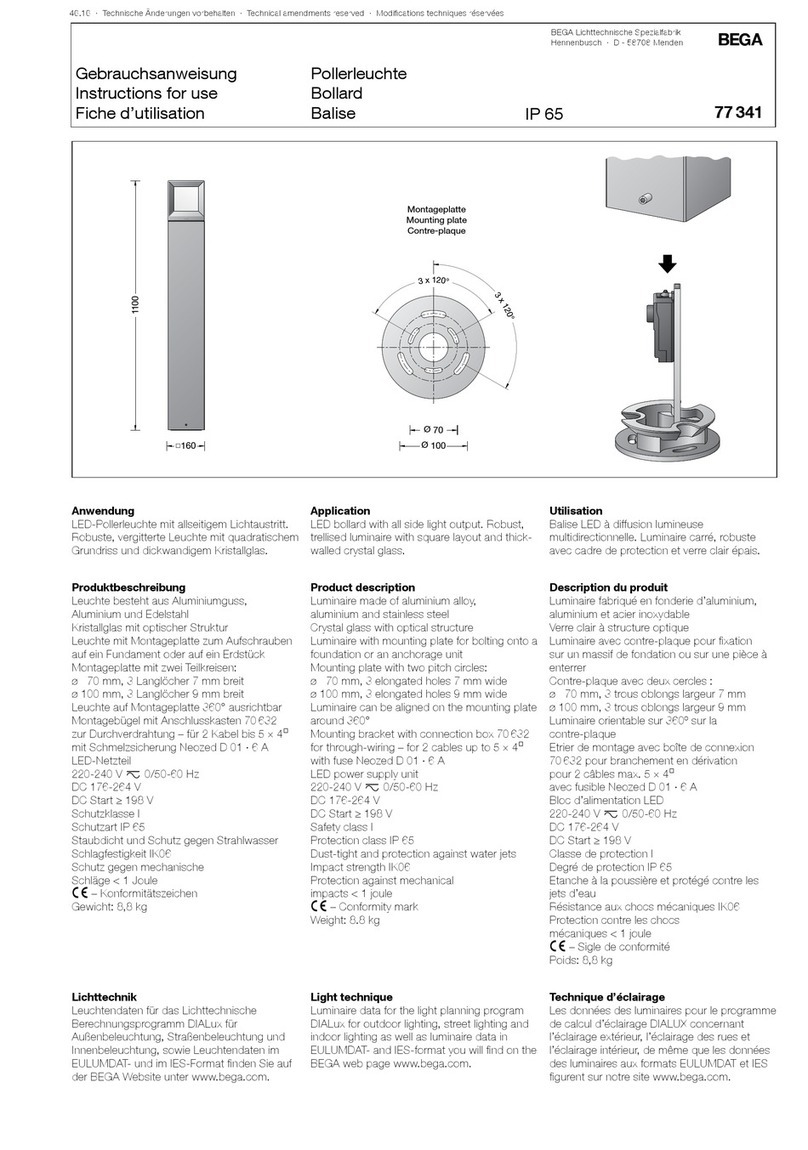
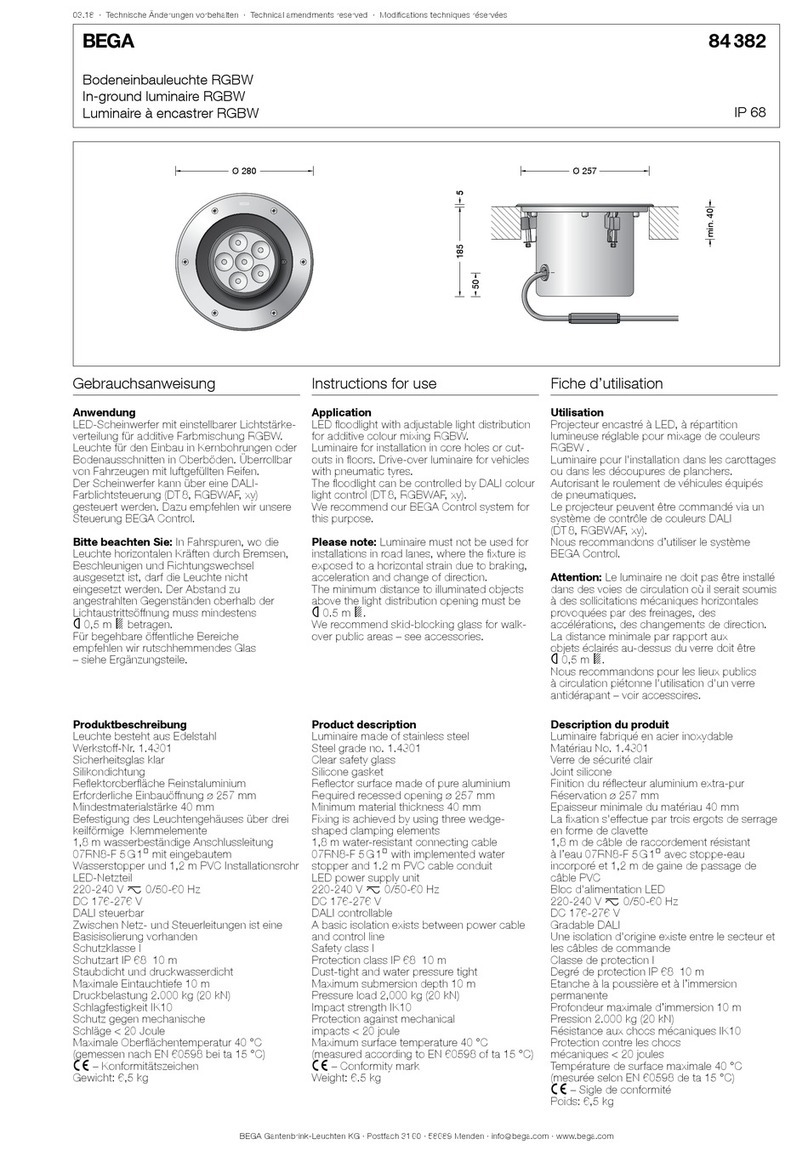
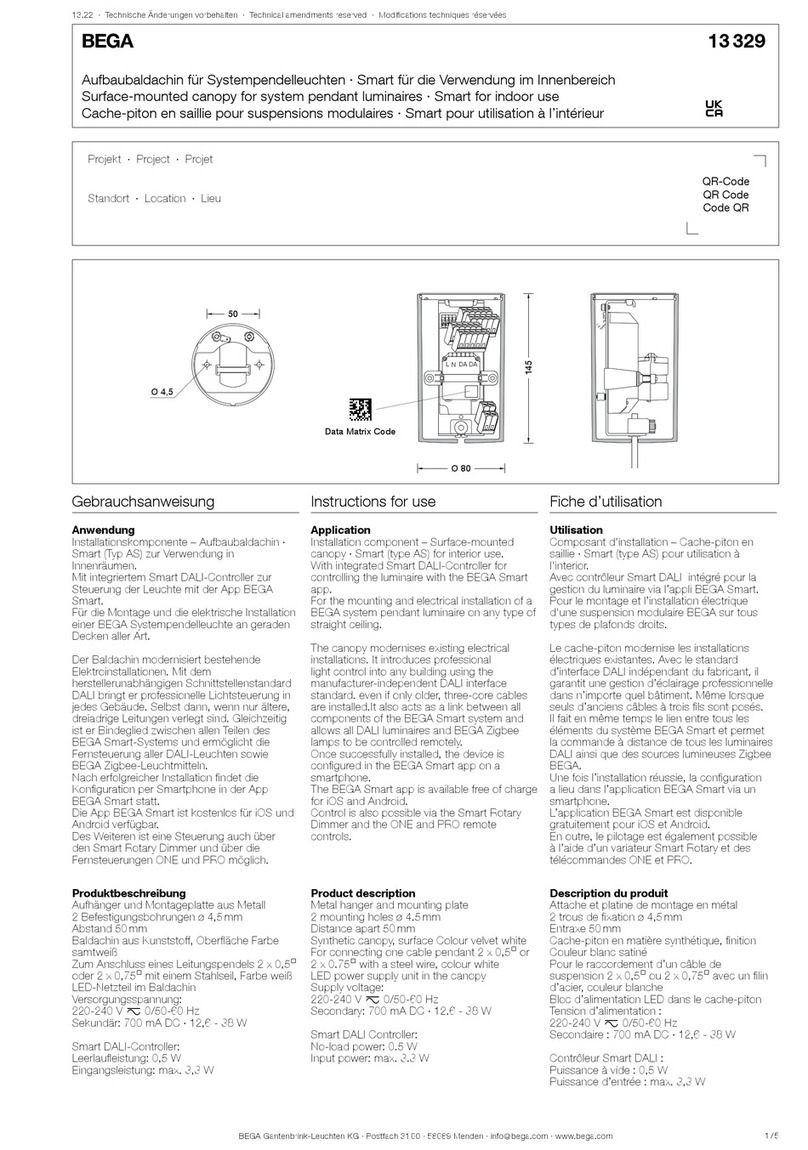
Für die Installation und für den Betrieb
dieses Lichtmastes sind die nationalen
Sicherheitsvorschriften zu beachten.
Der Hersteller übernimmt keine Haftung für
Schäden, die durch unsachgemäßen Einsatz
oder Montage entstehen.
Werden nachträglich Änderungen an dem
Lichtmast vorgenommen, so gilt derjenige als
Hersteller, der diese Änderungen vornimmt.
Safety indices
The installation and operation of this pole are
subject to national safety regulations.
The manufacturer is then discharged from
liability when damage is caused by improper
use or installation.
If any pole is subsequently modied, the
persons responsible for the modication shall
be considered as manufacturer.
Sécurité
Pour l’installation et l’utilisation de ce mât,
respecter les normes de sécurité nationales.
Le fabricant décline toute responsabilité
résultant d'une mise en œuvre ou d'une
installation inappropriée du produit.
Toutes les modications apportées au mât se
feront sous la responsabilité exclusive de celui
qui les effectuera.
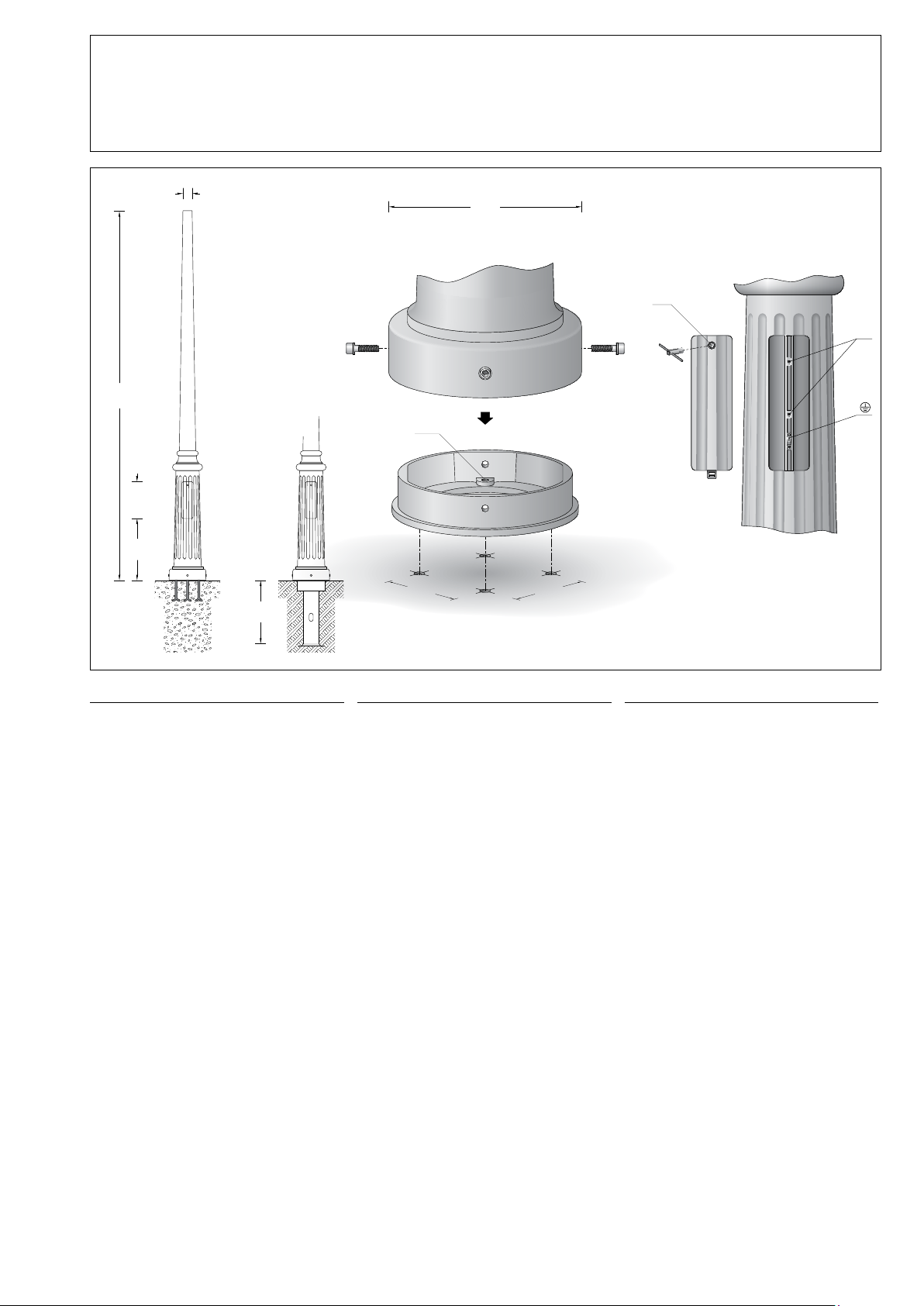
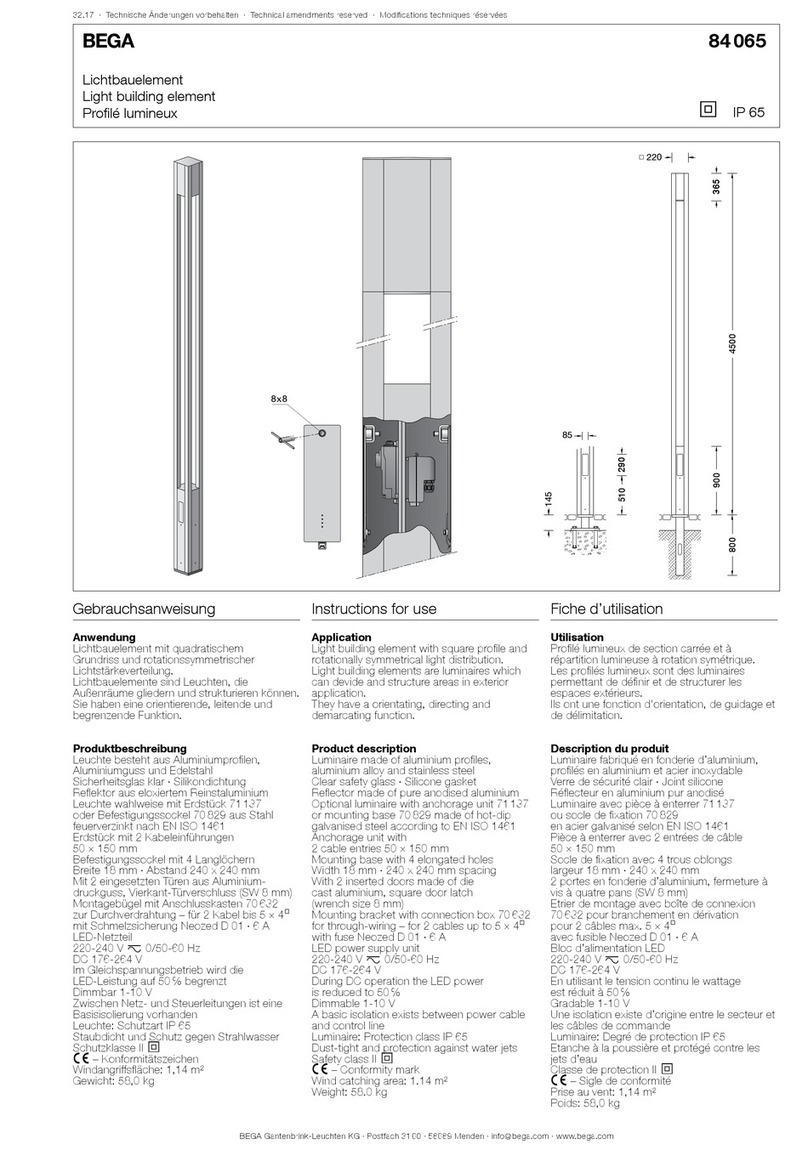
800 × 800
600
800 × 800
600
Erdreich · Soil · Terre
Sauberkeitsschicht · Sub-base
Couche d’assainissement
Drainage · Drainage · Drainage
Beton · Concrete · Béton
BEGA 70 897
Montage
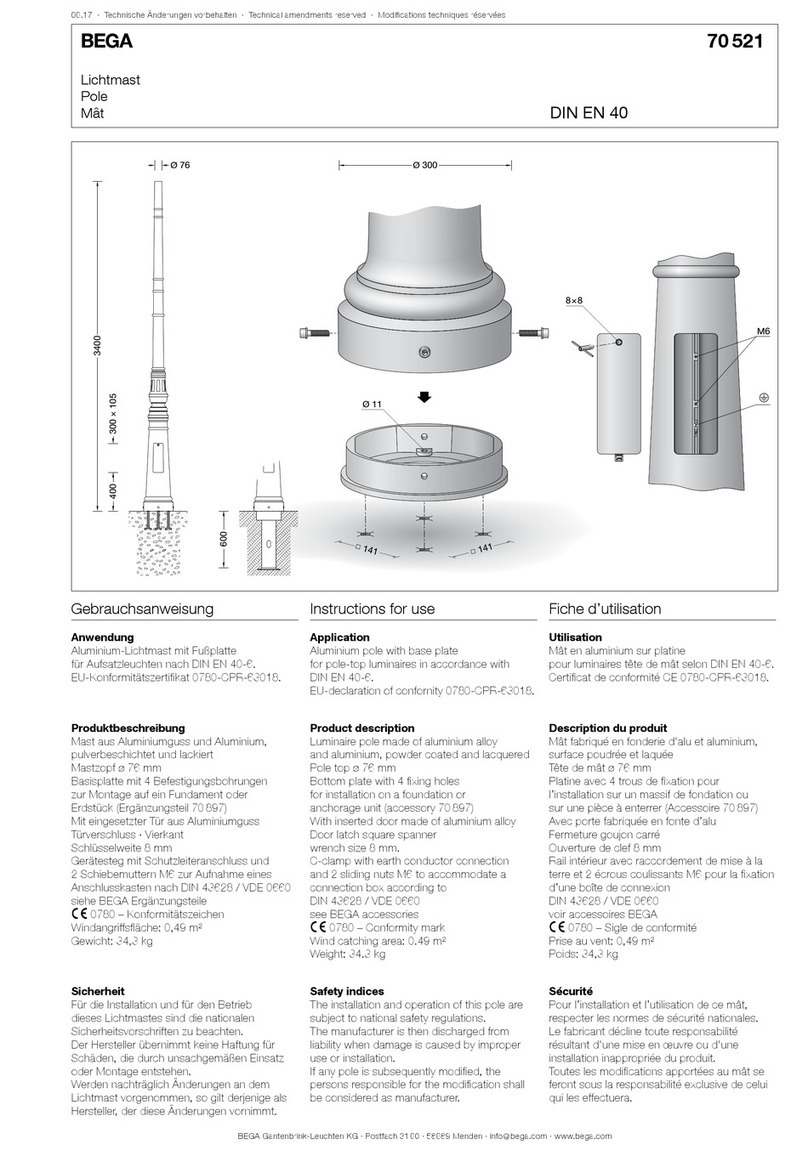
Der Mast ist je nach Einsatzart, Leuchtengröße
und Gewicht standsicher zu gründen.
Die Fundamentgrösse ist abhängig von der
Topographie, Bodenbeschaffenheit und
Windbelastung und muss jeweils bauseits
bestimmt werden.
Dazu gilt die Norm DIN 1045.
Die obige beispielhafte Fundamentempfehlung
gilt für einen tragfähigen Baugrund.
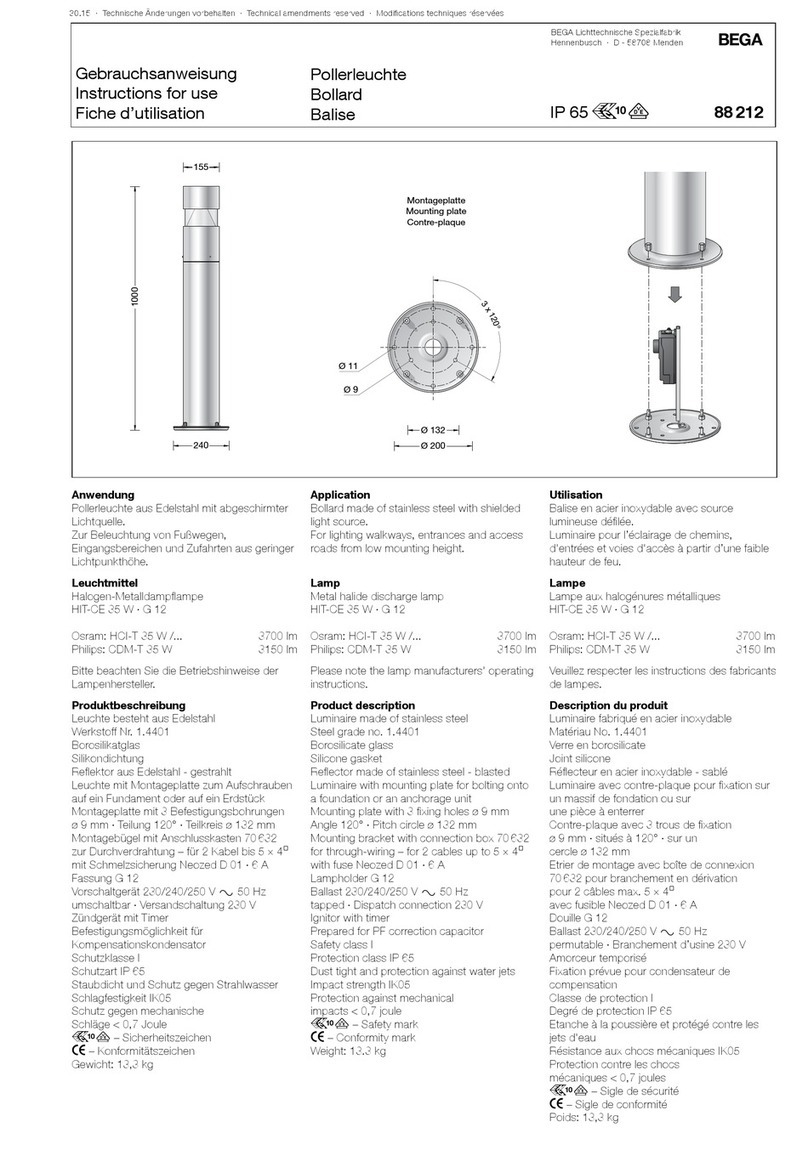
Innensechskantschrauben im Fußpunkt des
Mastes lösen und Basisplatte herausnehmen.
Basisplatte auf Fundament oder Erdstück
(Ergänzungsteil 70 897) standsicher befestigen.
Das Befestigungsmaterial für die Montage auf
ein Fundament ist bauseits festzulegen und zu
stellen: z. B. Steinschrauben aus Edelstahl
M10 x 250 DIN 529.
Dabei auf bauaufsichtliche Zulassung achten.
Feuchter Beton kann stark alkalisch sein und
darf nicht dauerhaft mit dem Mast in Kontakt
kommen.
Wir empfehlen den Montagebereich zu
drainieren und mit Isolieranstrich zu versehen.
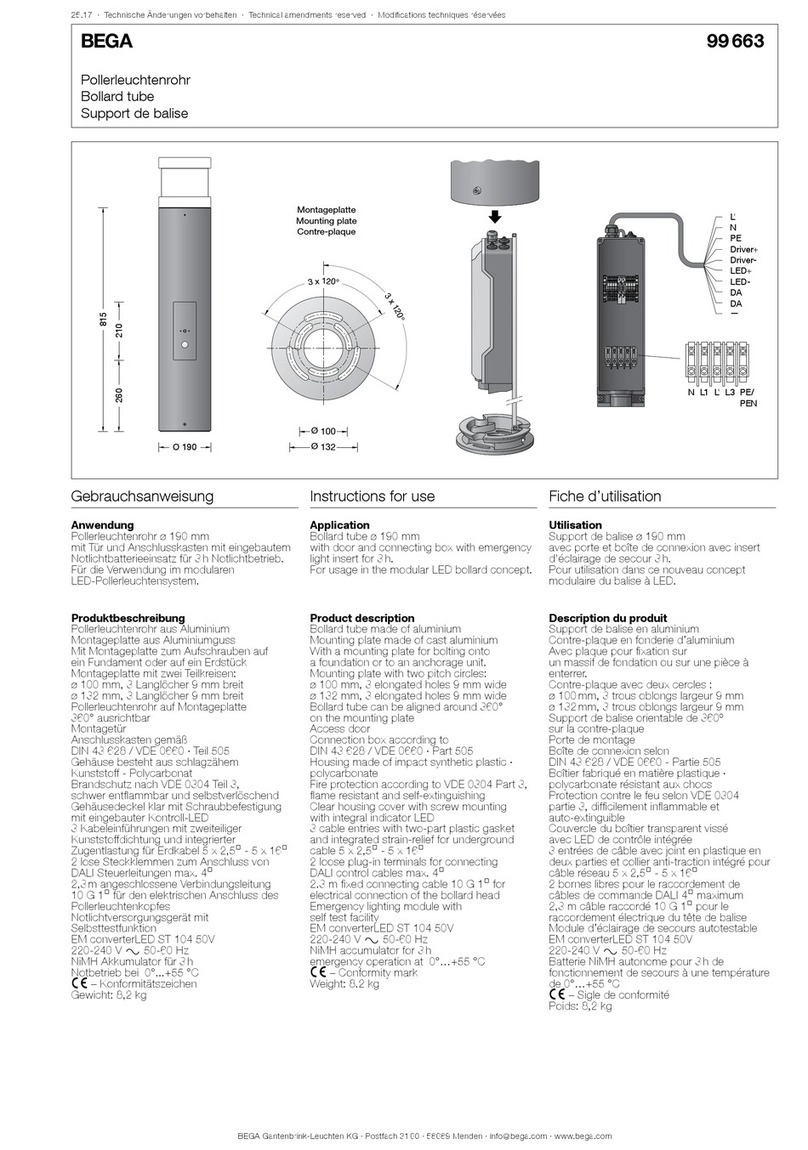
Tür mit beiliegendem Vierkantschlüssel öffnen
und entnehmen.
Erdkabel in den Mast führen.
Mast auf Basisplatte setzen und befestigen.
Leuchte und Anschlusskasten montieren.
Hierzu die Gebrauchsanweisung der Leuchte
beachten.
Installation
Depending on the mode of application, the size
and weight of the luminiare the pole must be
rmly xed.
The size of the foundation depends on the
topography, condition of the soil and the wind
load and must be determined on site.
DIN1045 applies.
The above exemplary recommendation for a
foundation is applicable for a stable subgrade.
Undo hexagon socket screws at the base of
the pole and remove the bottom plate.
Fix mounting plate on a foundation or an
anchorage unit (accessory 70 897).
The xing material for an installation on a
foundation must be determined and provided
by the customer: e.g. stone bolts made of
stainless steel M10 x 250 DIN 529.
Note authorization through supervision of
construction.
Wet concrete can be very alkaline and must not
get into contact with the pole permanently.
We recommend to drain the mounting area and
to provide it with insulating paint.
Open door with enclosed square spanner and
remove door.
Lead underground cable into the pole.
Place pole on bottom plate and x it.
Assemble luminaire and connection box.
Note the instructions for use of the luminaire.
Installation
Le mât doit être installé en tenant compte de
son utilisation, des dimensions et poids du
luminaire, de la prise au vent.
Le volume et les dimensions du massif béton
dépendent de la topographie, la pression à
fond de fouille du sol, de la zone de vent, ainsi
que des forces et des charges exercés et doit
être individuellement déni sur le chantier.
La norme DIN1045 est alors applicable.
Le massif de fondation recommandé ci-dessus
est un exemple uniquement valable pour un
terrain à bâtir solide.
Desserrer le vis à six pans creux au pied du
mât et retirer la platine.
Fixer le mât de facon stable sur le massif
de fondation ou sur une pièce à enterrer
(accessoire 70 897).
Les matériaux de xation pour la xation sur
une massif de fondation doit être déterminé
et fourni sur le chantier: par exemple vis à
scellement en acier inoxydable
M10 x 250 DIN 529.
Respecter les consignes de la maitrise
d'ouvrage.
La laitance du béton peut être fortement
alcaline et ne doit pas être en contact durable
avec le mât.
La surface où est installé le luminaire doit être
draînée et protégée par une matière isolante.
Déverrouiller et retirer la porte avec la clé jointe.
Introduire le câble réseau dans le mât.
Poser le mât sur la platine et xer.
Installer le luminaire et la boîte de montage -
voir la che d'utilisation.
Produkteigenschaften
Widerstand gegen horizontale Lasten:
vref,0 = 32 m/s
Geländekategorie: 1
nach DIN EN 1991-1-4
Leuchten mit einem Gewicht bis 30kg
und einer Windangriffsäche max. 0,1m²
Verformungsklasse: 2 – Sicherheitsklasse: A
nach DIN EN 40-3-3
Verhalten bei Fahrzeuganprall nach
DIN EN 12767 (passive Sicherheit): Klasse 0
Product characteristics
Resistance against horizontal loads
vref,0 = 32 m/s
Terrain category: 1
in accordance with DIN EN 1991-1-4
Luminaires with a maximum weight of 30kg
for a wind catching area max. 0.1m²
Deformation class: 2 – Safety class: A
in accordance with DIN EN 40-3-3
Properties in case of vehicle impact
(passive safety): class 0 in accordance with
DIN EN 12767
Caractéristiques de produits
Résistance aux charges horizontales:
vref,0 = 32 m/s
Catégorie de terrain: 1
selon DIN EN 1991-1-4
Luminaires avec un poids jusqu'à: 30kg
et une surface de prise au vent: 0,1m²
Classe de déformation 2 –
Classe de sécurité A selon DIN EN 40-3-3
Performance en cas d’impact d’un véhicule
(sécurité passive): Classe 0